Summer Craft Beer Sales: The Dallas Operator’s Playbook for Peak Season
The window is open. From Memorial Day to Labor Day, Dallas turns into one of the most beer-thirsty cities in America — patios packed, strings lights glowing, and guests who aren’t just looking for a cold drink, they’re looking for an experience. Summer craft beer sales aren’t a secondary revenue opportunity for Dallas bar owners, restaurant operators, and retail buyers. They are the revenue opportunity. The season that separates a good year from a great one.
Here’s the honest truth: despite a challenging national craft beer landscape — volume down 4% nationally in 2025 per the Brewers Association — the operators who plan their summer intentionally and execute with focus are consistently outperforming the ones who wing it. And in a city like Dallas, where triple-digit heat meets an outdoor culture that refuses to go inside, the upside for smart operators is real, measurable, and available right now.
This is a playbook. Not theory — tactics. Over the next 10 minutes, we’re going to walk through five pillars that define a winning summer beer program: understanding the summer revenue window, stocking the right styles, building a tap list that moves volume and margin, programming your patio like a pro, and planning inventory before the rush hits. We’ll also cover the fastest-growing beer category in the country that most operators are still sleeping on.
Let’s get into it.
Summer Is Peak Season And the Data Proves It
There’s a reason experienced operators start planning their summer beer programs in March. Summer isn’t just the busiest stretch of the year — it’s the stretch that defines the entire year. For most Dallas bars and restaurants, the Memorial Day through Labor Day window represents a disproportionate share of annual beer revenue. Miss it, underplan for it, or show up with the wrong inventory, and you’re not just leaving money on the table. You’re setting the tone for everything that follows.
Let’s start with the national picture. According to the Brewers Association’s 2025 national beer stats, craft beer now accounts for 24.8% of the $113 billion U.S. beer market by dollar value — even as overall craft volume declined 4% and retail dollar sales dipped 2.8% to $28 billion. That sounds like bad news. But read the fine print and the story changes significantly: the primary reason dollar sales declined less than volume was stronger on-site sales growth versus distribution. Taprooms and on-premise accounts — bars, restaurants, beer gardens — outperformed the distribution channel by 1 to 2 points in the first half of 2025, according to Craft Brewing Business’s midyear 2025 outlook.
What that means in plain terms: the bar and restaurant channel is where craft beer is actually growing. If you’re a Dallas operator and you’re wondering whether craft beer still has legs — it absolutely does, and your tap handles are the proof.
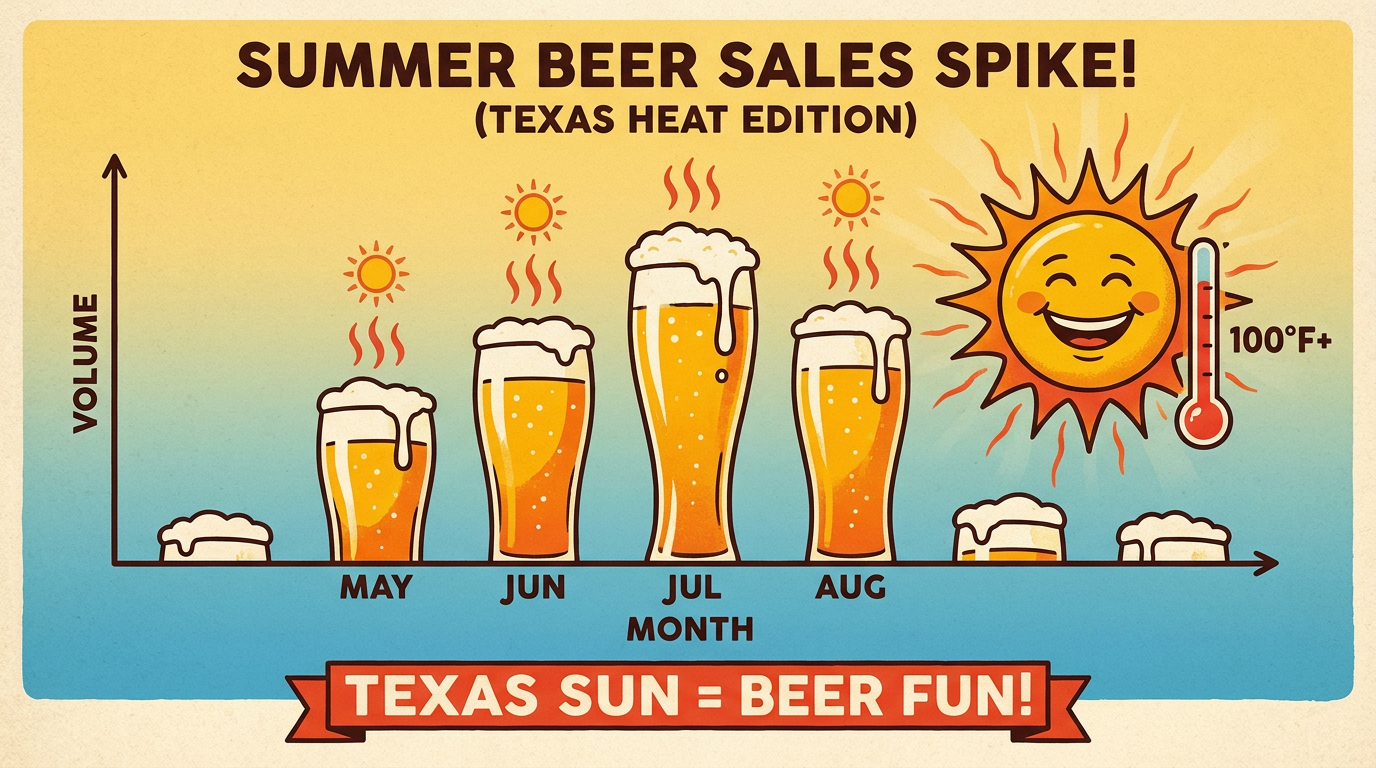
Now layer in the Texas context. Dallas temperatures regularly exceed 100°F from June through August. This isn’t a weather inconvenience — it’s a commercial reality. Sustained heat creates sustained demand for cold, sessionable beverages, and beer is the primary beneficiary of that demand. When your guests are stepping off a hot sidewalk onto a shaded patio, they aren’t thinking about what’s complex or nuanced on your menu. They’re thinking about what’s cold, refreshing, and going down smooth. Your summer tap list is your answer to that question.
Texas on-premise alcohol sales reached $10.25 billion in 2025, with summer driving a disproportionate share of that figure. Dallas’s outdoor dining and drinking culture — rooftop bars, patios, beer gardens, neighborhood hangouts — makes the city particularly well-positioned to capture that summer spending. But “well-positioned” only converts to revenue when operators are prepared.
“The operators who win summer aren’t just lucky — they plan their tap lists, inventory, and programming weeks in advance.”
That’s not a platitude — it’s the single most consistent differentiator between the Dallas accounts doing exceptional summer numbers and the ones scrambling to restock on a Saturday night in July. According to Craft Brewing Business, 49% of craft brewery survey respondents reported production growth in 2025 despite the broader downturn — and the majority of those gains were concentrated in hyperlocal, on-premise channels. Small and independent breweries producing under 1,000 barrels saw 50% of respondents reporting growth. The message is clear: local craft, served on-premise, is the sweet spot.
Summer isn’t a bonus season layered on top of your normal operations. It’s the season that defines annual performance for most Dallas craft beer accounts. Plan accordingly — or let someone else take the revenue.
Knowing why summer matters is the foundation, but the real work starts when you get specific about what Dallas drinkers actually want when it’s 105°F outside — because the wrong tap list doesn’t just underperform, it actively pushes guests toward your competitors.
What’s Actually Selling: Summer Craft Beer Trends Dallas Operators Need to Know
Not all beer is built for summer. That sounds obvious, but you’d be surprised how many tap lists in June still look like they were designed for November. Barrel-aged stouts, high-gravity imperials, heavy malt-forward seasonals — these are exceptional beers. They’re also exactly the wrong call for a patio full of guests who are already sweating through their shirts at 7 PM.
Consumer preference in summer shifts sharply and predictably toward sessionable, lower-ABV, refreshing styles. The data backs this up. According to Provi’s summer beer styles checklist for bars and restaurants, the top-performing summer styles by demand are:
- Light lagers — crisp, clean, and the highest-volume movers in any summer lineup
- Session IPAs — hop flavor and aroma without the ABV punch that slows guest throughput
- Fruit-infused beers and refreshing ales — flavor-forward, refreshing, and increasingly in demand across diverse guest demographics
- Wheat beers and shandies — smooth, slightly effervescent, natural daytime drinkers
Each of these categories serves a specific role. Light lagers anchor your volume. Session IPAs capture the craft-curious guest who still wants complexity. Fruit beers and refreshing ales open the door to flavor-forward drinkers who might otherwise reach for a cocktail or hard seltzer. Wheat beers give you the outdoor brunch and early-afternoon crowd. A complete summer tap list touches all four quadrants.
Now, here’s where Dallas gets specific — and where operators in this city have a genuine competitive advantage if they’re paying attention. The Dallas market skews heavily toward sessionable, accessible craft beer that can sustain a long afternoon on the patio without tipping the ABV scale. The city’s large and influential Latino community, combined with a broader multicultural food and drink culture that runs through every neighborhood from Oak Cliff to Deep Ellum to The Cedars, makes refreshing, light-drinking craft beer central to how Dallas drinks in summer.
This is where Four Corners Brewing Co. punches well above its weight. Local Buzz Honey Blonde at 5.0% ABV is the sessionable workhorse for Dallas summers — made with Texas-sourced honey, slightly floral with a clean rye malt finish, and it tells a local story guests genuinely connect with on a warm evening. It’s sessionable enough to sustain a long patio afternoon while being flavorful enough to make every sip worth ordering again.
For the IPA lovers who want to stay in the game across a long patio session, a Hazy Session IPA from the special releases lineup gives them the tropical fruit and hop character they’re craving at an ABV that won’t end the night early. And the Pinchelada! Chelada at 4.5% ABV — with its natural fruit flavors and hint of chile pepper — hits a category no macro brand can authentically replicate, capturing flavor-forward drinkers and culturally resonant occasions in a single pour.
Beer and food pairing is another underleveraged summer revenue driver. Lighter, sessionable beers pair naturally with the kind of fare that moves in summer — tacos, grilled items, lighter appetizers, shareable plates. When your staff can confidently recommend a Local Buzz alongside street tacos, or a Pinchelada! with chips and guacamole, you’re not just selling a beer. You’re building a moment that turns a first-time guest into a regular.
According to Craft Brewing Business, 9.8% of legal-age U.S. adults consumed craft beer in the past 30 days as of mid-2025 — up from 6.6% in 2013. The audience is growing. The question every Dallas operator needs to answer is: Is my summer tap list actually meeting them?
Knowing what styles to stock is the first half of the equation. The second half is understanding how to structure your lineup — because a great tap list isn’t just a collection of good beers. It’s an architecture designed to move volume, protect margin, and create a guest experience worth returning to.
Building a Summer-Ready Tap List That Drives Volume and Margin
Walk into almost any underperforming bar in Dallas and you’ll find the same problem: a tap list that nobody thought about strategically. Fifteen handles, half of them slow-moving, with no clear volume anchors, no price architecture, and staff who couldn’t describe a single beer on the board. It’s not a beer problem — it’s a planning problem. And summer, more than any other season, punishes unplanned tap lists and rewards intentional ones.
Tap list architecture is a discipline, not an afterthought. A well-curated summer list does three things simultaneously: it drives high-volume sales on your accessible, sessionable anchors; it captures margin on your craft conversation-starters; and it gives every guest — light lager drinker, craft enthusiast, honey blonde devotee — a reason to order a second round. When those three things are working together, your summer revenue takes care of itself.
Start with your volume anchors. Per the Provi summer beer styles framework, a busy summer weekend should be planned around these order quantities per 100 guests:
- Light Lagers: 8–10 cases
- Wheat Beers: 5–7 cases
- Session IPAs: 4–6 cases
- Fruit Beers / Refreshing Ales: 3–4 cases
- Shandies / Radlers: 2–3 cases
Use these as your planning anchors, then adjust based on your venue type, historical summer data, and any major events on the calendar. A neighborhood bar with a heavily Latino guest demographic should probably weight sessionable lagers and refreshing ales higher. A craft beer bar in a more IPA-forward neighborhood might push session IPAs up. The point isn’t rigid adherence to the numbers — it’s that you’re making intentional decisions based on data rather than gut feeling the week of.
Draft versus packaged strategy matters more in summer than any other season. Draft is your margin driver on-premise — ideal for your high-velocity sessionable beers, wheat beers, and session IPAs where you’ll be pouring fast and frequently. Cans, on the other hand, give you flexibility that draft simply can’t: patio service where running draft lines is impractical, outdoor events, retail display, and the increasingly common “grab-and-go” guest who wants something cold immediately. Four Corners’ year-round lineup — all available in cans — gives operators exactly that flexibility. Local Buzz on draft for your pour-heavy bar service, and Local Buzz and Pinchelada! cans on ice in a cooler on the patio for the guests who want that cold-can moment.
Seasonal tap rotation is one of the most underleveraged tools in a bar operator’s toolkit. Guests return when they see something new on the board. A single seasonal tap swap — a summer limited release, a collaboration brew, something that wasn’t there last week — creates a reason for regulars to come back and something for first-time visitors to discover. Four Corners’ special releases are specifically designed to give operators those rotating craft conversation points that keep the menu feeling alive across the full summer season.
Price point architecture is the quiet margin driver most operators get wrong. Local Buzz Honey Blonde at 5.0% ABV priced accessibly becomes a high-velocity volume driver that keeps guests at the bar longer. El Chingón IPA at 7.3% ABV, priced at a modest premium, captures the craft enthusiast who’s actively choosing your house craft option over something generic. Both serve different guests, both drive revenue, and the interplay between them gives your bartenders natural upsell language: “If you like that honey blonde, you should try the El Chingón — it’s the bold, hop-forward brother.”
Then there’s the unsexy but essential stuff: table tents, chalkboard menus, and staff training. If your staff can’t describe the beer, it won’t sell. Full stop. A thirty-second training on what makes Local Buzz different — Texas honey, refreshing finish, made right here in Dallas — turns every server interaction into a sales moment. The operators who invest ten minutes in beer training before a summer shift consistently see higher beer attach rates on food orders. It’s that simple.
According to Bar & Restaurant Magazine’s 2026 operations guide, the front-of-house team’s ability to speak confidently about the beverage menu is one of the highest-return investments an operator can make — and it costs nothing but time.
Avoid the common summer mistake of overloading your menu with heavy, high-ABV options. Beyond the guest experience issue, high-ABV beers slow throughput. A guest who hits 8% ABV twice in an hour is done for the evening. A guest drinking 4.5% ABV refreshing ales or 5.0% honey blondes is staying for another round — and another. Your summer tap list should be built for dwell time, not just opening orders.
A great tap list sets the stage, but the stage itself matters enormously. Now that we’ve locked in the right lineup, let’s talk about the other half of the summer equation: building a patio experience that gives guests a reason to stay longer, spend more, and come back next weekend.
Own the Patio: Programming Summer Experiences That Sell More Beer
There’s a hard truth every Dallas operator learns eventually: the patio is the summer profit center. Not the bar. Not the dining room. The patio — because that’s where Dallas wants to be from May through September, even with the heat, even with the humidity, even on a Tuesday. The operators who treat the patio as an afterthought and the ones who treat it as the main event are playing completely different games. Intentional patio programming is the force multiplier for summer craft beer sales. Guests who feel at home stay longer. Guests who stay longer drink more beer. And guests who drink more beer come back next time with friends.
Experience-driven programming transforms a single visit into a habit. Live music, trivia nights, themed beer events, and pop-up partnerships create external reasons to return that go beyond “the beer was good.” That’s important because Dallas is a competitive market — there’s no shortage of places to drink in this city. The operators who build community around their patio space earn a loyalty that pure product quality alone can’t generate.
Let’s get specific about what works. Beer-forward events that consistently move the needle for summer volume include:
- Tap takeovers and local brewery partner nights — bring in Four Corners for a dedicated evening and let the brand’s story do the selling. Guests who meet the brewery behind the beer develop brand loyalty that translates into repeat orders.
- Summer beer flights — curated three- or four-beer flights themed around summer styles give guests a low-commitment way to explore your lineup and consistently drive upsells to full pours.
- Craft beer tasting stations — particularly powerful in Dallas given the cultural resonance of the category. A dedicated station featuring local Dallas craft beers with accompaniments is a photogenic, shareable, revenue-generating activation that costs almost nothing to set up.
- “Meet the brewer” evenings — these have become one of the most reliable community-building tools in the on-premise playbook. Guests pay attention and pay more when there’s a human story behind the product.
- Themed holiday promotions — Memorial Day, Fourth of July, and Labor Day are the three highest-volume weekends of the summer. Plan specific activations (limited-time drafts, beer bundles, event covers) tied to each, placed on the calendar now, not two days before.
The ambient environment matters more in summer than in any other season because guests are making a deliberate choice to stay outside in Texas heat. That choice needs to be rewarded. String lights signal welcome. Fans and misters in Texas summer are not optional — they’re the difference between a patio people linger on and one they escape from after twenty minutes. Comfortable, well-arranged seating that allows groups to pull tables together signals that this is a place designed for staying, not just passing through.
“Guests who feel at home stay longer — and guests who stay longer drink more beer. That’s not a secret. That’s just good hospitality.”
Social media amplification is built into great programming — and this is where the visual language of craft beer becomes a genuine marketing asset. A well-lit patio moment, a condensation-beaded Local Buzz can in a guest’s hand, a Four Corners tap handle in the background of an Instagram story — that’s organic marketing at zero additional cost. According to Think with Google, 89% of dining decisions are now researched on mobile. Every photogenic moment your patio creates is a discovery pathway for someone who hasn’t found you yet.
Collaborate with local food vendors, musicians, and community organizations to co-host events. This isn’t just about reach — it’s about rootedness. Four Corners Brewing was built on a deep connection to Dallas’s multicultural, community-first neighborhoods, from The Cedars outward. When a bar or restaurant operator partners with FC for a summer event, they’re tapping into that cultural identity and signaling to their own guests that they’re part of the same community fabric. That kind of authentic local positioning is worth far more than any advertising spend.
Check out the Four Corners Taproom events calendar for inspiration on what well-executed brewery event programming looks like — and use it as a blueprint for your own summer schedule.
One final note on the Texas summer reality: programming needs to account for the heat as a design constraint. Early evening start times dramatically outperform midday activations in June, July, and August. Covered patio space with adequate shade extends dwell time significantly. Operators who ignore the heat in their programming design consistently underperform those who build the experience around it.
The patio is full, the vibe is right, the beer is flowing — but if your inventory runs dry on a Saturday night in late July, none of the rest of it matters. Let’s talk about how to make sure that never happens.
Summer Inventory Planning: Order Smart, Stock Right, Don’t Run Dry
Ask any experienced Dallas bar manager what their worst summer memory is and it probably goes something like this: a packed Fourth of July weekend, the patio full, the energy high — and the Local Buzz gone by 9 PM. Nothing deflates a great summer night like telling a guest you’re out of what they came for. And nothing costs more, in both revenue and guest trust, than running dry on your best-selling SKU during your highest-volume window.
Summer inventory planning is not glamorous work. It doesn’t come with a ribbon on it. But it is, without question, one of the highest-return activities a bar manager or retail buyer can invest time in before the season begins. The operators who stock right don’t just serve more beer — they capture the full revenue potential of every summer weekend instead of leaving the last third of it on an empty shelf.
The single most common summer inventory mistake is underestimating velocity during peak weeks. Most operators have a reasonable sense of their average weekly beer movement, but summer doesn’t move at averages — it moves in spikes. The week of July 4th. The weekend of a major local festival. A Saturday night when three rooftop bars in the neighborhood post the same sunset photo and every millennial in Dallas decides it’s a patio night. During these moments, velocity can run 2–3x your normal pace, and the operators who aren’t stocked for it pay the price in stockouts, substitutions, and frustrated guests.
Start early. According to Provi’s summer checklist for bar and restaurant managers, summer orders should be placed 3–4 weeks before Memorial Day to ensure availability of seasonal SKUs. Seasonal limited releases from local breweries sell through fast — and late orders mean stockouts on exactly the items your guests are most excited about. This is especially true for Four Corners’ special releases, which have limited production runs and strong local demand. The buyers who get in early get the beer. The ones who wait get put on a list.
Here’s a practical summer inventory framework to build your planning around:
- Anchor your order on your peak weekend projections — not your average weekend. What does your highest-volume summer weekend look like? Start there.
- Use the Provi per-100-guest model as your calibration tool: Light Lagers (8–10 cases), Wheat Beers (5–7 cases), Session IPAs (4–6 cases), Fruit Beers/Refreshing Ales (3–4 cases). Multiply against your projected guest counts.
- Audit your cold storage before the season starts. Increased summer volume means more inventory on-hand, which means more cold storage space needed. If you’re tight, prioritize your fastest-turning SKUs in cold storage and plan packaged overflow strategically.
- Rationalize your SKU count. A focused summer lineup of 6–8 well-chosen beers consistently outperforms a bloated 20-tap list where nothing gets proper promotion or velocity. Fewer options, more concentration, deeper stock on what’s actually selling.
- Build a reorder cadence. Don’t wait until you’re low to check in with your distributor rep. A weekly check-in during summer months lets you catch velocity changes early and adjust before you’re out.
- Track what’s selling weekly and adjust. What sells in May often isn’t what’s moving in August. Consumer behavior shifts within the summer season — early summer might be big wheat beer and session IPA territory, while late summer swings even harder toward honey blondes and refreshing ales as the heat peaks. Stay adaptive.
The packaged vs. draft split is a strategic decision that shapes your entire inventory approach. Draft beer is your on-premise margin driver — but it requires operational attention to line maintenance, temperature control, and keg management. Cans give you operational flexibility: outdoor service, event distribution, retail display, and faster turn in high-velocity situations. For Dallas operators running busy patio programs, having the Four Corners lineup available in both draft and can format gives you coverage across every service scenario.
One advantage that local craft breweries offer that national brands simply can’t match: responsiveness. When you’re mid-season and your Local Buzz is moving faster than expected, Four Corners can often respond to reorder requests and mid-season adjustments far faster than national distributors managing massive portfolios across multiple states. Local partnership isn’t just a values play — it’s an operational advantage.
Use the Four Corners Brew Finder to locate FC beers at nearby Texas accounts and build your distribution context, especially if you’re managing purchasing across multiple locations.
You’ve got the data, the tap list, the programming, and the inventory locked in. But there’s one more category growing faster than almost anything else in the beer world right now — and most Dallas operators are still treating it like an afterthought. That’s a mistake worth correcting before summer hits full swing.
The Non-Alcoholic Opportunity: The Fastest-Growing Summer Beer Category
Here’s a number that should change the way you think about your summer beer program: NA beer was up 22.2% year-to-date in 2025, with on-premise growth of 26.4% — and a staggering 30.8% year-over-year surge specifically during July 2024, according to Craft Brewing Business’s midyear 2025 report. In a category where overall volume is down 4% nationally, non-alcoholic beer isn’t just a bright spot — it’s the single fastest-growing segment in the entire beer market.
Let that sink in for a moment. While traditional beer categories are contracting, NA beer is growing at a pace that hasn’t been seen in the beer industry since craft’s initial surge. And the growth is happening most aggressively on-premise — in bars, restaurants, and beer gardens — which means this is directly and immediately relevant to every Dallas operator reading this.
The demographic driving this growth should look familiar: Millennials and Gen Z — the exact audience that makes up the core of Dallas’s culturally-aware, health-conscious, patio-obsessed drinking demographic. The data from the same report is striking:
- 61% of younger drinkers say they’d choose a non-alcoholic version of their favorite beer
- 57% say they’d stay longer at a bar with solid NA options
Read that second stat again. Fifty-seven percent of your most valuable demographic — the guests who research bars on their phones before they leave the house, who post stories that drive discovery, who come back if they feel seen and catered to — say they would physically stay longer at your establishment if you gave them a quality NA option. That’s not a niche preference. That’s your patio staying full longer on a Friday night.
“57% of younger drinkers say they’d stay longer at a bar with solid NA options. That’s not a niche. That’s your patio staying full longer.”
The summer connection to NA beer is particularly powerful and worth thinking through carefully. Summer presents a host of occasions where guests want to participate in the beer moment but can’t or won’t consume alcohol: the designated driver, the guest who has an early morning, the person who’s sober-curious and exploring, the health-conscious guest who’s watching their intake in the heat. Right now, if you don’t have a quality NA craft option on your menu, that guest is ordering a water or a soda — and checking out of the beer occasion entirely. That’s a complete revenue loss.
Add one or two high-quality NA craft beers to your summer lineup and that same guest is ordering a round, staying engaged with the group, and potentially adding a full-alcohol beer later in the evening. The incremental revenue isn’t theoretical. It’s the difference between a table that contributes $12 in non-alcoholic beverage revenue and one that contributes $35 because you gave every guest at the table a reason to participate in the beer program.
For Dallas specifically, the audience alignment is almost perfect. The city’s multicultural, health-conscious, and socially-aware millennial and Gen Z population is precisely the demographic leading NA consumption growth nationally. This isn’t a trend imported from coastal markets — it’s showing up in Texas, in Dallas, in the same neighborhoods where Four Corners has been building community for over a decade.
The message for smart operators isn’t that NA beer replaces craft beer. It’s that it expands the craft beer occasion to more guests at more moments. It’s additive revenue from guests who would otherwise leave the beer category entirely during your highest-volume season. Explore Four Corners’ innovation pipeline and special releases for what’s coming from the brewery’s creative team — the brand that’s been thinking about cultural relevance in Dallas since 2012 isn’t sleeping on the formats and occasions that matter to its audience.
The Summer Playbook, Brought Together
Summer in Dallas isn’t just a season. It’s a revenue window that opens hard on Memorial Day weekend and closes on Labor Day with the speed and finality of a walk-in cooler door. The operators who understand that — and plan for it — are the ones running their best numbers while the ones who wing it are scrambling for inventory and wondering where the season went.
Across the six sections of this playbook, five pillars have emerged that define a winning summer beer program for Dallas operators:
First, recognize summer as the peak revenue window it actually is — not a bumper season, but the season that defines annual performance. The data is clear: on-premise craft beer is where growth is happening in 2025, and Dallas’s heat, outdoor culture, and patio obsession make it the ideal environment for capitalizing on that channel strength.
Second, stock the right styles. Summer is sessionable — light lagers, session IPAs, wheat beers, and refreshing ales for the Dallas market. Consumer preference is not abstract in summer; it’s driven by heat, occasion, and ABV tolerance. The wrong tap list is an active drag on revenue, not just a missed opportunity.
Third, build a tap list with architecture. Volume anchors, seasonal conversation-starters, smart price-point tiering, draft and packaged balance, and staff who can actually sell what’s on the board. These aren’t extras. They’re the fundamentals of a summer beer program that performs.
Fourth, program your patio like a profit center — because it is one. Events, ambient environment, community partnerships, and holiday anchors don’t just fill seats. They extend dwell time, drive repeat visits, and generate the organic social proof that keeps new guests discovering you all summer long.
Fifth, plan your inventory proactively, rationalize your SKU count, track velocity weekly, and don’t sleep on the NA beer category growing at 22%+ while the rest of the market contracts. Smart operators don’t just stock for what’s already moving — they position for where demand is heading.
Four Corners Brewing Co. — born in Dallas, brewed for this city’s heat and its culture — offers the lineup that makes all five pillars executable. From the honey-smooth Local Buzz Honey Blonde telling a local story on your patio, to the El Chingón IPA keeping the craft conversation alive, to the Pinchelada! chelada turning heads and generating social moments, to the special releases keeping your tap list fresh through August — this is a craft beer portfolio designed for exactly this city, exactly this season.
The brand’s roots in The Cedars, its multicultural identity, its unapologetic pride in being Dallas’s own — these aren’t just nice brand narratives. They’re the reason guests connect, servers tell the story, and regulars come back. In a competitive Dallas market where every operator is competing for the same summer dollars, the craft brand your guests actually feel something for is the one that wins.
Summer is here. The window is open. Let’s make it count.
Ready to Make This Your Best Summer Yet?
Whether you’re building out your summer tap list from scratch or looking to add a local Dallas craft brand that your guests genuinely connect with — the Four Corners team wants to talk. Let’s figure out what fits your program, your guests, and your summer goals.
Want to explore the full lineup before you reach out? From the honey-smooth Local Buzz Honey Blonde to the bold El Chingón IPA and the refreshingly diferente Pinchelada!, see what Four Corners has ready for your summer program.