
From Salazar's Garage to The Cedars: The Story of Four Corners Brewing Co.'s Dallas Journey
Picture this: it’s a warm Texas evening, and you’re holding a cold El Chingón IPA at 1311 S. Ervay St. The brick walls of a century-old carriage house wrap around you. Through the windows, the lights of downtown Dallas shimmer just north. Colorful flags sway overhead. A DJ is warming up in the corner. The room smells like fresh hops and possibility. And somewhere in the back, the brew tanks are already working on what comes next.
Now ask yourself: how did we get here?
The answer is the Four Corners Brewing Co. Dallas history — a story more than two decades in the making, built on kitchen-stove curiosity, a few borrowed garages, one corporate chapter that changed everything, and an unshakeable conviction that Dallas deserved a craft brewery built from the inside out. This is not a story about investors finding a market opportunity. It’s a story about three guys who loved beer, loved their neighborhood, and decided to do something about it.
George Esquivel, Greg Leftwich, and Steve Porcari didn’t come from the brewing industry. They came from Dallas. They came from Oak Cliff. They came from the specific kind of creative restlessness that makes someone decide, at some point in their weekend, to start brewing beer on a kitchen stove and see what happens. What happened, eventually, was one of the most beloved independent craft breweries in Texas — a Latino-owned Dallas institution that has earned its place not through branding alone, but through every decision, every batch, and every neighborhood it has called home.
This is that story. Pull up a stool. Vida Well Crafted starts here.
It Started on a Kitchen Stove: The Homebrew Years
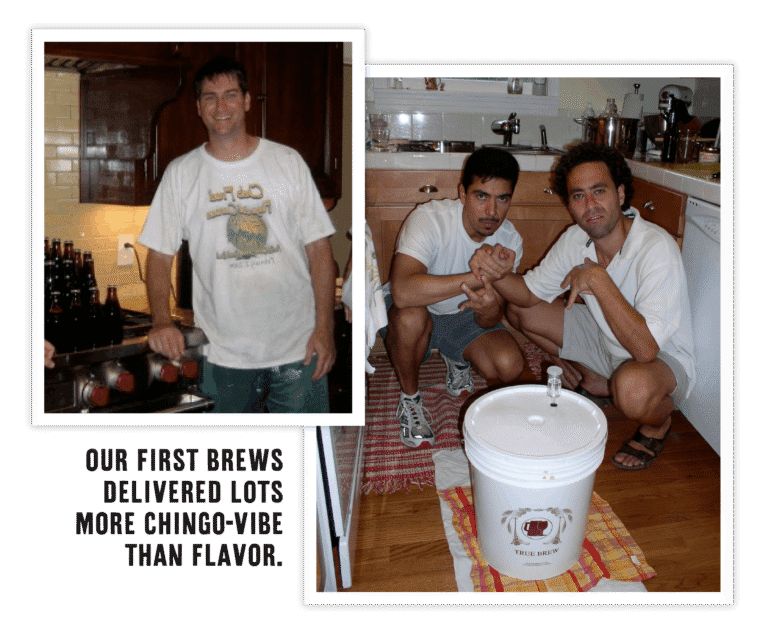
Around 2002, in a dusty garage somewhere in Dallas, George Esquivel and Steve Porcari started making beer. Not good beer, at first. But beer. And that distinction matters more than it might seem.
Esquivel’s path to brewing wasn’t a straight line. His first dream was music — he fronted a band, the kind that plays local venues and fills rooms with energy even when the crowd is small. When that dream didn’t fully materialize, he pivoted to advertising. “Growing up, I thought advertising was sexy,” he told D CEO magazine in December 2021. He landed at Mission Foods, working in brand packaging and identity — learning, firsthand, how the way something looks on a shelf shapes the story people believe about it. He saw his plans translated into real consumer decisions. That was exciting. That stuck.
But it was beer that lit something different in him. Not craft beer as we know it today — widely available, culturally celebrated, with a tap handle in every restaurant worth its salt. This was the early 2000s, when craft beer was still a niche pursuit, still something you had to seek out. Esquivel tried a blueberry beer. He thought it was the coolest thing he’d ever tasted. So he and Porcari tried to recreate it.
“It ended up being horrible,” Esquivel recalled, laughing.
But here’s the thing about obsession: failure doesn’t extinguish it. It deepens it. The first batch was bad. So they tried again. And again. They furnished Porcari’s house with a five-gallon brewing system — a basic extract setup, the kind that fits on a kitchen stove and ferments in a bathroom tub. Weekends became brew days. Brew days became a ritual of drawing sugars from grain, testing the hops-to-yeast ratio, tweaking temperatures, taking notes, and trying again. There was no grand plan. Just curiosity, chemistry, and the particular satisfaction of making something with your hands.
As the years passed, the ambition grew. The equipment upgraded. The home garage was commandeered — a natural progression for any homebrewer whose batches keep getting bigger and whose neighbors are starting to notice the smell. By the time 2007 rolled around, something had genuinely shifted in the quality of what they were producing.
That year, they entered a homebrewing competition at Eno’s Pizza Tavern in the Bishop Arts District, competing alongside six other teams. In a move that perfectly captures who these people are, Esquivel’s band also played the entertainment that night — because of course it did. The beer and the music hit the right note. The room responded. “From there, we met the right people to help us realize our potential,” Esquivel said.
“Beer is beyond a product. It’s a thing that brings cultures together.”
— George Esquivel, Four Corners Brewing Co.
By 2010, they had won a Home Brew Championship. That was the confirmation. This wasn’t a hobby anymore. This was something worth betting on. Esquivel quit his day job. A third partner — Greg Leftwich — joined the team, completing the trio that would define everything that followed. They launched a funding campaign in 2011 that raised $650,000 in its first round. A second round brought in $1.5 million more. Suddenly, Four Corners Brewing Co. wasn’t just a dream in a garage. It was a business plan with a budget and a mission.
The humility of those homebrew years never really left, though. You can still feel it in the way the brand talks about itself — lowercase, conversational, self-aware. “We were craft beer fans that became home brewers,” reads their About page. No mythology. No revision. Just the truth: great things begin in humble places, and the people who build them don’t forget where they started.
By 2012, it was time to find a real home — and they knew exactly the kind of place they were looking for.
Salazar’s Garage and the La Bajada Years: Four Corners’ First Home
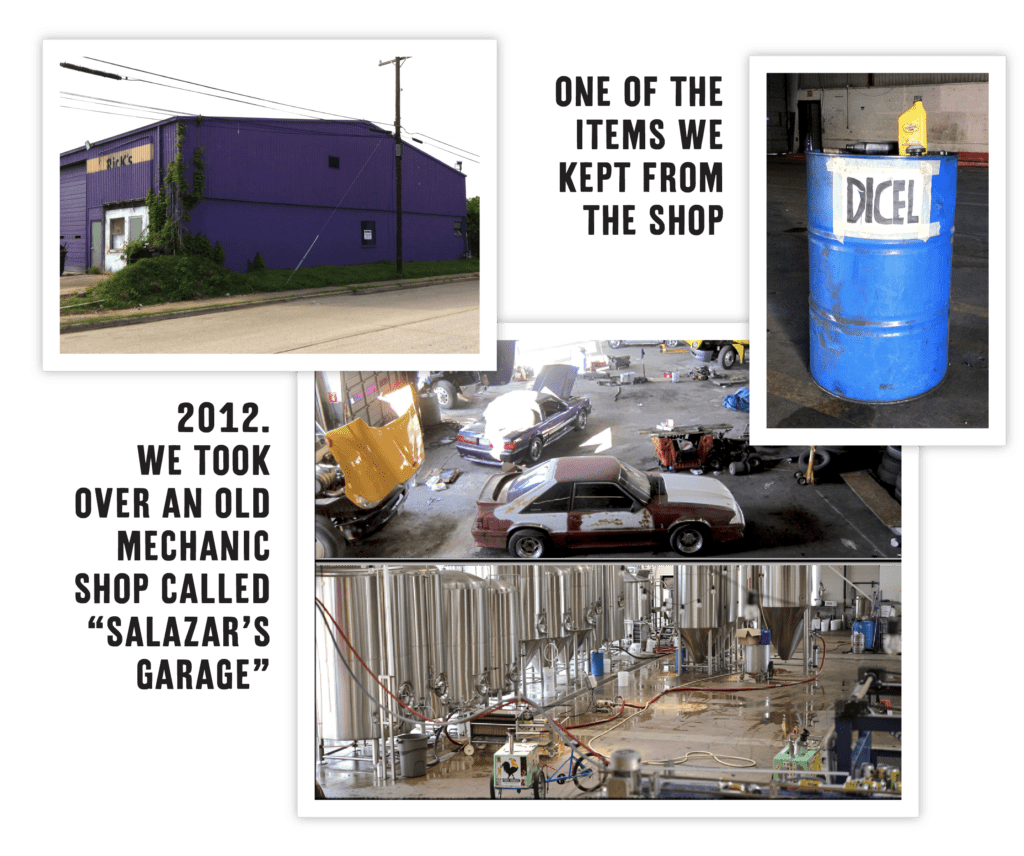
The first official home of Four Corners Brewing Co. was not glamorous. It was not designed by an architect. It did not have a tasting room with Edison bulbs and shiplap walls. It was Salazar’s Garage — an old mechanic shop in the La Bajada neighborhood of West Dallas, just west of the Trinity River and in the early orbit of what would eventually become Trinity Groves. It was scrappy, raw, and completely theirs.
The move made sense in every way that matters. West Dallas in 2012 was on the edge of something — a neighborhood with deep roots and fresh momentum, a place where new businesses were arriving alongside longtime residents, where the energy felt like the start of a chapter rather than the middle of one. Four Corners was exactly that kind of business: grounded in community, unapologetic in identity, arriving with purpose.
One of the most iconic moments in the brewery’s early visual history happened on a ladder outside that mechanic shop. A friend climbed up and hand-painted the Four Corners rooster logo on the side of the building — freehand, no stencil, no safety net. Just a brush, an idea, and the nerve to commit to it. That image — a proud rooster on weathered brick, painted by hand in a neighborhood full of character — captured something essential about who Four Corners was and intended to remain.
The operational reality inside was serious from day one. They started with a 30-barrel brewing system and produced 14,000 cases in 2013 — a meaningful number for a brand-new independent operation with no corporate backing and no inherited distribution. They were building this from scratch, one case at a time, one account at a time, one neighborhood bar at a time.
The accolades started stacking up fast:
- 2015: D Magazine Editors’ Choice Award for Best Brewery in Dallas
- 2015: Dallas Society of Visual Communications gold awards for packaging design and Judge’s Choice
- 2016: Signed with Andrews Distributing, a major distribution milestone that expanded the brand’s reach significantly across Texas markets
- By 2016, production capacity had grown to 8,000 barrels annually
The La Bajada American Brown Ale — still part of the lineup today — is named directly after this neighborhood. At 5.0% ABV, malty and nutty, it’s a tribute beer in the truest sense: a living monument to the place where everything became real. Every batch is a callback. Every pour is a thank-you.
2012 → 2013 → 2015 → 2016. Four years. From mechanic shop to award-winning brewery. From 14,000 cases to a statewide distribution deal. The growth was undeniable. And that growth brought the only problem a young brewery ever wants: they ran out of room.
By 2016, there were no options to buy the property, no room to expand within it. The city was calling Four Corners forward, and they had to answer. The search for a new home began — not with anxiety, but with the same scrappy confidence that had built everything to this point.
But before we follow them into The Cedars, it’s worth pausing on something that was crystallizing during all these La Bajada years: the cultural DNA that made Four Corners more than a brewery, and more than a brand.
What’s in a Name: The Cultural Identity That Built the Brand
Every great brand has an origin story for its name. Most of them are invented — workshopped, focus-grouped, and arrived at through a process that has nothing to do with the product itself. Four Corners is not that.
The name comes from a real intersection: Davis Street and Llewellyn Avenue in Oak Cliff. Four corners, four entities, four flavors of the neighborhood that shaped George Esquivel’s sense of what community could look and feel like. On those corners: Taqueria El Si Hay, Gloria’s Latin Cuisine, the now-closed Bolsa, and a tire shop. Not a curated food hall. Not a developer-designed destination. Just a real street corner in a real neighborhood, doing what real street corners in Oak Cliff do — holding space for everyone.
“That street quadrant felt like the crossroads of inclusivity,” Esquivel told D Magazine. “It felt dynamic, vibrant, accepting. That’s exactly what we wanted to package up and share with people.”
“Four Corners is inspired by an intersection in our neighborhood that is colorful, diverse, and inclusive — we hope our beers are too.”
— Four Corners Brewing Co.
That’s a declaration of values, not a branding exercise. The name doesn’t just describe where the founders are from — it describes what they believe a brewery can be. A crossroads. A meeting place. Somewhere everyone belongs.
Then there’s the logo: a rooster perched on a weathervane. As the brand’s own story puts it — “a yard bird, but a proud bird.” Not an eagle. Not a lion. Not something mythological or intimidating. A rooster. Scrappy, grounded, unafraid to crow, unbothered by what anyone else thinks of it. It’s the perfect mascot for a brewery that has always done things its own way.
The packaging takes the cultural identity even deeper. Inspired by lotería — the traditional Mexican card game that generations of families have played at kitchen tables, at parties, at quinceañeras — the Four Corners cans are instantly recognizable to anyone who grew up with the game, and warmly inviting to anyone who didn’t. The artwork is bold, colorful, and specific. It doesn’t try to be universal by erasing its roots. It achieves universality by committing fully to them.
The beer names tell their own stories. El Chingón IPA — bold, unapologetic, exactly what it sounds like. Local Buzz Honey Blonde — grounded, approachable, community-oriented. El Grito, Heart O’ Texas, El Super Bee — names that make you smile before you even open the can, names that make you want to know the story behind them. Explore the full lineup here.
“We’re trying to give the industry an artful balance… by merging worlds together,” Esquivel said. “Our real mission is to bridge cultures.”
That mission shapes everything at Four Corners — not as a marketing strategy, but as a lived philosophy. This is explicitly a Latino-owned craft brewery, one of the most visible in Texas, and that ownership is a statement as much as it is a fact. In a craft beer landscape that has historically skewed in a very particular demographic direction, Four Corners arrived with a different story to tell and a different community to welcome in. The Vida Well Crafted tagline — a life well crafted, a beer well crafted, a community well crafted — is the north star that makes all of it coherent.
With its cultural identity now fully crystallized and its La Bajada years behind it, Four Corners was ready to find a bigger stage — one worthy of everything it had become.
Moving to The Cedars: A Historic Carriage House and a New Chapter
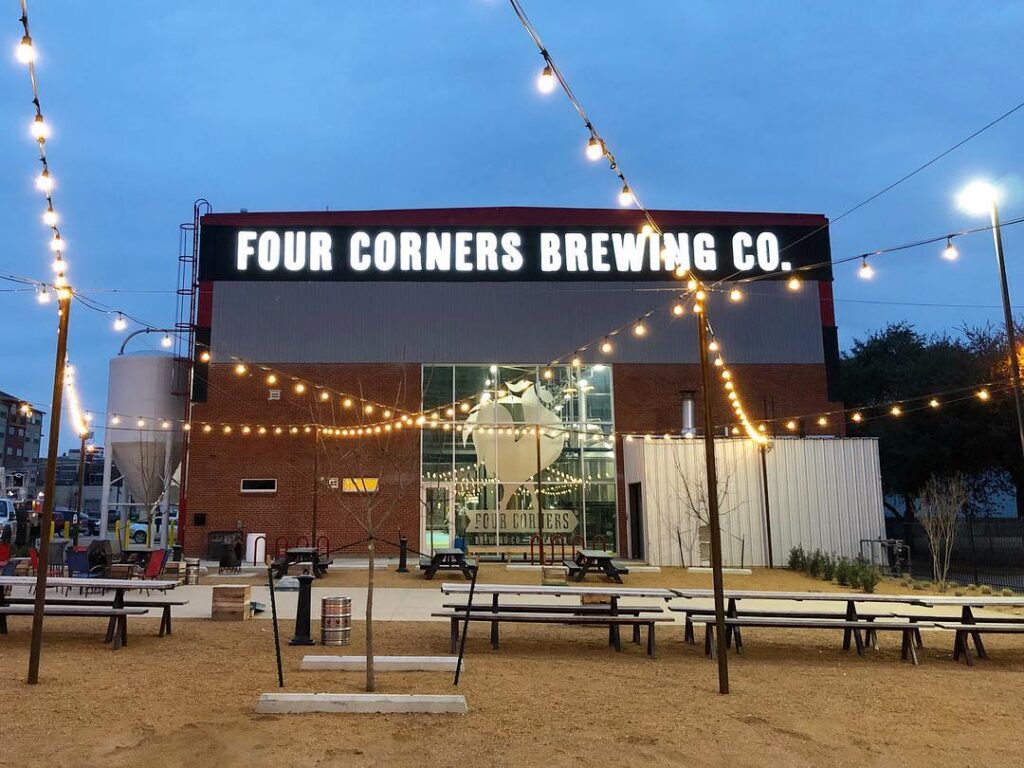
When Four Corners outgrew Salazar’s Garage in just five years, it wasn’t a crisis — it was evidence. Evidence that Dallas had embraced this brewery, this brand, this idea. But without room to buy or expand at the La Bajada location, the team had to go looking. What they found in The Cedars — a neighborhood just south of downtown Dallas that has its own long story of resilience and reinvention — was something they couldn’t have planned for.
The address: 1311 S. Ervay St., Dallas, TX 75215, directly across from the historic Ambassador Hotel. The property: two acres, multiple buildings, a century of history baked into every brick.
The main brewery building was originally part of Conley-Lott Nichols Machinery Co., which operated in the late 1930s and early 1940s. “They were somewhat of a competitor to Caterpillar, selling road equipment and big, heavy machinery,” explained co-founder Greg Leftwich at the October 2017 grand opening, as reported by Beer in Big D. “The parking lot was a retail yard where you could come and look at the equipment, while our main building served as the repair shop.”
Another garage. But a much more epic one.
And then there was The Stables — built around 1915 as the original horse stables for the Ambassador Hotel. Victorian bones. Century-old brick. Vaulted ceilings that seem designed to hold the sound of a good crowd. Today it houses the Four Corners taproom and an event space — the community living room that the brand had always envisioned but never had the physical canvas to fully realize.
The operational leap between the two locations was staggering in scale:
- Brewhouse: From a 30-barrel system at La Bajada to a new 4-vessel, 50-barrel brewhouse — tripling production capacity overnight
- Fermenters: From 100-barrel tanks to 200-barrel fermenters, doubling the ability to condition and store beer
- Brew Lab: A planned 7-barrel small-batch system in The Stables, designed for taproom-only experimental releases — the beginning of what would later become a fast, creative special releases program
- Canning Line: A new line installed to double production output and supply an expanded Texas distribution footprint
- Capacity: From 8,000 barrels to 25,000 barrels in 2017
“Most breweries typically pull out all of their really cool beers for an anniversary,” Esquivel joked at the ribbon cutting, which was attended by a trio of Dallas city councilmen. “We thought we’d open a whole new brewery instead!”
The grand opening ran across an entire October weekend in 2017, culminating in the annual Día de los Puercos event — a celebration as distinctly Four Corners as the brewery itself. From Salazar’s Garage to The Stables. From a freehand rooster mural on a mechanic shop wall to grain silos visible from downtown Dallas. The scale of the leap was cinematic, but the spirit was the same: it’s still, at its core, a bigger garage. Just one with century-old bones and a view of the city.
The cultural fit between Four Corners and The Cedars wasn’t accidental, either. The Cedars is a neighborhood defined by exactly the values that Four Corners was built on: resilience, reinvention, multicultural roots, and an identity that doesn’t bend to trend or pressure. The brewery didn’t arrive in The Cedars to colonize it. It arrived because it belonged there.
The new home was everything the brand needed. And for about a year, everything felt like it was building toward something extraordinary — which, in July 2018, it was.
The Constellation Chapter: Growth, Stability, and the Road Back Home
In July 2018, Constellation Brands acquired Four Corners Brewing Co. Financial terms of the deal were not disclosed. What was disclosed: that a Fortune 500 company — the brand behind Corona, Modelo, and Pacifico, with a market capitalization that would eventually approach $43 billion — had decided that Four Corners was worth owning.
To understand why, consider the numbers. By 2018, Four Corners had grown its case production from 14,000 in 2013 to 178,000 cases — a roughly twelve-fold increase in five years. Sales had grown five-fold since 2014. The brewery had distribution across Texas and a brand story that resonated far beyond the usual craft beer audience. Constellation saw something real, and they moved on it.
Crucially, the management team stayed. Esquivel, Leftwich, and Porcari remained in place. The beer stayed the same. The address stayed the same. To most people pouring a can of El Chingón in 2019, nothing had changed. But inside the business, the implications of corporate ownership were real and significant — in both directions.
What it enabled was scale. Under Constellation, production peaked at 228,000 cases in 2020 — the highest output in the brewery’s history. Distribution expanded into Southern California. The brand reached markets it had never previously accessed. And when COVID-19 hit the hospitality industry like a freight train in March 2020, corporate ownership provided something that no amount of brand loyalty can manufacture: financial stability.
“It should not be missed that it would have been very scary times to be an independent brewer during the pandemic,” Esquivel told the Dallas Morning News, as cited by Dallas Innovates. Across the craft beer industry, dozens of beloved independents closed during those years. Four Corners stayed open, kept its people, and kept making beer. That mattered.
What corporate ownership cost was harder to quantify but just as real: creative agility. New product development — something that had always been a strength, a joy, a direct expression of the founders’ personalities — could now take up to nine months to navigate through corporate approval processes. Culturally specific events like Taco Cons and Día de los Puercos, the kind of programming that defines what Four Corners means to its community, required layers of sign-off. The brewery was still Four Corners in name and in beer. But something was waiting. Something was being held in reserve.
By 2022, production had scaled back to 165,000 cases, and Constellation had made a strategic decision to concentrate its energy and resources on its flagship brands — Modelo, Corona, Pacifico. The craft and specialty portfolio, including Four Corners in Texas and Funky Buddha Brewery in Florida, was no longer the priority.
And that’s when everything changed.
“This is a small and growing brand, and it needs different attention and focus, and that’s what we’re going to put into it. We’re getting back to the entrepreneurial roots we started with.”
— George Esquivel, Dallas Morning News, 2023
In May 2023, George Esquivel, Greg Leftwich, Steve Porcari, and new partner Matt Waller bought Four Corners back. The Dallas craft beer community noticed. The response was immediate and genuine — the kind of enthusiasm you only get when a brand has actually earned its relationship with its audience over years and years of showing up.
What independence meant in practice was immediate and tangible:
- Product development timelines: 9 months → 15–16 weeks
- Beer to go returned to the taproom (it had been restricted under corporate ownership)
- Cultural events like ¡Lotería Live!, Taco Cons, and Día de los Puercos came back fully and freely, on the brewery’s own terms
- The freedom to say “let’s brew this” and have it on tap six weeks later — to see what’s happening in limited releases as a direct expression of creative momentum
The Constellation chapter was not a detour. It served a real purpose at a critical time. It provided the stability that allowed Four Corners to survive a pandemic, scale its distribution, and reach communities it had never reached before. But independence is where the brand lives. Independence is where the rooster crows loudest.
The buyback isn’t an ending. It’s the beginning of the best chapter yet.
Vida Well Crafted: What Four Corners Means to Dallas Today
Stand at the bar at 1311 S. Ervay on a Thursday night. ¡Lotería Live! is in full swing — a live DJ spinning, bilingual energy bouncing off century-old brick, someone winning a prize in the back of the room, the whole space vibrating with exactly the kind of community that George Esquivel was describing when he talked about that intersection in Oak Cliff. Dynamic. Vibrant. Accepting.
This is what Vida Well Crafted looks like in practice.
Four Corners today operates out of the historic carriage house in The Cedars, a brewery and taproom that has become one of Dallas’s most distinctive gathering places. But the taproom is not a byproduct of the brewery — it’s an expression of the brand’s core purpose. It’s the place where the mission becomes tangible, where the beer in your hand connects to the neighborhood around you and the people who built all of it. Explore the taproom.
The beer lineup is the foundation: El Chingón IPA for those who want something bold and unapologetic, Local Buzz Honey Blonde for something smooth and sessionable, chelada options, lagers, and a rotating slate of limited releases that reflect the faster, more creative pace of post-independence brewing. And then there’s the La Bajada Brown Ale — still in the lineup, still named after the original West Dallas neighborhood, still a quiet tribute to everything that made this brewery possible. Every sip is a callback to Salazar’s Garage.
The events calendar reads like a neighborhood’s social life:
- ¡Lotería Live! every Thursday — live DJ, bilingual energy, prizes, the whole thing
- Karaoke Fridays and Saturdays — because sometimes the best thing after a long week is to sing badly in public with people who love you for it
- Bar Jeopardy Wednesdays — knowledge is a taproom sport
- General Trivia Sundays — for those who save their competitive energy for the weekend
- Pickleball Open Play Tuesdays — because the brewery has a beer garden, and the beer garden has a court
Community isn’t a marketing word at Four Corners. It’s the weekly calendar. It’s the reason people show up on a Tuesday afternoon and stay through sunset.
The numbers tell part of the story: 31% annual growth since the 2012 founding, through 2021. Available in 4,500+ stores across Texas, as of that same year. One of the most widely distributed Latino-owned craft breweries in the state. But numbers only go so far. The real measure is what you feel when you walk through the door at The Stables — the sense that this place was made for the people in it, not the other way around.
Taproom hours if you’re ready to go:
Tuesday–Wednesday: 3pm–10pm | Thursday–Saturday: 11am–11pm | Sunday: 11am–8pm
The Legacy Brews page is its own kind of archive — a catalog of beers that have survived and evolved through every chapter of this story, from the La Bajada mechanic shop to the ambassador hotel stables to the Constellation years and back to independence. Every beer is a timestamp. Every recipe is a record.
What “Vida Well Crafted” means in 2026 is this: the freedom to make the beer they want, host the events they believe in, welcome the community they’ve always been part of, and do it all from a building that history built. Four Corners isn’t just a brewery in Dallas. It’s a brewery that helped define what craft beer could look and feel like in a multicultural, community-rooted Texas city — and it did that by being exactly, unapologetically, entirely itself.
That’s the whole story. And the next chapter is being written right now.
The Story Continues: One Beer at a Time
From a kitchen stove in 2002 to a historic carriage house in 2026. From 5-gallon batches to 228,000 cases. From Salazar’s Garage to The Stables. From independent to corporate and back to independent again, with everything learned and nothing essential lost. The Four Corners Brewing Co. Dallas history is the story of people who knew what they were building before they had the words for it — and built it anyway, one decision, one neighborhood, one beer at a time.
The geography changed. The scale changed. The ownership changed. The mission never did: share the culture, bridge the communities, build something worth building. The Vida Well Crafted tagline isn’t a marketing line — it’s a record of every choice these founders made, every garage they called home, every can they put their name on. It’s proof that the life and the brewery were crafted with the same intention, the same pride, and the same roots.
Four Corners isn’t just one of the best craft breweries in Dallas. It’s one of the most honest. And in the end, that’s the whole point.
Come Be Part of It
The story is ongoing, and you’re invited.
Come experience it in person. Four Corners Brewing Co. is open Tuesday through Sunday at 1311 S. Ervay St. in The Cedars, Dallas — inside one of the most remarkable historic spaces in the city, with a cold beer and la buena onda waiting for you.
Check out what’s on the events calendar this week. From ¡Lotería Live! on Thursdays to Karaoke nights on the weekend, there’s always something worth showing up for — and someone worth meeting when you do.
Explore the full beer lineup. From El Chingón IPA to the La Bajada Brown Ale, every pour has a story. Now you know a few of them.
Can’t make it to The Cedars right now? Find Four Corners near you — in one of the 4,500+ stores across Texas where the beer is already waiting.
Want to go deeper on The Cedars? Read our companion piece on the neighborhood that became Four Corners’ forever home — and why the fit was always perfect.