

Pop-Top Era: The Story of Four Corners Brewing’s Iconic 360 Cans
Close your eyes for a second. Picture a warm Dallas afternoon. The sun sits low and heavy, and the air makes you want to slow everything down. Now picture cracking open a beer. Not the familiar pfft of a standard pull-tab. Something different. Something you had never seen before.
You grip the tab and pull. The entire top of the can comes off. No narrow drinking hole. No metallic-edged opening forcing you to tilt the can just right. Just a wide-open vessel, full of golden ale, the aroma rising up to meet you like a South Dallas summer breeze.
Ese momento. That moment. That was the Four Corners pop-top experience.
For years, Dallas craft beer fans still talk about those cans with real warmth. Four Corners Brewing Co. did something no Texas brewery had ever done before. They put their beer in pop top cans that opened completely, transforming a simple aluminum can into something closer to a pint glass. It was bold. It was unexpected. It was muy chingón. And it became one of the defining chapters in the Four Corners story.
This blog is that chapter. It is a love letter to la buena onda, the good vibes, of the pop-top era. We will take you all the way back to the beginning. First, we cover the frustrated engineer whose idea changed the beer world forever. Then, we move to the spring of 2014, when Four Corners became the first brewery in Texas to use 360 End™ lids. After that, we get into the community that made those cans feel like home. Finally, we share the honest story of why the era had to end and what comes next.
Pull up a barstool. This story is worth hearing from the beginning.

Before the Pull-Tab, There Was a Car Bumper: A Brief History of the Pop-Top Can
Every revolution has an origin story. Some are glamorous. Others are born at a picnic table in Ohio, surrounded by warm beer cans that nobody could open.
The Church Key Era
Before 1962, opening a beer can required a separate tool. People called it a church key. The name alone tells you how essential it was. You didn’t leave home without it. You didn’t show up to a cookout without it. Forget the church key, and your six-pack was useless. Every beer drinker in America carried one out of necessity, not choice.
Then came the summer of 1959. A mechanical engineer named Ermal Frazeforgot his.
Fraze founded Dayton Reliable Tool & Manufacturing Company in Ohio. He found himself at a picnic with cans of beer and no way to open them. Rather than accept defeat, he did what engineers do: he improvised. He used his car’s bumper to pry open the cans. It worked, barely. It was messy, awkward, and a little dangerous. However, somewhere between the frustration and the warm beer, a billion-dollar idea was born.
Fraze Gets to Work
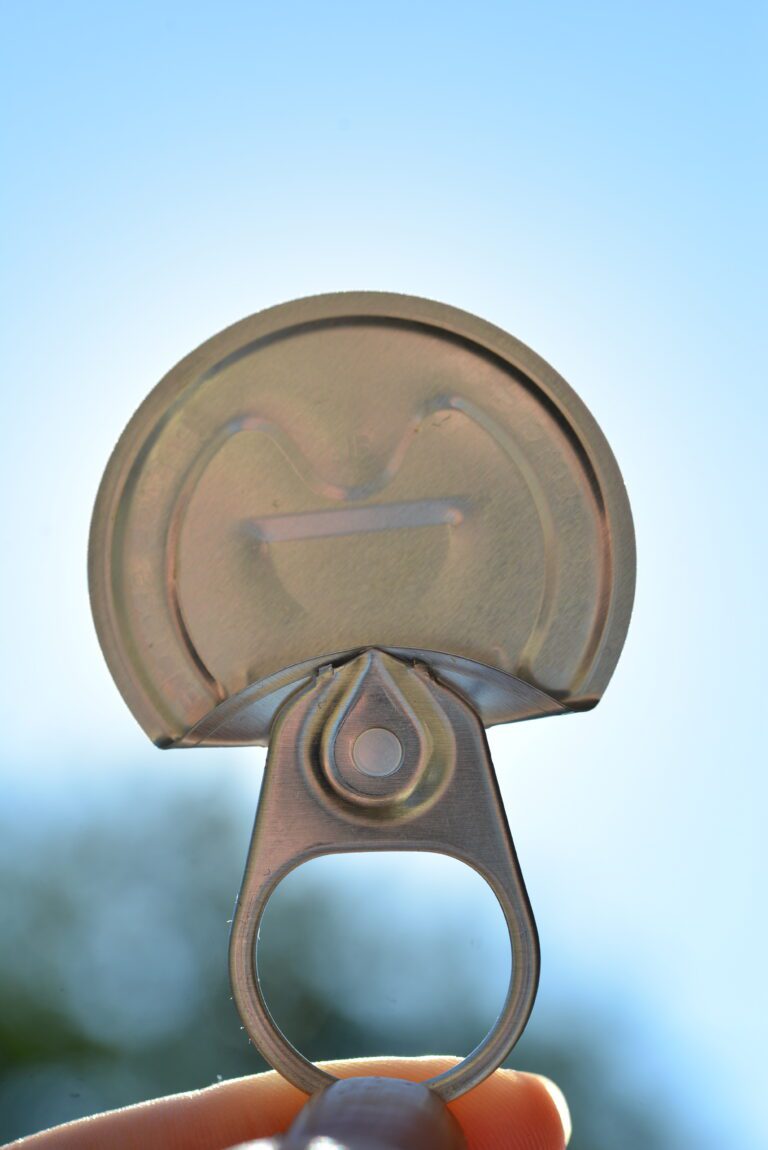
Fraze went home and got started. He spent the next several years developing a mechanism that let a drinker open a can using only their hands. No separate tool required. The solution was elegant and simple: a pre-scored section on the can’s lid, connected to a small riveted lever tab. Lift the tab, and the scored section breaks open cleanly. He patented the design in 1963, but the technology had already made its public debut the year before.
“Who knew that a bad picnic could change the beer world forever?”
In 1962, Pittsburgh Brewing Company became the first brewery in history to use Fraze’s pull-tab design. They put it on their legendary Iron City Beer. The reception was immediate and overwhelming. Sales tripled in the first year of production. Within three years, by 1965, approximately 75% of American breweries had adopted the pull-tab. The church key was, for all practical purposes, gone.
The Unintended Consequences
However, the pull-tab brought unintended consequences. The original design produced a fully detachable tab. It was a small aluminum ring that came completely off the can after opening. Millions of them ended up on sidewalks, in parks, on beaches, and on stadium floors. Kids accidentally swallowed them. Beach-goers sliced their feet on them. As a result, environmentalists pointed to them as a symbol of throwaway consumer culture. By the early 1970s, the pull-tab faced real regulatory and social pressure.
The solution arrived in 1975, thanks to another engineer: Daniel F. Cudzik of Reynolds Metals. Cudzik designed what became known as the “stay-tab.” It was a non-removable tab that stayed attached to the can’s lid even after opening. It addressed the litter and safety concerns without sacrificing convenience. Falls City Brewing Company adopted it first. Within a decade, the stay-tab had completely replaced the detachable pull-tab across the industry.
For the next forty-plus years, things stayed comfortable and predictable. The stay-tab opened a small drinking hole, you tilted the can to your lips, and that was that. The aluminum can had found its final form. Or so everyone thought.
Because in 2014, a brewery out of Dallas had a different idea entirely. They didn’t want to open a small hole. They wanted to blow the whole lid off.
Four Corners Goes Topless: How the 360 End Can Changed Texas Craft Beer
The year 2014 was a big one for Texas craft beer. The state’s brewing scene was in the middle of a cultural renaissance. New taprooms were opening. New voices were entering the conversation. An audience of adventurous drinkers was ready for something new.
Texas’s First Pop-Top Brewery
Into that moment walked Four Corners Brewing Co. They came from the Oak Cliff neighborhood of Dallas, and they carried something no Texas brewery had ever tried before.
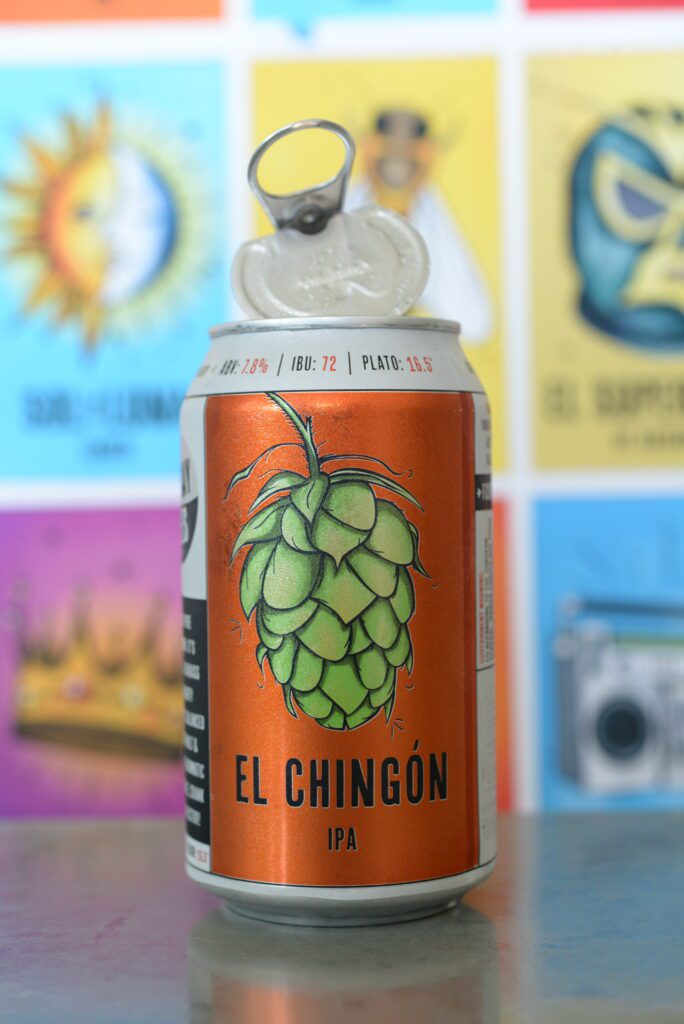
In the spring of 2014, Four Corners became the first brewery in Texas to package their craft beers in 360 End™ lids manufactured by Crown Holdings, Inc. These were fully removable pop-top lids. They didn’t just open a drinking hole. They removed the entire top of the can.
Let that sink in for a moment. The whole top. Gone. What remained was essentially a seamless aluminum cup, wide open, with the beer breathing freely. No narrow metallic opening. No barrier between you and the full sensory experience of the beer. It was, in the most literal sense, a different way to drink beer from a can. And it was unlike anything Texas had seen.
The technology came from Crown Holdings, a global packaging company with decades of innovation in the can space. Their 360 End™ lid used a specialized scored design. When you activated the tab, the entire lid panel lifted away cleanly. The mechanism was precise, reliable, and genuinely impressive to witness. Watching someone pop a Four Corners 360 End can for the first time was guaranteed to get a reaction.
“We didn’t just make beer. Hicimos historia.”
The Launch Lineup
For the launch, Four Corners chose three of their flagship All Day Ales. These beers were already beloved by Dallas drinkers. Now, they came packaged in something extraordinary:
- Local Buzz: A golden ale brewed with locally sourced honey and rye malt. Light-bodied and approachable, with a sweet floral aroma and a gently spicy finish. The kind of beer that made Oak Cliff feel like a neighborhood, not just a zip code.
- El Chingón IPA: Bold American hops colliding with Munich malt, then dry-hopped for an intense fresh aroma. “Hop machismo” personified. A beer that arrived with a name and a reputation, and always delivered on both.
- Block Party Porter: Smooth, chocolaty, full-bodied, and deeply satisfying. The round malt character and balanced sweetness made it the beer you handed to someone who said they didn’t like craft beer. And then they liked craft beer.
Reaching Dallas Shelves
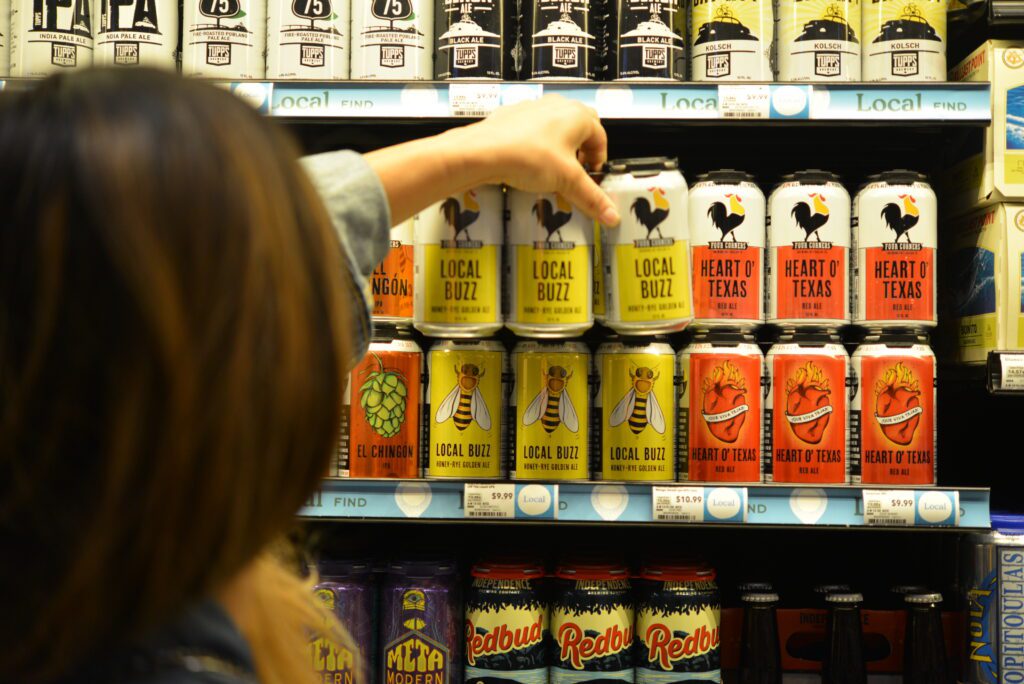
These beers weren’t just available at the taproom. Four Corners took the pop-top can to major Dallas retailers. You could find them at Central Market, Whole Foods, Kroger, Spec’s, Total Wine, H-E-B, and Walgreens. The price point was $8.99 to $9.99 for a six-pack. Accessible, affordable, and impossible to miss on a shelf.
Moreover, the distinctive 360 End lid made the cans stand out visually. You didn’t even need to explain the concept. The moment a curious shopper picked one up, they were sold.
This move was entirely consistent with who Four Corners was — and still is. Innovation wasn’t a marketing strategy for them. It was an expression of identity. The craft beer packaging choice reflected the same values that shaped everything from the beer names to the taproom culture: bold, community-centered, and unafraid to do something nobody else was doing. Explore their full lineup of brews and you’ll see that spirit hasn’t changed one bit.
The pop-top can wasn’t just a novelty. It was a statement. And Dallas listened.
The Can That Became a Cultural Icon: Why Dallas Loved the Pop-Top Era
There are products, and then there are experiences. The Four Corners 360 End pop top can firmly belonged in the second category. That distinction is everything when it comes to understanding why it resonated so deeply with the community.
A Ritual, Not Just a Can
Opening a standard beer can is functional. You do it, you drink, you move on. Opening a Four Corners pop-top can was a ritual. You’d peel back the tab, feel the resistance, and then pop the entire lid came free in your hand. You’d hold it for a second, look at this small aluminum disc, and set it aside. Then you’d look down into the open can and take your first sip.
There was a theatricality to it. It made drinking a can of beer feel like an occasion. That’s not an accident. That’s great design doing exactly what it’s supposed to do: transforming the ordinary into something memorable.
For Texas craft beer fans, memorable experiences were exactly what the mid-2010s were all about.
The Instagram Moment
This was the height of craft beer culture’s Instagram era. What your beer looked like mattered almost as much as what it tasted like. Sharing experiences visually had become a genuine form of community-building. And the 360 End can was inherently, irresistibly visual.
A fully open beer can with the lid resting beside it? That was a photograph. That was a story. People shared their “topless” Four Corners cans constantly. At backyard cookouts, at Cowboys watch parties, at outdoor concerts, and at tailgates. Consequently, the can became its own conversation starter, its own social currency.
“You’d pop that lid off and suddenly it was just you and the beer. No barrier. No narrow opening. Just the real thing.”
The Aroma Advantage
Beyond the visual and the social, something more fundamental was at work: the aroma. Beer culture has long known that aroma drives a large part of flavor. That’s why serious drinkers pour their cans into glasses to release the aromatic compounds that a narrow opening traps.
The 360 End lid solved that problem elegantly. With the full top removed, El Chingón IPA’s hop aromatics hit your nose with the same intensity as a fresh draft pour. Local Buzz’s honey and floral notes opened up in ways a standard can simply couldn’t deliver. Block Party Porter’s roasty, chocolaty warmth became something you could smell your way into before you ever took a sip.
In other words, this wasn’t just a novelty. It was a genuinely superior drinking experience from a sensory standpoint. And the Four Corners faithful knew it.
More Than a Beer: A Badge of Neighborhood Pride
For the Oak Cliff community specifically, the pop-top era carried extra meaning. Four Corners had always been a source of neighborhood pride. They were a brewery founded by and for the multicultural, tight-knit community of South Dallas. Learn más about who they are and where they come from, and you’ll see that the brewery was never just making beer. They were expressing a way of life.
The 360 End can added another dimension to that expression. It said: this is ours, and it’s unlike anything anyone else is doing.
That kind of differentiation builds the deepest brand loyalty. Not the loyalty that comes from advertising, but the loyalty that comes from shared experience. The pop-top era created a generation of Four Corners fans who were fans not because they’d seen a commercial, but because they’d been there. They’d held the open can. They’d smelled the hops. They’d shown a friend how it worked and watched their eyes go wide. That’s Vida Well Crafted in action: a life built around intentional, meaningful experiences.
The era was alive, vibrant, and deeply loved. Which made what came next all the harder to accept.
Why the Pop-Top Era Ended: The Two Reasons We Had to Move On
There’s a version of this story where a brewery quietly phases out a product and hopes nobody notices. That’s not the Four Corners way. When the end of the pop-top era came, they were straight about it. The community that had loved those cans deserved nothing less than the truth.
In 2019, Four Corners Brewing officially announced that they would discontinue the use of 360 End™ lids starting in 2020. The Dallas Morning News covered the announcement. That alone tells you everything about the cultural weight of the decision. This wasn’t a minor packaging update. This was news.
The reasons were two-fold. Both were beyond the brewery’s control, and both are worth understanding clearly.
Reason One: The Supplier Ended Production
Crown Holdings, the manufacturer of the 360 End™ lid, decided to discontinue the product entirely.From a pure economics standpoint, the 360 End was a specialty item within a specialty market. Despite the enthusiasm from breweries like Four Corners and from drinkers across the country, the commercial footprint wasn’t large enough to justify continued manufacturing at scale. Additionally, the lid had run into distribution headwinds that limited how widely breweries could adopt it. When the numbers didn’t work out, Crown Holdings made their call.
Without a viable supplier, there was no path forward. No supplier, no cans. As simple, and as frustrating, as that.
Reason Two: Local Litter Laws
Here’s where history comes full circle in an unexpected way. Remember those environmental concerns that forced the switch from detachable pull-tabs to stay-tabs in the 1970s? Those same concerns, written into law across parts of the United States and Canada, created a legal wall for the 360 End lid fifty years later.
The litter ordinances from the 1960s and 1970s were designed specifically to address the problem of detachable can tops. As a result, they explicitly prohibited the use of fully removable lids on beverage containers in certain jurisdictions. The same quality that made the pop-top can extraordinary. The fact that the lid came completely off was precisely what put it in conflict with that regulatory framework. In the eyes of those litter laws, a lid that separates from its container is, categorically, a potential piece of litter.
Consequently, a patchwork of legal restrictions limited where Four Corners could sell and distribute the 360 End cans. For a brewery trying to scale its reach across Texas and beyond, those restrictions created real logistical complications that compounded the supply chain problem.
Together, a dead supply chain and a regulatory environment that hadn’t caught up to the innovation meant the era was over. Not by choice. Not by a failure of vision or passion or commitment to the craft. By circumstance.
Four Corners had ridden the 360 End wave longer, louder, and more passionately than any brewery in Texas. When it ended, it ended with every ounce of dignity it had earned. And what it had built? That was permanent.
The Legacy of the Pop-Top: What That Era Built for Four Corners
“End of an era” sounds like a sad phrase. However, here’s the thing about chapters that close well: they become foundations. The pop-top era didn’t leave a hole in Four Corners’ story. It left a blueprint.
A Reputation for Bold Choices
What the 360 End years proved, above all else, was that Four Corners was a brewery willing to take swings that nobody else in Texas was taking. Being the first in Texas to use the 360 End™ lid wasn’t a decision made in a conference room. It was an instinct that drove the decision to name a beer El Chingón, to set up shop in the historic carriage house district of South Dallas, and to build a brewery around community identity rather than mass appeal.
The pop-top can was a physical expression of a brand philosophy that had always existed: if there’s a better way to do this, we’re going to find it.
That reputation, earned through genuine innovation, became one of Four Corners’ most valuable assets. In the booming Texas craft beer packaging landscape of the mid-2010s, Four Corners wasn’t just another taproom. They were the brewery that had done something nobody else had done. That credibility doesn’t expire when the product does.
The Beers Outlasted the Cans
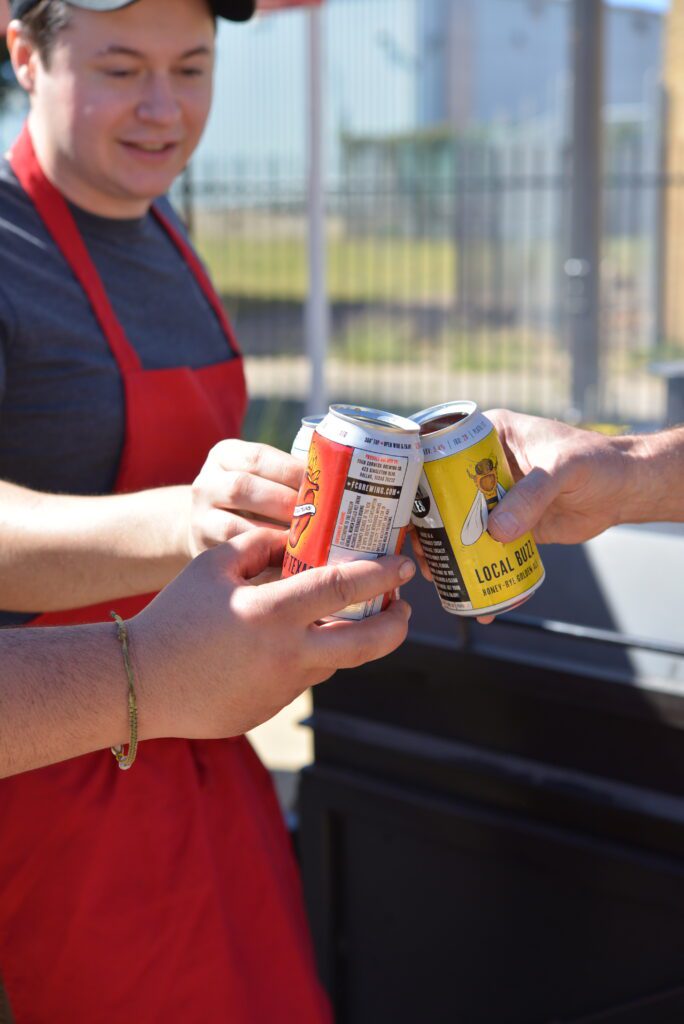
The three beers that launched the pop-top era, Local Buzz, El Chingón IPA, and Block Party Porter, became cornerstones of the Four Corners lineup. They endured far beyond the novelty of their packaging. Fans didn’t just love those beers because of the cans. They loved them because they were genuinely, uncommonly good.
The 360 End lid gave people a reason to pick them up the first time. The beer itself gave them a reason to keep coming back. That’s the real legacy of the pop-top era: it introduced thousands of Dallas drinkers to a brewery they then fell in love with on the beer’s own terms.
Loyalty That Carried Through the Hard Seasons
The community loyalty built during that era — the shared experience, the memory of the topless can, the neighborhood pride — became the kind of fan base that sustains a brewery through its hardest seasons. And Four Corners had hard seasons.
In 2018, Constellation Brands acquired the brewery. Constellation is the global beverage giant behind Corona and Modelo. For a community-first, founder-driven brewery, it was a significant transition. But the fans who had been there since the pop-top days never stopped showing up.
“The lid came off. The era came to an end. But what you gave us was your loyalty, your vibes, your amor for what we were building. That never left the building.”
In 2023, Four Corners returned to full founder independence. It was a new beginning that carries the same energy as the original 2012 founding and the 2014 pop-top launch: bold, authentic, and entirely on their own terms.
If you look at the rooster on the Four Corners logo, proud, upright, chest forward, facing the horizon, the pop-top era embodied exactly that posture. The brewery took a chance, held its ground, built something meaningful, and kept crowing. And now, independent again, the rooster is still crowing.
¡Adelante! What’s Next for Four Corners Brewing Co.
The pop-top era is history. What’s being made right now at 1311 S. Ervay St. in Dallas is the next chapter. And if the past is any guide, it’s going to be worth showing up for.
Four Corners returned to full founder independence in 2023. That return wasn’t just a business transaction. It was a reorientation and return to the original mission that George Esquivel, Greg Leftwich, and Steve Porcari set out on when they first opened their doors on Singleton Boulevard in 2012 and started brewing beer for their community. From that first location on Singleton, to planting roots in the Cedars neighborhood in 2017, to reclaiming full independence in 2023 while remaining in the Cedars, the address has changed, but the mission never has.
The Taproom Is the Soul
The independence doesn’t mean Four Corners is looking backward. It means they have the freedom to move forward on their own terms, without compromise. That’s the same freedom that led them to pop the top on Texas craft beer a decade ago.
The taproom at 1311 S. Ervay St. remains the soul of the operation. It is a gathering place where multicultural energy mingles with cold beer, good music, and the kind of conversations that only happen when people feel genuinely welcome. Visit the taproom and you’ll find the same warmth that defined the pop-top era, now poured into every pint that crosses the bar. The space has always been more than a place to drink beer. It’s a living expression of what Four Corners believes a community can be.
What’s Coming Next
New brews are in the works. New experiences are being designed. New chapters are being written by the brewers, by the taproom staff, and by every Dallas local who walks through those doors and makes a new memory. The DNA hasn’t changed: community-first, culturally rich, experience-driven.
See what’s on tap right now and you’ll taste it in every glass. You’ll feel it in every carefully considered recipe. You’ll hear it in every beer name that carries a story.
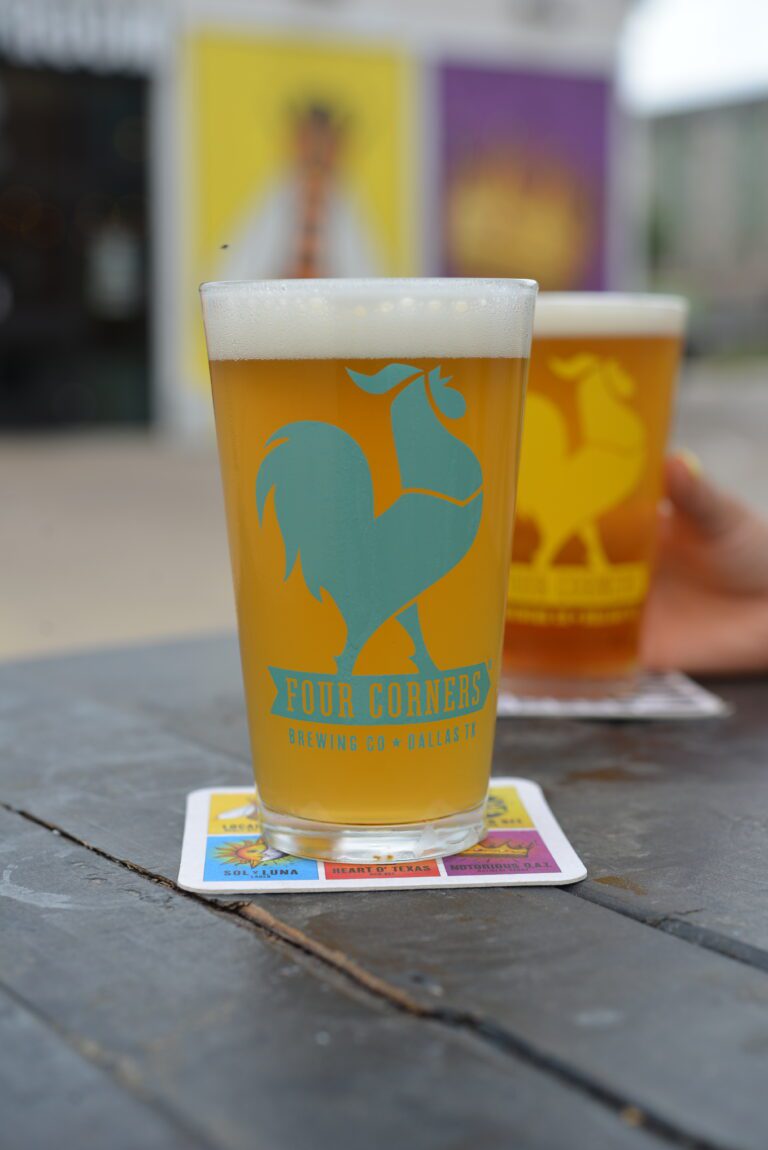
The spirit of the pop-top era lives on! Not in a particular package or product, but in an approach. It lives in the willingness to try something nobody else is trying. It lives in the commitment to giving fans not just a good beer, but a genuine experience. It lives in the belief, held from day one and never surrendered, that craft beer is about community as much as it is about craft.
The 360 End lid is gone. The commitment to giving you the best possible experience? That will never be discontinued.
La vida’s too short for bad beer and no good stories. That’s always been the Four Corners philosophy, long before anyone put a name to it. Today, that philosophy goes by the name it’s always deserved: Vida Well Crafted. A life and beer made with intention, creativity, and a deep love for the people around you.
Stay connected to everything that’s coming. Check out the latest news from Four Corners Brewing Co. Beer drops, special events, taproom updates, and all the good things being built right now. The next era is already underway.
Full Circle: A Final Sip of the Pop-Top Era
Go back to that moment. The warm afternoon, the open can, the aroma rising up to meet you. The lid sitting on the bar beside you, small and round, a tiny aluminum circle that held an enormous idea inside it.
The Pop-Top Era was a bold, beautiful, community-defining chapter in the Four Corners Brewing story. For five-plus years, Four Corners did something no other Texas brewery was doing. They handed drinkers an experience those drinkers didn’t know they wanted. They built a neighborhood brewery into a cultural landmark, one topless can at a time. Local Buzz and El Chingón IPA became synonymous with a moment in Dallas craft beer history that felt like ours. Because it was.
But here’s what the pop-top era was not: the whole story.
The Story Continues
Four Corners Brewing is still here. Still independent. Still brewing. Still showing up for Oak Cliff and for Dallas with the same energy that put the 360 End lid on a grocery store shelf twelve years ago. The packaging changed. The philosophy never did.
Vida Well Crafted isn’t a slogan. It’s a promise. Every beer poured, every event hosted, and every new chapter written will carry the same intention and care that defined the pop-top era at its peak. There will be other bold choices. Other innovations. Other moments worth remembering.
The rooster is still upright. The horizon is still forward.
Thanks for riding this era with us. ¡Salud!
Come Experience the Next Era
The taproom is open and waiting for you.
Visit us at 1311 S. Ervay St., Dallas, TX.
Tuesday–Wednesday: 3pm–10pm | Thursday–Saturday: 11am–11pm | Sunday: 11am–8pm
Plan your visit →
Never miss what’s next.
Sign up for our newsletter! Beer drops, taproom news, special events y todo chingón.
Join the community →
Share your Four Corners memories, old and new.
Tag us and keep the story going.
#FCBREWING | @FCBREWING