

Book Your Company Holiday Party Now: The Dallas Venue Timeline Every Planner Gets Wrong
Ya sé, it is September You are still cleaning up the shared drive from the summer offsite, the AC has not caught a break since May, and somebody just dropped “holiday party” onto the agenda for next week’s leadership sync. It feels absurdly, almost comically early. Nobody in your office has thought about December since roughly January.
Here is the reframe that makes this whole post worth your time. If you are going to start looking at holiday party venues in Dallas, late August is not early. It is roughly on time.
That gap between how it feels and how it actually is has one cause: the planner’s clock and the venue’s clock do not run at the same speed. Your clock starts around October, when the calendar finally looks close enough to December to justify the effort. The venue’s clock started in July. By the time your clock catches up, other people have been holding the good dates for eight weeks. That mismatch, not procrastination and not poor planning on your part, is the entire problem this post exists to solve.
So this is not a vague “book early” nag. It is a concrete, month-by-month countdown from September to early December: what you should have decided at each stage, what a venue actually needs from you, and specifically what you lose if you slip. You also get a pre-inquiry checklist that will collapse a two-week email thread into a single conversation, and a headcount-to-space matching guide so you can figure out in about thirty seconds which room you should even be asking about.
One honest note on credibility before we start. This is not manufactured urgency. It is simply what the calendar looks like from the venue side of the table, where a small number of December nights get spoken for in a very particular order.
Worth saying up front: this post answers when. It does not answer where. We already made the full case for the brewery taproom versus the conventional venue in Why a Dallas Brewery Taproom Is Your Best Corporate Event Venue (And How to Book One), so we will not relitigate it here. If you already know where you want to be and just want to move, the private events page is right there.
First, though, the math. The timeline only makes sense once you see how compressed December really is.
Why the December Calendar Fills Before You Start Looking
Every year, a version of the same conversation happens in venues across this city sometime around the second week of November. A planner calls, friendly and organized, with a clear vision and a reasonable budget, asking about the second Friday in December. And the answer has to be no. Not because anybody wants to say no, but because that Friday was claimed in September by someone who called when it still felt too early to call.
When should you book a company holiday party venue?
For a December corporate party, most planners should be scoping venues in August and locking a date in September, roughly three to four months out. The date is the scarce resource, and it is the first thing to disappear.
Now here is why that is true, laid out as plainly as possible.
Start with the realistic December window. Your party is not happening on December 28. It is probably not happening on December 22 either, because half your team will already be traveling, and the other half will be mentally checked out in a way no open bar can fix. In practice, the workable window for a company holiday party is roughly the first three weeks of the month. Call it December 1 through December 19 in a typical year.
Now narrow it again. Most companies want a weekday evening that does not eat into a full weekend, which in practice means Thursday or Friday. You are not imagining that preference, and you are not alone in it. The Tripleseat 2022 Corporate Holiday Events Survey found that Friday is the single most requested day for corporate holiday parties, followed by Saturday and Thursday.
Do that arithmetic across three weeks and you land on roughly six prime evenings. Six. That is the entire realistic inventory of first-choice December nights, and every in-demand venue in Dallas is working from that identical short list. Every corporate holiday party in the metroplex is competing for the same handful of squares on the same calendar page.
Which brings us to the sentence this entire article rests on.
A venue cannot add a second Friday, December 12.
Demand is concentrated into a few weeks. Supply is fixed by the structure of the calendar itself. Restaurants can add a seating. Hotels can sell another room. A venue with a fixed number of December evenings cannot manufacture more of them, no matter how much anyone wants to. That is not a sales tactic, it is just how time works, and it is the one thing about managing a private event calendar that no amount of operational cleverness can solve.
Here is the part that should genuinely reassure you, though. That same Tripleseat survey found that 51% of planners booked their holiday party just one to three months in advance, and another 13% booked less than a month out. Read that again. Nearly two thirds of corporate planners are operating inside a compressed window that starts in roughly October. You are not disorganized. You are typical. The trouble is that being typical is precisely what costs you the date, because typical means you are arriving at the same time as everybody else, asking about the same six nights.
How far in advance should you book a holiday party?
Three to four months is a comfortable planning window for most corporate groups. That gets you real choice on date, real choice on space, and enough runway that nothing becomes a rush order.
There are two situations that warrant more lead time. The first is a larger headcount, because the number of spaces in any city that comfortably hold 200 or more people is smaller than the number that hold 50, so your options thin out faster. The second is a genuine must-have date, whether that is because of a board meeting, a quarterly close, a visiting executive, or a tradition your team has held for a decade. If the date is non-negotiable, treat it like a flight during a holiday weekend and move early.
There is an inverted logic to all of this that is worth naming directly, because it runs against instinct. The planners who end up with the date, the space and the budget they actually wanted are the ones who moved while it still felt too early. Urgency in event booking is inverted. It feels lowest in early September, when your options are widest and your leverage is greatest. It feels highest in November, when your options have narrowed to whatever is left. The feeling and the reality point in exactly opposite directions.
We are not going to do the countdown-clock thing here, or tell you not to get left out in the cold. You are a professional with a budget and a boss, and you can read a calendar. The math is the argument. Six prime nights, one fixed supply, and roughly two thirds of your peers all arriving at once in October.
So if the window is genuinely that small, the useful question is not whether to move but what to do in each month between now and then. That is the countdown.
The Month-by-Month Holiday Party Booking Timeline
Before anything else, one important piece of framing. What follows is a general planning timeline used across the events industry. These are not Four Corners deadlines. We are not publishing cutoff dates, we are not implying anything about what is or is not currently available, and nothing here is a policy. Actual availability for any specific date comes from one place only, which is the reservation form. Treat this as a map of how corporate event planning tends to work, not as a countdown clock with our name on it.
Each phase below uses the same three-part structure, so you can find your place quickly and know what to do next.
- What you should have decided
- What the venue needs from you
- What gets harder if this slips
Copy the whole thing into Slack if it helps. That is what it is built for.
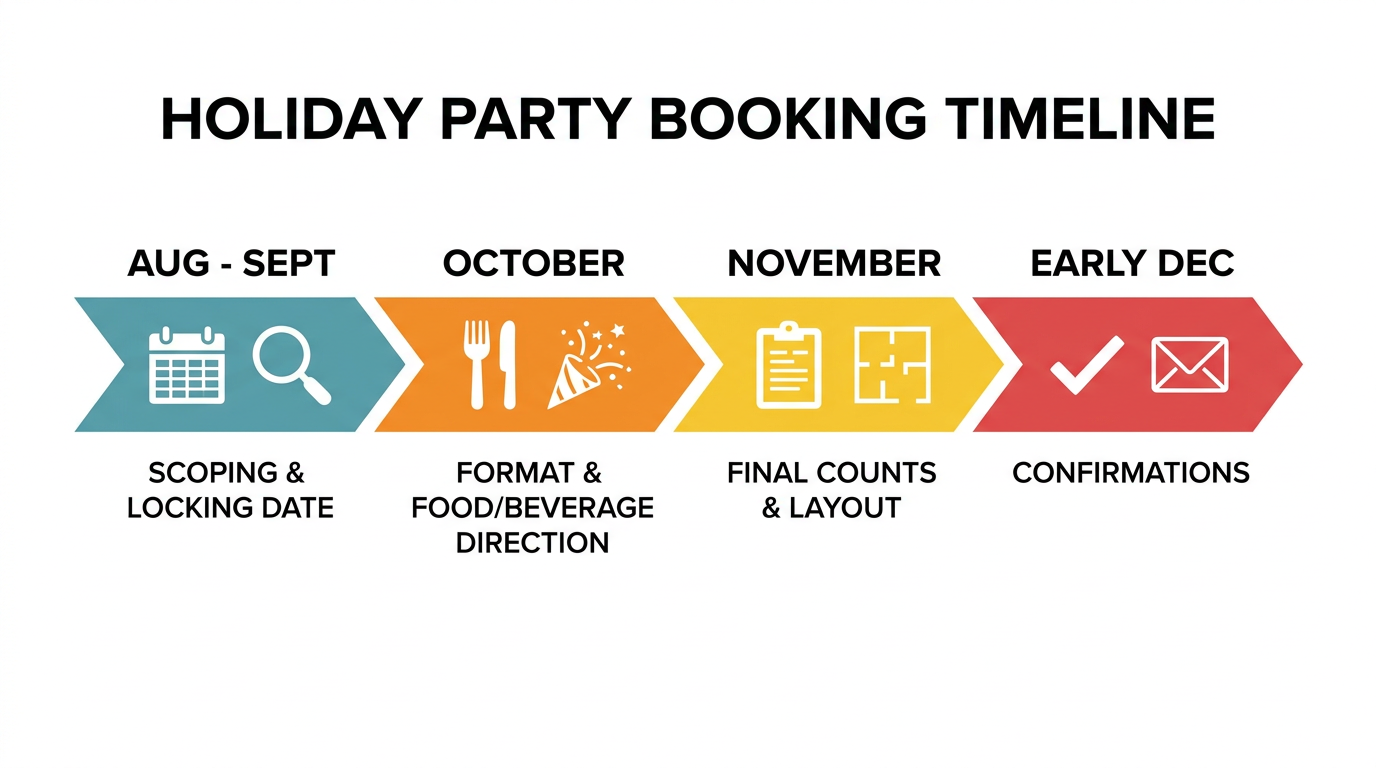
Phase 1: August and September, scope, visit and lock the date
What you should have decided. Three things, and none of them need to be precise. A headcount range, not a number. A budget range, not an approved line item. And two or three candidate dates, ranked in order of preference. That is genuinely the whole homework assignment for this phase, and if you have those three answers in a notes app right now, you are ready to start conversations today.
This is also the phase for site visits. Walk the room. Stand where your CEO will stand during the toast and see whether anybody at the back can actually see them. Check the parking situation the way your guests will experience it, not the way the map shows it. If you want a full framework for what to evaluate on a site visit and how a taproom compares to a conventional room, we covered exactly that in our companion post on choosing a brewery taproom for corporate events, so we will not duplicate it here.
What the venue needs from you. Less than you think. A date and a rough guest count is typically enough to begin a real conversation about what is possible. You do not need catering decisions, you do not need a finalized invite list, and you certainly do not need internal sign-off on every line of the budget. Send your details through the reservation form and find out what is open. That single step, taken in August or September rather than October, is the highest-leverage thing in this entire article.
What gets harder if this slips. Your first-choice date is the thing you lose, and you lose it first. Not the food, not the layout, not the budget. The date. Everything else in this timeline can be adjusted, compressed or improvised later. A specific Friday evening in December cannot be recovered once it is spoken for. This is also the phase where Dallas event venue booking is genuinely pleasant rather than stressful, because you are choosing between options rather than reacting to what remains.
One more consideration specific to a working brewery, and to a lot of venues with public-facing operations. The December calendar fills with two different kinds of commitment at once: private bookings like yours, and public programming that the venue schedules for its regular community. A look at the Four Corners events calendar gives you a sense of how active a taproom calendar stays year round. Both types of commitment consume the same evenings, which is another reason the December grid tightens earlier than most planners expect.
Phase 2: October, direction and structure
What you should have decided. Your headcount range should now be tighter, ideally within a band of twenty or so. Your food and beverage direction should be settled in broad strokes: are you doing a seated dinner, passed apps during a cocktail reception, or something more casual and continuous. And you should know your technical needs. Is there a presentation? An awards segment? A playlist somebody feels strongly about? A slideshow of the year in photos that the marketing team has already started assembling?
What the venue needs from you. Format clarity, primarily. Format is the input that drives layout, staffing, timing and flow. A seated dinner for 100 and a cocktail reception for 100 are two entirely different events that happen to share a number, and they require different room setups, different service patterns and different staffing plans. Once a venue knows your format, most other planning questions become answerable.
What gets harder if this slips. You are now negotiating from a shorter runway, and shorter runways cost money in quiet ways. Any specialty vendor becomes a scramble. Custom items with production lead times start bumping against rush windows. And you lose the luxury of changing your mind, which matters more than planners expect, because October is exactly when someone senior tends to look at the plan for the first time and suggest something different.
Phase 3: November, details and counts
What you should have decided. Final counts. The floor layout. A run of show for the evening, even a rough one, covering when people arrive, when food comes out, when anybody speaks and roughly when the night winds down. Dietary requirements, gathered from an actual survey of your team rather than guessed at. Arrival and departure timing.
What the venue needs from you. Firm numbers. Everything operational downstream depends on the count: how much food, how many staff, how the room gets arranged, how the bar is set. A number that keeps moving in November is the single most common source of friction in corporate event planning, and it is almost always the result of an RSVP process that started too late rather than a team that cannot make up its mind.
What gets harder if this slips. This is where budgets get messy and where guest experience quietly degrades. Late count changes rarely break an event outright. Instead they produce a night that is subtly off: a room that feels slightly wrong for the number of bodies in it, a bar line that is longer than it should be, a dinner service that runs behind and pushes the speeches into the part of the evening when people were hoping to relax. Nobody files a complaint about any of it. They just remember that it was fine rather than great.
Phase 4: Early December, confirm and execute
What you should have decided. Everything, honestly. This phase is confirmation, not decision-making. Day-of logistics, a point-of-contact list with actual phone numbers rather than email addresses, load-in and setup timing for anything you are bringing, and clear parking and arrival instructions to send to your guests.
What the venue needs from you. Confirmation and contacts. Who is arriving first, who has authority to make a call if something needs adjusting, and who is handling anything you are bringing in yourself.
What gets harder if this slips. You spend your own party troubleshooting instead of hosting. That is the real cost, and it is a personal one. You organized this thing. You should get to enjoy it, hold a drink and have an actual conversation with the person from the team you never get to talk to. The planners who reach December in good shape are the ones who spent August doing twenty minutes of low-stakes thinking.
Where you actually are right now
You’re reading this in September, here is the honest assessment: you are in Phase 1, and you are on time. Not late, not behind, not scrambling. You are exactly where a well-run planning process should be. Your job this month is small and specific: settle on a headcount range, agree internally on a rough budget band, pick two or three candidate dates, and send an inquiry or two. That is a morning’s work at most, and it protects everything that comes after it.
If you are reading this in October, you are inside the crowd where most planners live, and you should compress Phases 1 and 2 into a single week. If you are reading this in November, focus entirely on securing any date that works and let the details follow. A great party on a Tuesday beats a hypothetical party on a Friday that never got booked.
How much lead time does an event venue need?
Enough to hold a date, then progressively more detail as the event approaches. That is the short answer, and it is more encouraging than most planners assume, because the initial bar is genuinely low.
The pattern looks like this. Early on, a venue needs very little: a date and a rough headcount. In the middle stretch, it needs your format and structure. Close in, it needs firm numbers and logistics. The biggest single jump in usefulness happens the moment a date is locked, because a locked date converts a hypothetical event into a real one that can actually be planned around. Everything before that moment is conversation. Everything after it is progress.
A timeline is only motivating if the cost of ignoring it is concrete. So here is exactly what slipping costs you, in specifics.
Have a headcount range and a couple of candidate dates? That is genuinely enough to start a conversation. You do not need approvals, final numbers or a menu.
Send it over through the reservation form on the Private Events page and find out what is open.
Four Corners Brewing Co., 1311 S. Ervay St., Dallas, TX 75215, in The Cedars.
What You Actually Lose by Waiting
“Book earlier” is advice nobody argues with and almost nobody acts on, because it is abstract. So let us make it concrete. Waiting does not produce one big failure. It produces five specific, recognizable losses, and they arrive in a predictable order.
Date choice goes first. This is the fastest and most visible loss, and it usually shows up as a slow slide rather than a hard no. You wanted the second Friday in December. Then you wanted any Friday in December. Then you were looking at a Tuesday, which is a perfectly workable night that simply requires more effort to get people to attend. Or you punt to mid-January and hold a “holiday” party after the holidays. To be clear, a January party is a genuinely fine outcome. Some companies actively prefer it: rates are calmer, everyone’s calendar has cleared, and the event gets to be the first good thing of the new year rather than the eleventh obligation of December. But there is a real difference between choosing January and ending up in January. One is strategy. The other is a consequence.
Space choice goes second. The room that fits your group comfortably may already be committed, which leaves you choosing between two versions of wrong. Squeeze 150 people into a room built for 100 and the night is loud, warm and physically awkward, with a bar line that never resolves and conversations everyone has to shout through. Spread 60 people through a space built for 200 and you get the opposite problem, which is arguably worse: a room that reads as empty, where the energy never gathers and everyone privately concludes that nobody came. Room fit is one of those variables that guests never name but always feel, which is why it is worth checking what each private event space actually holds before you fall in love with a room.
Vendor timelines compress. Anything with a production lead time gets harder and more expensive the later you start. Custom printing. Engraved awards for the recognition segment. Specialty AV beyond what a venue has on hand. Entertainment worth booking. Transportation, if you are shuttling people. None of these become impossible in November, but all of them become rush jobs, and rush jobs carry a premium in both cost and stress. The awards plaque that would have been straightforward in September becomes a tracking-number situation in December.
Negotiating room shrinks. This one is simple and general, and it applies to every category of purchasing, not just events. When you have options, you have leverage. When exactly one venue has exactly one date that works for you, you no longer have a negotiation, you have a request. Nothing about that is anyone acting in bad faith. It is just the natural consequence of having removed your own alternatives by waiting. The Tripleseat data showing that most planners book inside that compressed one to three month window is worth sitting with here, because it describes the crowd you are standing in when you finally start calling.
Internal excitement suffers, and attendance follows. This is the underrated one, and if you sit in HR or on a people team it may be the most important line in this article. A date announced in September becomes real. People put it in their calendars, they plan around it, they mention it to their partner, they start deciding whether they are going to be the person who wears the ridiculous sweater. A date announced three weeks out lands in the middle of the most congested month of the year, competing with school recitals, family travel, client dinners, and every other December obligation your team already committed to. The party does not get cancelled. It just gets a lower turnout, and a room at sixty percent capacity feels fundamentally different from a room that is full.
Attendance rate is the metric nobody tracks and everybody feels. Two identical parties with identical budgets can produce completely different nights based purely on how much notice people got. Lead time is not just a logistics variable. It is a morale variable.
None of this is meant to be dramatic. Plenty of great parties get planned in six weeks by capable people who make it work. The point is narrower than that: every one of these five losses is avoidable with a single, low-effort action taken earlier than instinct suggests. That action is a short inquiry with three pieces of information in it.
Which raises a fair question. What exactly should be in that inquiry?
The Questions to Answer Before You Inquire
Most planners delay their first inquiry for one reason, and it is a well-intentioned one: they think they need certainty before they can ask. They want the final headcount, the approved budget and the locked date before they feel entitled to take up a venue’s time. That instinct is professional, it is courteous, and it is the single most expensive belief in corporate event planning. It is what costs people August and September.
You do not need certainty. You need approximation, organized. Arriving with the seven answers below turns what would have been a two-week email thread into one productive conversation, because venues can only answer specifically when the question is specific. “Do you have anything in December?” produces a vague reply. “We are looking at 80 to 110 people, cocktail format, ideally Thursday December 10 or Friday December 11” produces a real answer.
What should you prepare before contacting an event venue?
- A headcount range, not an exact number. “Somewhere between 80 and 110” is more useful than a precise figure you will revise twice before Halloween. A range lets a venue point you toward the right room immediately. An exact number that later moves by thirty people helps nobody.
- Two or three candidate dates, ranked. This single habit is the difference between “that date is booked” and “your first option is taken, but let’s look at your second.” One date gives a venue a yes or a no. Three dates gives them something to work with.
- Your format preference. Seated dinner, cocktail reception, or something activity-led. This drives layout, flow, timing and staffing, and it changes how many people a given room comfortably holds. If you are still weighing the tradeoffs between formats and venue types, our companion post on brewery taprooms as corporate event spaces works through that in depth.
- A budget range. Again, a range is plenty. Nobody is asking you to reveal your negotiating position. A range simply lets a venue direct you toward the space that fits rather than guessing and wasting a round of emails on options that were never realistic.
- Plus-ones, yes or no. This is the most commonly forgotten input and it quietly changes your headcount by an enormous factor. A team of 90 becomes a party of 150 the moment partners are invited. Decide early, because it changes which room you should be asking about.
- Whether there is a presentation or awards component. If somebody is speaking, presenting slides, or handing out recognition, the room needs to be planned around that from the beginning. Sightlines, sound and staging are straightforward to design in and awkward to retrofit two weeks out.
- Your rough arrival and end time. Even approximate timing helps. A 5:30 start and a 9:00 finish is a different event from an 8:00 start, in terms of food, staffing and how the evening flows.
That is the whole list, and you can probably answer six of the seven right now without asking anyone.
Once you have them, putting them into an inquiry is straightforward. The Four Corners reservation form asks for your name, your company, your contact details, a reservation date and time, which space you are interested in, and your guest count, plus a comments field at the bottom.
That comments field is where the rest of this list belongs. Put your ranked candidate dates there, note your format, flag the plus-one question, mention the awards segment, and ask anything the form does not have a box for. A form submission with a well-used comments field gets a much more useful reply than one without, because it gives whoever reads it enough context to answer properly the first time. If your question sits outside a booking inquiry entirely, the contact and FAQ page is the better door.
One of those seven answers does more work than the others. Your headcount determines which space you should be asking about in the first place, so it is worth knowing where your group actually lands.
Matching Your Headcount to the Right Space at Four Corners
Most planners spend longer than they need to on this step, cross-referencing capacity charts and trying to picture rooms they have never stood in. So here is the shortcut. Find your number, read the row, and you will know within about thirty seconds which space you should be asking about.
Here are the private event spaces, by capacity.
- Taproom Lounge, capacity 30. Best for small team gatherings, single-department parties and holiday happy hours. You are in the heart of the taproom action here, with 20+ brews on tap including experimental and limited-edition beers that are only available in the taproom.
- Adaptive Space, capacity 50. The outdoor beer garden, semi-private, with the Dallas skyline as your backdrop. Best for mid-sized teams who want an open-air evening.
- Davis Room at The Stables, 75 seated or 100 cocktail. Best for a full department or a growing company that wants a private room with real character.
- Lewellyn Room at The Stables, 125 seated or 150 cocktail. Best for a company-wide party where plus-ones are on the invite.
- Block Party at The Stables, 200 seated or 250 standing. Best for the largest gatherings, multi-team celebrations and full-company events.
Two notes worth understanding before you pick a row.
First, on the Adaptive Space and December. A December evening in Dallas can be genuinely pleasant, and outdoor space works well this time of year with a little planning around the weather. We are not going to promise you a mild night in December, because nobody can. Just build a little flexibility into the plan and it is a beautiful way to spend an evening.
Second, and this connects directly to the format question from the last section: cocktail-style formats hold more people than seated formats in the same room. That is why the Davis Room holds 75 seated but 100 for a cocktail reception. If you are sitting right on the edge of a capacity number, your format choice may be the thing that decides which room you are in. It is worth settling that question before you inquire rather than after.
A word on The Stables, because the building deserves two sentences. It went up in 1916 as the horse and buggy stables for the Ambassador Hotel, which was Dallas’ first luxury hotel. Today it is a private event space just south of I-30 in the historic Cedars neighborhood, and you can read the fuller Four Corners history if you want the whole arc from the 2012 founding in Oak Cliff to the 2017 move into The Cedars.
That location matters practically, not just romantically. The Cedars sits directly south of downtown, which means easy access from Downtown Dallas for guests coming straight from the office. If your team is spread across the metroplex, a central location removes one of the most common reasons people skip the party. For a sense of the neighborhood your guests will be arriving in, our guide to The Cedars covers the murals, the food and the history within walking distance.
What are the best holiday party venues in Dallas?
The useful answer first, and it is deliberately not self-serving: the best venue is the one that matches your headcount, your format and your date, in that order. A stunning space that seats 200 is the wrong venue for your team of 40. A perfect-sized room that cannot host you on any night your people can attend is not a venue, it is a daydream. Sort for fit and availability before you sort for atmosphere, because atmosphere cannot rescue a room that is the wrong size or a date nobody can make.
By that standard, a brewery event space is worth a look precisely because of its range. Across the Taproom Lounge, the Adaptive Space and the three Stables configurations, Four Corners covers everything from a 30-person department gathering to a 250-person standing reception, all at one address with one point of contact. For a planner weighing a private event venue in Dallas against a shortlist of conventional options, that flexibility is the practical advantage: you are not restarting your search because your headcount moved by forty people.
Picking the right-sized room is only half the job, though. What happens inside it is what people actually remember.
What Makes a Company Holiday Party Actually Good
Let us be honest about the failure mode of the corporate holiday party. It is not disaster. It is politeness. Everyone shows up, sits with the four colleagues they already eat lunch with, listens to a toast, eats something perfectly acceptable, and leaves at 8:40 feeling like they attended a meeting with better lighting.
The fix is structural, not decorative. Activity-led formats consistently outperform seated-and-speeches formats when your actual goal is morale. A room where people can move, mix and do something together produces genuine mingling. A room where everyone is assigned a chair produces the same conversations those people have every Tuesday. This is specific to the company party, where the entire unspoken point is getting people talking to colleagues they do not normally talk to, which is why it belongs in this post rather than in a general venue discussion.
People remember who they talked to, not what was served.
This is where on-site games earn their keep as built-in icebreakers. Cornhole, Towerball, yard pong, Giant Connect Four and ping pong all do the same quiet social work: they give people something to do with their hands and a reason to stand next to somebody new. A cornhole bracket is the most efficient mechanism ever invented for getting the quiet person from Accounting into a real conversation with the loud person from Sales. Nobody has to be brave. They just have to be on the same team.
There is a logistical angle worth flagging too, purely from a planner’s perspective. With 20+ taps of year-round and seasonal craft beer and Pacheco Taco N Burger on site, a layer of catering coordination comes off your plate. That is one less vendor to chase in November, one less contract to route, one less delivery window to babysit on the day. If you have ever spent a Tuesday afternoon reconciling a catering invoice, you understand why this belongs on the list.
Private brewery tours are available as an add-on if you want an experience layer built into the evening. One sentence is all that needs saying: it gives people something to do together early in the night, which sets a better tone than a cocktail hour where everyone stands in their existing clusters.
And that is genuinely all we are going to say on the subject of what makes the venue work, because we made the full case for the brewery-versus-conventional-venue question in a separate post that walks through the whole argument and the booking process. Read that one if you are still deciding where. This one is about when, and when is now.
So here is the single practical step that puts it on the calendar.
How to Start the Conversation
The bar for starting is much lower than you think. You do not need a final headcount. You do not need a signed-off budget. You do not need a locked date, or an approved menu, or a decision about the awards segment. A range, a couple of candidate dates and a rough sense of format is enough to have a genuinely useful conversation.
The primary path is the reservation form on the Private Events page. When you fill it out, include three things:
- Your headcount range, such as 80 to 110
- Your candidate dates, two or three, in order of preference
- Your event format, whether that is a seated dinner, a cocktail reception or something activity-led
Everything else goes in the comments field. That box is genuinely useful, so use it for the details the form does not have a dedicated space for: the plus-one question, the presentation or awards component, arrival and end times, and anything you are unsure about. If you would rather look at the spaces once more before you send anything, that page has them all. For questions that are not really booking questions, the contact and FAQ page is the right place.
Interested in adding a private brewery tour to your event? Send that inquiry to robert@fcbrewing.com.
We are at 1311 S. Ervay St., Dallas, TX 75215, in The Cedars, with easy access from Downtown Dallas. That directions link is worth saving if you are scheduling a Phase 1 site visit.
One last piece of honesty, because it matters. Every timeline in this post is general industry planning practice, not a set of Four Corners rules. We have not published a deadline, a cutoff, or a claim about what is or is not currently open, because we genuinely cannot know that from a blog post. For actual availability on a specific date, the reservation form is the only real answer. Send it over and let’s see what’s open.
The Easier Version of the Same Job
The December calendar does not care that it feels early, because it is not operating on your calendar’s logic. It has about six prime evenings in it, a fixed supply that cannot be expanded, and roughly two thirds of the city’s corporate planners scheduled to arrive at once sometime around October. The planners who end up with the date, the space and the budget they actually wanted are the ones who moved while it still felt too early.
Here is the reframe worth carrying out of this article, though, because it is more useful than any deadline.
Booking in August and September is not more work than booking in November. It is the same work, done with more options and less stress.
You will answer the same questions either way. Headcount, format, budget, date. The only variable is whether you answer them while you still have choices or while you are working with what is left. One version of that job ends with you standing in a room you chose, on the night you wanted, holding a drink and watching your team actually enjoy themselves. The other version ends with you at the same party, on a Tuesday, checking your phone.
Because that is what all of this planning is really for. Not the logistics. The room. A room full of people who are glad they came, talking to somebody they do not usually talk to, at the end of a long year they got through together. Good beer, good food, good people. Vida, well crafted.
December dates are finite, and your options are widest right now.
Send your details through the reservation form: headcount range, two or three candidate dates, and your format preference. Still matching your group to a room? Browse the private event spaces. For brewery tours, email robert@fcbrewing.com.
Four Corners Brewing Co., 1311 S. Ervay St., Dallas, TX 75215, in The Cedars.
Nos vemos in December. ¡Salud!