

The Texas Bar Owner’s Guide to Draft Beer Pricing & Margins (2026)
If draft beer isn’t your highest-margin pour right now, your pricing strategy needs a hard look.
That’s not a dig — it’s an invitation. Because the data heading into 2026 is telling a story that every Texas bar and restaurant operator needs to hear: draft beer has officially overtaken packaged beer in on-premise volume for the first time in U.S. history. And if you’re not actively optimizing your draft program, you’re leaving real money on the table every single night.
According to NIQ’s 2026 Draft Beer Report, draft now commands 53.1% of all on-premise beer volume — a milestone moment for an industry that’s been watching draft claw its way back for years. The consumer has spoken. They want freshness, quality, and an experience — and draft delivers all three.
This guide is built for Texas bar and restaurant operators who are serious about running a profitable program. Not a general overview. Not a think-piece. A practical, data-backed playbook covering the three things that make or break a draft beer program: pricing, pour cost and margins, and program strategy from tap handle placement to seasonal rotation to why local craft is your highest-leverage move right now.
We’re Four Corners Brewing, a Dallas-born, award-winning brewery that has been in the trenches of the Texas on-premise market since 2012. We know what works on tap lists across DFW and beyond and we want to share it. Oye, let’s get into it.
Draft Beer Is Now the Biggest Opportunity on Your Bar Floor
There’s a momentum shift happening in American bars, and it’s moving fast. Draft beer didn’t just edge out packaged beer in on-premise volume in 2026 — it surged past it, reaching 53.1% of all on-premise beer volume, up two full percentage points in just two years. For the first time ever, the tap has officially outpaced the bottle and can in U.S. bars and restaurants. That’s not a trend. That’s a structural shift.
And it’s not just volume. NIQ’s research shows that draft beer’s share by value has reached 49.9% — nearly at dollar-for-dollar parity with packaged, and still climbing. The gap is closing. Which means the operators who have already built strong draft programs are capturing both the volume and the revenue upside, while everyone else watches from the packaged beer cooler.
Here’s what makes this really interesting: the guest who chooses draft isn’t the same guest who grabs a bottle. Draft drinkers spend an average of $45 more per month than packaged beer drinkers at the same outlet. Their household income runs $23,000 higher than their packaged counterparts. These are your higher-value guests. They’re coming in ready to spend — and they’re choosing your bar specifically because you have good beer on tap.
“Draft carries all the momentum in beer sales at the moment. It’s hitting the sweet spot of quality and value that many US On-Premise guests demand.”
— Matt Crompton, VP On-Premise Americas, NIQ
Why are they choosing draft? According to NIQ, 59% of draft drinkers choose it for superior taste, and 42% cite freshness over packaged alternatives. This isn’t a price play — consumers are actively seeking the sensory experience that only a well-poured draft can deliver. That’s a powerful insight for operators: your draft program isn’t just a beverage option, it’s an experience category.
The financial data backs this up from every angle. Dollar sales of draft imports jumped 8.1% in 2025, while packaged imports dropped 6.8% during the same period. The flight to draft is real, it’s accelerating, and it’s happening across all beer styles. Equally significant: draft delivers double the average value velocity in outlets where it’s stocked alongside packaged beer, according to NIQ’s Quality on Tap report. That means your revenue per tap point is dramatically higher than what you’re generating from a cooler full of cans.
And there’s a new frontier worth watching: the no/low alcohol draft segment nearly doubled its share in 2025. For operators looking at incremental revenue opportunities — particularly during daytime service, in family-friendly venues, or for health-conscious guests — this is an emerging category worth a dedicated tap position.
Texas adds its own layer of urgency to all of this. With 77% of Texas restaurant operators reporting rising costs, optimizing the highest-margin category on your floor isn’t a nice-to-have. It’s a survival strategy. You can’t cut your way to profitability — but you can price and program your way there.
For a deeper dive into how draft drives occasion frequency and per-visit spend, NIQ’s full downloadable report is worth the read. And if you want to understand what putting a local craft tap on your list does specifically for your bottom line, we’ve written about the ROI of a local craft beer tap from a Texas operator’s perspective.
The opportunity is undeniable. The question is whether you’re pricing it right to actually capture it.
How to Price Draft Beer: The Formula Every Texas Bar Needs
Pricing draft beer well is one of those things that looks simple until you actually sit down and do the math — and realize how many operators are flying blind. Setting a price based on what “feels right,” or matching whatever the bar down the block charges, is one of the most common and most costly mistakes in the business. Pricing has to start with your actual cost structure. Full stop.
The foundational metric is Pour Cost Percentage — and if you’re not calculating it for every keg on your tap list, start today. The formula is straightforward:
Pour Cost % = (Cost of Pour ÷ Selling Price) × 100
Let’s walk through a real Texas example so this lands practically, not theoretically.
A standard half-barrel keg holds 15.5 gallons, which translates to 1,984 fluid ounces. But you’re not going to pour every ounce into a guest’s glass. Once you account for roughly 20% waste — foam from the tap, line purge, minor spillage, the occasional overpour — your usable yield drops to approximately 1,587 ounces. At a standard 16oz pint pour, that’s about 99 pints per keg. That’s your production reality.
Now layer in cost. If a craft keg runs you $150, your cost per pint is roughly $1.52. Sell that pint at $6.00, and your pour cost percentage is 25.3%. Is that good? Depends on your target. But at least you know your number — which puts you ahead of most operators.
The smarter approach is to price from your target pour cost, not toward it. If your craft bar target is 22% pour cost, the math flips: divide your cost per pint ($1.52) by 0.22, and your minimum retail price becomes $6.91. Round to $7.00, and you’re hitting your margin. This approach forces pricing discipline and stops you from undercharging just because you’re nervous about consumer pushback.
According to Backbar Academy’s 2026 pour cost targets, here are the benchmarks Texas operators should be working toward:
- Craft bar: 20–26% pour cost target
- Neighborhood bar / sports bar: 22–28%
- Brewery taproom: 15–22%
These aren’t arbitrary ranges. They reflect the intersection of what the market will bear, what your cost structure demands, and what kind of volume you’re moving. High-volume sports bars can absorb a slightly higher pour cost because they’re moving more liquid through the system. Craft-focused bars with higher keg costs and lower volumes need to price tighter.
Several variables can dramatically shift your cost-per-pint calculation, and ignoring them is where operators get into trouble. Keg size matters more than most people realize: a sixth-barrel (5.17 gallons) or quarter-barrel (7.75 gallons) costs more per ounce than a half-barrel, which impacts your pour cost even if the keg purchase price looks lower. Serving size is another lever — a 12oz pour vs. a 16oz vs. a 20oz changes your cost per transaction and your perceived value equation with the guest. And regional pricing norms in Texas markets vary more than you’d think; a craft pint that sells for $6 in a Deep Ellum dive might command $9 in a Uptown restaurant bar.
Buyers Edge Platform’s bar pricing methodology reinforces one more critical point: price craft draft at a premium, and own it. Consumers not only accept higher prices for craft beer — they expect them. A $5 craft pint signals something is off. A $8 craft pint with a staff member who can tell the story behind it? That’s a transaction that justifies itself.
Understanding keg sourcing and cost variables across Texas markets is also part of the pricing equation. If you want a deeper breakdown of how craft distribution works and what that means for your keg pricing, our guide on Texas craft beer distribution for bar owners breaks it down from the brewery side.
Getting your pricing formula right is the foundation — but a correct price on the menu means nothing if your margins are leaking somewhere between the keg and the guest’s glass.
Draft Beer Pour Cost: Where Your Margins Are Actually Leaking
You can do everything right on paper — source the keg at the right price, set the right retail, calculate the perfect pour cost percentage — and still bleed margin every night. The gap between your theoretical pour cost and your actual pour cost is where profit goes to die in bars across Texas. And most operators don’t even know the gap exists.
Here’s the distinction that matters: Theoretical pour cost is what your margins should be based on keg math and menu pricing. Actual pour cost is what they are after accounting for everything that happens between the keg and the POS receipt — waste, theft, variance, comps, and operational slippage. Backbar Academy sets the professional standard: a well-run bar stays within 1.5% of theoretical pour cost. More than that, and you’ve got a problem to investigate.
Let’s name the four biggest profit leaks in a draft program, because the first step to fixing them is knowing exactly what they look like.
1. Overpours
This one is quiet, constant, and devastating at scale. One extra ounce per pour seems like nothing — until you do the math. If your bartender is consistently pouring 17oz instead of 16oz across 100 pints on a Friday night, that’s nearly a full extra pint given away for free every single shift. Multiply that across a week, a month, a year — and you’re looking at thousands of dollars in margin walking out the door one ounce at a time. Jiggers and pour spouts exist. Train to standard and enforce it consistently.
2. Foam Waste
A poorly maintained draft line — wrong temperature, wrong CO₂ pressure, lines that haven’t been cleaned — can cost you 15–20% of every keg in foam. That’s not a rounding error. On a keg that should yield 99 pints, that’s potentially 15–20 pints you’re literally pouring down the drain. The financial hit is real, and so is the guest experience hit — nobody orders a second pint of a beer that showed up mostly head.
3. Line Cleanliness
The industry standard is cleaning your draft lines every two weeks. This isn’t just a quality issue — it’s a yield issue. Dirty lines harbor bacteria and wild yeast that break down beer quality, generate off-flavors, and reduce pour efficiency. They also create conditions that drive more foam, which loops back to waste. Clean lines protect both your product and your margin. If you’re not on a two-week schedule, you’re paying a tax you haven’t invoiced yet.
4. Spillage and Comp Culture
Untracked comps and “buybacks” are invisible margin destroyers. Every spilled beer that doesn’t get logged, every round bought without manager approval, every poured taste that doesn’t get counted — it all adds up. This isn’t about being stingy with your guests. It’s about tracking everything so you understand your actual cost structure. Hospitality is part of the program. Unaccounted hospitality is just lost margin.
Curious what Four Corners beers would look like on your tap list? Explore our year-round lineup and limited seasonal releases.
Beyond plugging leaks, yield management is the proactive version of pour cost control. The concept is simple: calculate your expected revenue yield per keg, then reconcile it against actual POS rings weekly. If your $150 craft keg should generate $600 in revenue at $6/pint and you’re only ringing $490, you have an 18% yield gap — and something specific is causing it. That’s the conversation you need to have with your team.
Temperature and pressure deserve their own moment here, because they’re profit levers that get treated like technical afterthoughts. Most craft beer should be served at 38°F at the glass — if your lines are running warmer, you’re generating more foam and getting less yield per keg. CO₂ pressure calibrated to your line length and temperature keeps beer flowing cleanly. These aren’t set-it-and-forget-it variables; they need periodic checks, especially in Texas where building temperatures fluctuate dramatically with the seasons.
Staff training is arguably the highest-ROI investment in your draft program’s profitability. A trained bartender who understands proper pour technique, glass rinsing (a clean, wet glass dramatically reduces foam and improves head retention), and draft system basics will pay for that training investment within days. Not weeks. Days. According to Vanta Insights’ 2026 bar profit margins analysis, operational discipline at the pour level is one of the most direct levers on net margin that operators control.
One more angle worth mentioning: draft beer’s sustainability story. One keg replaces approximately 1,100 bottles or cans in landfill and recycling impact. For operators who want to communicate environmental values to their guests — and more and more guests are asking — draft plus local craft is a genuine, defensible story.
Once your pour cost is tight and your operations are clean, the next step is benchmarking: understanding what profitable actually looks like in 2026, and whether your program is hitting the mark.
Draft Beer Profit Margin Benchmarks: What “Good” Looks Like in 2026
Knowing your pour cost is one thing. Knowing whether it’s good requires context — and that context is benchmarks. Without a clear picture of what margins look like across venue types in the Texas market, operators are flying without instruments. Let’s put some data on the dashboard.
The baseline: the average bar net profit margin falls between 7–12%, with gross margins of 75–80% across total beverage alcohol, according to Vanta Insights and Clarify Capital’s 2026 bar profitability analysis. Those are blended numbers across all revenue streams. Draft beer, when managed well, punches significantly above that average.
A well-run draft program can achieve 85–87.5% gross margin on draft beer specifically. That’s not theoretical ceiling — it’s an achievable operational reality when pricing is accurate, pour cost is tight, and waste is minimized. It’s also why draft beer should be treated as the premium product on your floor, not the commodity item it gets treated as in too many bars.
Here’s how margin targets break down by venue type in the Texas market:
- Neighborhood bar: Target pour cost 22–26%, net margin 8–12%. Volume is the engine here; consistency of pour cost is what keeps the lights on.
- Sports bar / high-volume: Target pour cost 20–24%. Volume covers the variance, but don’t let the busyness mask slippage — high volume amplifies both gains and losses.
- Restaurant with bar: Target pour cost 22–28%, balanced against food program economics. Beer margins often subsidize food margins; knowing your true beverage profitability matters.
- Craft-forward bar: Target pour cost 20–22%, with premium pricing justified by product quality and staff storytelling. This is where you have the most pricing power — use it.
The craft premium reality is worth dwelling on, because it’s where operators often leave the most money on the table. Craft draft should be priced higher — and consumers accept it, even expect it. The data from NIQ is unambiguous: draft drinkers are higher-income, higher-spending guests who are choosing quality over price. They’re not hunting for the cheapest pint. They’re looking for something worth talking about. Price accordingly — and make sure your staff can back up that price with knowledge and enthusiasm.
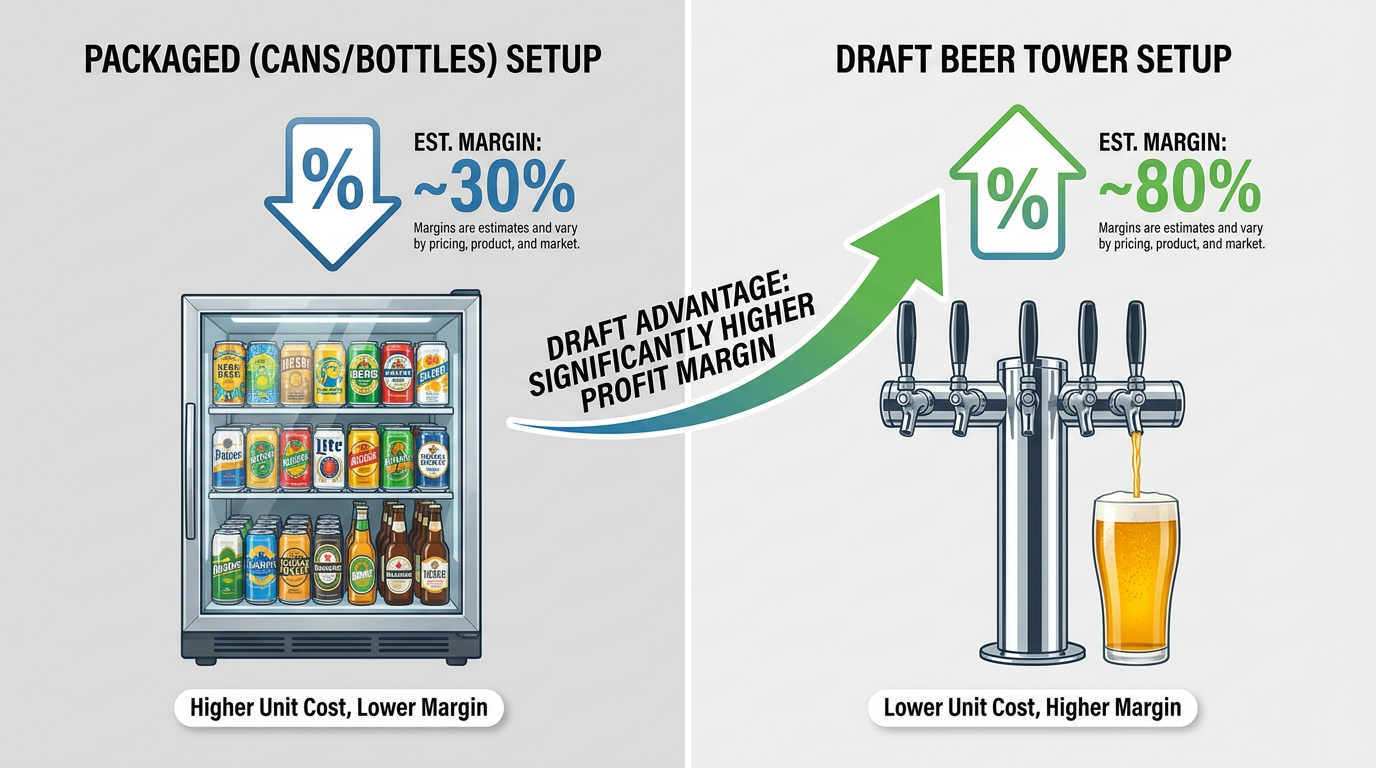
The packaged vs. draft margin comparison is also worth understanding clearly. Packaged beer (bottles and cans) carries higher unit cost per ounce served and lower gross margin per transaction. A 12oz can at a $4 retail generates a fundamentally different margin profile than a 16oz draft pint at $7 — even if the keg cost and can cost are nominally close. Draft wins on margin when volume is maintained and waste is managed. That’s the operating thesis, and the NIQ data on double value velocity for draft in mixed outlets confirms it.
Texas-specific context matters here too. Clarify Capital’s research shows that 37% of Texas bar operators reported alcohol sales drops in 2025. In that environment, chasing new volume is expensive and uncertain. Optimizing margin on existing volume — on the beer you’re already selling — is the more reliable lever. A 3% improvement in your pour cost percentage on existing draft sales is pure profit. No new marketing spend, no new staff, no new foot traffic required.
If you want to see how seasonal volume dynamics affect margin in the Texas market specifically, our piece on summer craft beer sales for Dallas operators is worth a read — particularly the section on managing margin through peak and shoulder seasons.
Benchmarks give you a target. But targets don’t build themselves — that takes intentional program design. Which brings us to the part of the conversation where pricing and math give way to strategy and craft.
Tap Handle Strategy & Seasonal Rotation: Building a Beer Program That Sells Itself
Every decision you make about what goes on your tap tower, where it goes, and when it rotates is a marketing decision. Not a procurement decision. Not a logistics decision. A marketing decision — one that directly impacts your per-visit check average, your guest return rate, and your draft revenue per square foot of bar space.
Here’s the starting point that reframes everything: 32% of on-premise purchase decisions are made at the bar itself, according to Boelter’s research on tap handle influence. Your guest walks up, scans the tap tower, and makes a choice. That moment — that visual sweep across your handles — is your primary point-of-sale interaction. Your tap tower is a menu. It’s a display. It’s a sales floor. Treat it like one.
The same research shows that attractive, distinctive tap handles can increase draft sales by up to 10% in the first three months of deployment. That’s a measurable ROI on a physical asset that most operators treat as furniture. Branded, well-maintained, visually compelling tap handles are a marketing investment with a direct line to revenue.
Placement strategy is where the real leverage lives. A few principles that the best-run bar programs follow consistently:
- Eye-level and first position matter. The first handle a guest sees anchors their decision. If you want to sell more of a particular beer — whether it’s your highest-margin pour or a local craft you’re featuring — put it where eyes go first.
- Group by style or story. Lagers together, IPAs together, or create a dedicated “neighborhood” section for local craft beers that tells a geographic story. Cohesion in your tap list communicates curation, and curation communicates quality.
- Feature your highest-margin pours in prime real estate. Not your cheapest keg. Not your most-recognized national brand. Your highest-margin pour. There’s a difference — and that difference compounds over thousands of transactions.
Seasonal rotation is one of the most underutilized revenue drivers in the Texas bar market. The mechanics are simple: rotating taps create urgency (“it’s only here through August”), generate repeat visits (“I heard you just tapped something new”), and give your staff a fresh conversation to have with every guest. That’s free marketing delivered by the people your guests already trust.
In the Texas seasonal calendar, the pattern is fairly consistent: lighter lagers, wheat beers, and sessionable styles dominate the spring and summer window — roughly March through September in DFW, when the heat is relentless and guests want something crushable. Darker styles, porters, bocks, and barrel-aged beers anchor the fall and winter rotation, when the weather finally breaks and guests are ready for something with weight and complexity.
Operators who rotate seasonals from local craft breweries — and build a reputation for it — create a “what’s new?” culture around their bar that keeps regulars coming back on a cadence that no static tap list can match. Bar & Restaurant’s expert coverage of profitable beer programs consistently points to seasonal rotation and local inclusion as key differentiators for bars that outperform their competitive set.
One practical financial note from Launch Advisor’s seasonal revenue research: budget 15–20% of your peak summer and holiday profits specifically to carry your program through slower rotation months. Seasonal revenue planning is as important as seasonal menu planning. The bars that manage this well don’t feel the slow months — they planned for them.
Staff education is the multiplier that makes tap handle strategy actually work at scale. Your bar team is your sales force. A staff member who can tell the story of the beer on tap — what style it is, how it tastes, what food it pairs with, who brewed it and why — closes the sale that the tap handle started. Invest in that knowledge. Make tasting sessions part of your onboarding. The return is measurable in average check size.
Want to see what a balanced tap list looks like between anchor year-round beers and rotating seasonals? Four Corners’ year-round lineup and limited seasonal releases are a practical reference point for what a Texas craft brewery’s full portfolio can look like on a well-curated tap list.
You’ve built the strategy. Now let’s make the case for the specific category — local craft draft — that will do the most work for your program in 2026.
The Craft Draft Advantage: Why Local Pours More Profit Per Tap
The consumer trend is unmistakable. Dollar sales for craft and imported draft beer jumped 8.1% in 2025, while packaged alternatives declined in the same period. Guests are moving toward quality, freshness, and experience — and draft is the format that delivers all three at once. But within the craft draft category, the highest-leverage move for a Texas bar operator isn’t just adding any craft tap. It’s adding a local one.
The Brewers Association’s 2025 industry review described last year as “a year of correction” for craft beer overall — a period of inventory rationalization, pricing normalization, and consumer selectivity. But the key insight buried in that narrative is that on-premise craft draft outperformed packaged craft significantly during the same period. The tap is where craft wins. The cooler is where craft loses. That’s a strategic signal operators can act on right now.
Why does local craft specifically outperform on margin and guest experience? There are a few distinct reasons, and they compound on each other.
No national distribution overhead baked into the price. Large national craft brands carry the cost of coast-to-coast distribution, marketing budgets, and retail placement fees. Local breweries don’t. That often translates into more competitive keg pricing for the operator — meaning you can hit a lower cost per pint while still delivering a premium product that commands a premium price. It’s a margin story, not just a quality story.
Community storytelling that sells itself. A local craft tap handle isn’t just a beer — it’s a story your staff can tell. The neighborhood it came from. The founders who built it. The inspiration behind the name. That story converts to a higher check average, because guests who feel connected to what they’re drinking linger longer, order more, and return sooner. SevenFifty Daily’s 2026 beer industry trend analysis consistently points to provenance and authenticity as the primary drivers of on-premise craft beer purchase decisions.
Guest loyalty that flows both directions. When a guest discovers a local beer at your bar — really discovers it, with a staff recommendation and a story — they often become loyal to both the bar and the brewery simultaneously. It’s a flywheel: the brewery brings its own community to your door, and your bar gives the brewery’s fans a place to gather. That’s the kind of symbiotic relationship that doesn’t show up in a cost-per-pint calculation but absolutely shows up in monthly revenue.
Genuine differentiation in a crowded market. In the DFW market — and across Texas broadly — the sports bar with five national draft taps is everywhere. There’s nothing wrong with nationals. But they don’t differentiate. A tap list that includes local craft, rotating seasonals, and styles with a story is a reason to choose your bar over the one across the street. Differentiation is margin protection. You can’t discount your way to loyalty, but you can story your way there.
“Consumers choose draft first for taste and freshness, making clean, well-maintained systems essential — not just for quality, but for profit.”
— Jennifer Hauke, Founder & CEO, Draftline Technologies
The demographics of craft draft are shifting in a direction that creates urgency for operators thinking about their guest mix. Female draft drinkers are up three percentage points year-over-year, now representing 36% of draft beer consumers. Younger adults and multicultural communities are underrepresented in the current craft draft consumer base but growing — and they represent the next decade of on-premise beer spending. Cultural-identity craft brands that speak authentically to these communities aren’t just telling a good story. They’re building the guest base of 2030.
For operators who want to communicate environmental values, local craft draft also delivers on sustainability in a concrete, communicable way. One keg eliminates approximately 1,100 bottles or cans of packaging waste. For a guest who cares about that — and an increasing number do — the math is part of the conversation your staff can have.
Since 2012, Four Corners Brewing has been crafting award-winning beer from Dallas, Texas. Beer that carries the identity, flavor, and community of this city in every pour. Putting a Four Corners tap handle on your bar isn’t just adding a SKU to your tap list. It’s bringing a decade-plus of brand loyalty, community goodwill, and craft credibility into your program. It’s the kind of partnership that the ROI analysis on local craft tap placements makes tangible in actual dollar terms.
If you’re ready to explore what that looks like in practice — from sourcing through distribution — our Texas craft beer distribution guide for bar owners walks through every step of how to get a local craft tap into your program.
The Draft Program You Build Today Pays for Tomorrow
Here’s what all of this comes down to: draft beer is the fastest-growing, highest-margin category in on-premise beer right now. Texas operators who build a smart, intentional draft program — one grounded in real pricing math, tight pour cost management, and a curated tap list that rotates with the seasons — win on volume, check average, and guest loyalty simultaneously.
The formula isn’t complicated. Know your pour cost. Price for your target margin, not your gut feeling. Plug the operational leaks before they compound. Build a tap list that has something to say — and train your staff to say it. Rotate seasonally to create urgency and earn repeat visits. And choose your craft partners with the same intentionality you’d bring to any other business relationship.
A local craft brewery that brings brand recognition, community loyalty, and consistent product quality to your tap line is worth more than the price on the keg invoice. It brings guests in the door, keeps them at the bar longer, and gives them a reason to come back. That’s the draft program you want. That’s the program that compounds.
Four Corners Brewing has been crafting Vida, Well Crafted out of Dallas since 2012. We’ve been on Texas tap lists through the highs, the lows, and everything in between — and we know what it means to be a partner, not just a supplier. Let’s build something profitable together.
Ready to Put Four Corners on Tap?
Let’s talk about getting the right beers into your program. Whether you’re building a draft list from scratch or looking to swap in a local craft that your guests will actually ask for by name, we’re here for it.