The ROI of Putting a Local Craft Beer on Your Restaurant’s Tap List
If a single tap handle could lift your average check, drive repeat visits, and upgrade your brand perception — what would that be worth to you?
That’s not a rhetorical question. It’s a P&L question, and most restaurant operators have never sat down to actually answer it. The conversation around craft beer in full-service restaurants has been dominated for years by bar owners, taproom operators, and beverage directors at cocktail-forward concepts. But this post isn’t for them. It’s for the GM of a 120-cover neighborhood restaurant who’s trying to squeeze more revenue out of every seat. It’s for the operator running a lunch-through-dinner patio concept who knows that the right beverage program can make a Tuesday feel like a Saturday. It’s for the director of operations who thinks in revenue per turn, check average trends, and 90-day P&L cycles.
Here’s the premise: most full-service restaurant operators are dramatically underestimating the financial return of a well-chosen, locally rooted craft beer program. Not because they don’t care about beverage — but because no one has laid out the math in operator language. Check average lift. Repeat visit multipliers. Staff upsell capture rates. Patio revenue per cover. Brand equity that shows up in your Google review score. These are the ROI levers that a strategic local craft tap handle moves — and this post is going to walk through each of them.
The brand at the center of this conversation is Four Corners Brewing Co. — Dallas’s own, established in 2012, Latino-owned, community-rooted, and brewing a portfolio that was built for real-world operator needs. Not novelty. Not hype. Beer that performs at the table, on the patio, and in the hands of a server who knows how to sell it.
The data makes the case. Let’s get into it.
The Check Average Math: What a Craft Pour Is Actually Worth Per Table
Numbers first. That’s how operators think, and that’s how this conversation should start.
The most persistent myth in the craft beer conversation is that higher pour cost equals lower profit. It sounds logical on the surface — craft beer costs more to purchase, so you’re leaving margin on the table compared to a cheap macro lager, right? Wrong. The math runs in exactly the opposite direction, and understanding why is the foundation of the entire restaurant tap list ROI argument.
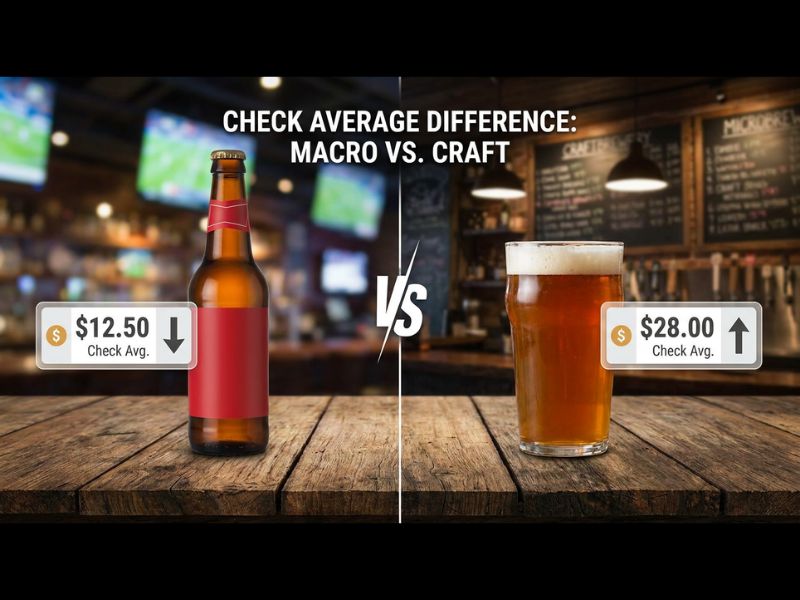
Let’s break it down. A macro beer — your standard domestic lager from one of the major conglomerates — typically carries a pour cost of around 29%. That sounds lean. But when you run the absolute numbers, that 29% pour cost on a $4–$6 retail price generates roughly $2.04 in profit per serve. Now look at craft. A well-priced craft pour carries a higher pour cost — approximately 44% — but because it retails for $8–$12 per pint, it generates approximately $2.97 in profit per serve. That’s roughly 45% more absolute profit per pint pulled compared to its macro counterpart. The percentage looks worse on paper. The dollars in your register tell a different story.
And the profit-per-serve math is only the beginning. When you zoom out to the table level, the impact compounds. A table of four where two guests order craft instead of macro generates an additional $8–$16 in beverage revenue in that single service — before you factor in any upsell from a second round, a food pairing recommendation, or a seasonal special. Multiply that across a dinner service with 30 covers, five nights a week, 48 weeks a year, and you’re looking at a material shift in annual beverage revenue from a menu decision that costs you nothing more than a tap handle and a server training session.
There’s another layer to this that goes beyond margin math: craft beer doesn’t just increase the profit per table — it puts people in the seats in the first place. The National Restaurant Association has found that 70% of consumers who drink beer, wine, or cocktails say the availability of alcoholic beverages directly influences their restaurant choice. Read that again: seven out of ten drinking-age guests are factoring your tap list into their decision about where to eat. Craft beer isn’t a nice-to-have on your menu — for a significant portion of your potential guest base, it’s a deciding factor in whether they walk through your door at all.
Now layer in the pricing dynamics. Craft beer guests are accustomed to paying $8–$12 for a well-made pint. They’re not shocked by that price — they expect it. That means there’s no pricing resistance to overcome, no guest hesitation to manage. When your server recommends a locally brewed IPA or a honey blonde from a Dallas brewery they can name and story-tell around, the guest doesn’t flinch at $10. They lean in. And that frictionless, higher-price-point purchase decision compounds across every table, every service, every week of the year.
The operators who capture this margin most effectively aren’t just stocking craft beer — they’re framing it correctly. Menu placement matters. Descriptive language matters. The way a server introduces a tap list matters. When craft beer is presented as a considered, curated choice rather than just another beverage option, guests respond with higher attachment rates and a willingness to order a second round. The first-table math looks good. The second-round math looks even better.
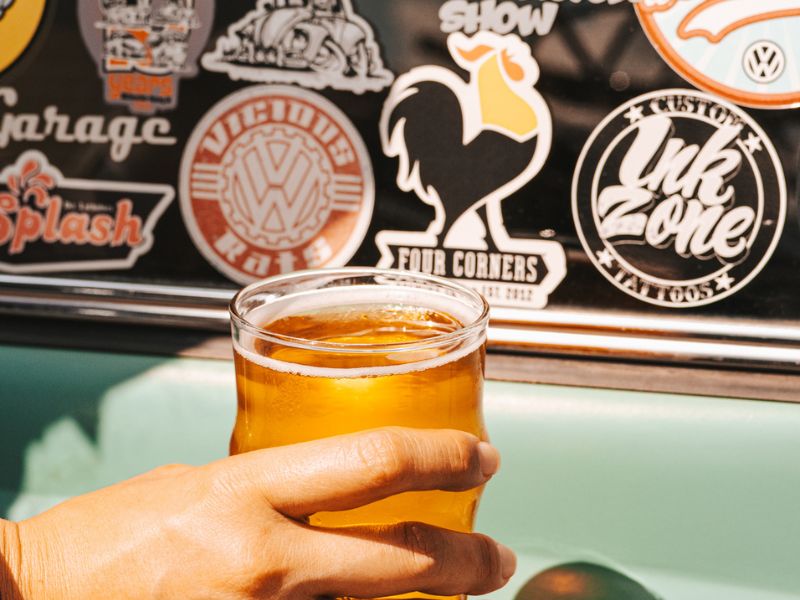
For Dallas operators specifically, Four Corners Brewing Co.’s year-round portfolio offers price points and styles that hit every segment of the dining room — from the sessionable lager drinker at the bar to the hop-forward IPA fan at the corner table to the guest who wants something completely different in the form of a fruit chelada. The range means operators aren’t choosing one craft style and hoping it appeals to the whole room. They’re choosing a portfolio with depth, built by a brewery that understands the Dallas palate.
The per-pour math is clear, and it’s compelling. But the real multiplier in this equation isn’t the first check — it’s what happens when the same guest walks back through your door next week.
Repeat Visits and Local Brand Loyalty: The Revenue Multiplier You’re Not Measuring
Single-transaction margin is a good story. Lifetime guest value is a great one.
Here’s what most restaurant operators are not measuring: the compounding revenue effect of a guest who becomes a regular. It sounds obvious when you say it out loud — of course regulars are more valuable than one-time guests — but the degree to which repeat visit economics outperform one-time guest economics is staggering, and it has direct implications for how you think about your tap list.
According to Circana data reported by Nation’s Restaurant News, restaurant loyalty traffic has doubled between 2019 and 2024. Loyalty members now account for 39% of total restaurant visits and make 22% more visits per year than non-members. That’s not a marginal difference — it’s a structural revenue advantage that accrues to operators who create experiences guests want to return to. And here’s the key insight: loyalty isn’t only manufactured through points programs and app-based rewards. It’s manufactured through experience anchors — things that are unique to your restaurant, that a guest associates with a good time, that they think about when they’re deciding where to go on a Thursday night.
A beloved local craft beer is one of those anchors.
When a guest discovers Four Corners’ Local Buzz for the first time at your restaurant — a honey blonde brewed with Texas-sourced honey that’s smooth, food-friendly, and genuinely refreshing — that becomes part of their memory of your place. It becomes a conversation piece they bring up with friends. “Oh, you should go there — they pour Local Buzz, you know, the one from that Dallas brewery.” That guest doesn’t just come back themselves. They bring people. And when they come back, they bring the context of their prior experience, which means they’re already predisposed to order, to engage, and to spend.
“Regular customers drive 6X more revenue for local businesses. A familiar craft beer on your tap list is a loyalty signal — not just a line item.”
That 6X figure comes from Square’s 2026 Local Economy Report, which quantifies something operators intuitively understand but rarely measure: the lifetime revenue difference between a one-time visitor and a regular is enormous. Six times. That means converting even a small percentage of first-time guests into regulars has an outsized impact on your annual revenue — one that dwarfs what you’d gain from a short-term promotional discount or a one-time marketing push.
The “local” dimension of this loyalty effect is particularly powerful and deserves its own examination. A Marketing Science study found that consumers exhibit a 15% drop in baseline product demand when their favorite local craft brand gets acquired by a larger company. Why does that matter? Because it proves that the “local” identity carries genuine, measurable consumer loyalty — loyalty that cannot be manufactured by a national brand with a local marketing campaign. When guests see a beer on your tap list from a brewery they know is genuinely from their city, they feel a connection that a macro brand simply cannot replicate. It’s not nostalgia. It’s identity. And identity drives behavior in ways that price promotions cannot.
Four Corners Brewing Co. has been building that identity in Dallas since 2012 — thirteen-plus years of community presence, neighborhood events, local partnerships, and a brand that Dallas residents have grown up with. Operators who carry FC beer on tap aren’t just adding a product. They’re inheriting an audience. Four Corners’ loyal fans are already in Dallas, already dining out, already making decisions about where to spend their restaurant dollars. When they see your restaurant carrying the beer they love, you’ve already won a significant portion of the loyalty battle before they even sit down.
The math on repeat visits is compelling enough to justify a tap line decision on its own. But loyalty and repeat visits are driven by something deeper than product availability — they’re driven by perception, identity, and the story your restaurant tells about itself. That’s where the conversation shifts to brand.
Brand Perception Uplift: How Carrying Local Craft Elevates Your Restaurant’s Identity
There’s a version of this conversation that lives entirely in spreadsheets — pour costs, check averages, visit frequencies. That version is important, and we’ve covered it. But there’s another version that lives in the mind of your guest before they’ve even sat down, and it’s equally important to the long-term health of your restaurant business. That version is about perception.
Today’s dining guest — especially the 25–45 demographic that drives full-service restaurant revenue — is not a passive consumer. They are actively making choices about which establishments reflect their values, their sense of place, and their identity. Experience-driven dining is not a trend that’s going to recede. It’s the dominant consumer mode, and it has fundamentally changed what guests are evaluating when they choose a restaurant. They’re not just evaluating the food. They’re evaluating whether the restaurant feels like it belongs to their community, whether it cares about quality in a meaningful way, and whether it has a story worth telling.
Featuring a local craft beer on your tap list communicates several things simultaneously, without you having to say any of them explicitly. It says: We are selective about what we serve. It says: We care where our products come from. It says: We are part of this city, not just operating in it. These are powerful brand signals, and they travel — through word of mouth, through social media posts, through the Yelp review that mentions “loved the local beer selection,” through the Instagrammed pint that tags your restaurant and the brewery in the same moment.
The data supports this. Beverage Industry’s 2024 Beer Report confirms that local and regional craft brands are outperforming broader craft industry trends by carving out authentic consumer niches that mass-market brands cannot penetrate. Operators who align with that momentum benefit from what might be called borrowed brand equity — the credibility and goodwill that a respected local brewery has built over years of community engagement transfers, at least partially, to the establishments that choose to serve their beer. You’re not just adding a tap handle. You’re making a statement about the kind of restaurant you are.
In Dallas specifically, the market signals are unmistakable. CRAFT Restaurant & Beer Market opened in April 2026 with more than 100 taps and 500 seats — a significant capital investment that would not have been made without strong evidence of consumer demand for craft-forward dining experiences in this market. Dallas guests are not only ready for a quality craft beer program — they are actively seeking it out. Operators who build their tap lists accordingly are riding a current that is already moving in their direction.
Four Corners is more than a well-made beer — it is a Dallas story with genuine cultural depth. Founded in 2012 and Latino-owned, the brewery has been a fixture in the community through all of the city’s transformations over the past thirteen years. The brand carries a narrative around Latino culture shaping the future of Texas craft beer — a story that adds a layer of meaning and authenticity to your menu that no macro import, no matter how aggressively marketed, can match. When your guests learn that the beer in their glass was brewed by a community-rooted Dallas brewery with a genuine story behind it, that experience becomes richer. The pint tastes the same. The moment means more.
And meaning, in the modern restaurant landscape, translates directly into reviews, social shares, referrals, and the kind of word-of-mouth that no advertising budget can fully replicate. Brand perception is not soft ROI — it is the upstream driver of every hard metric that follows: new guest acquisition, table conversion rates, repeat visit frequency, and review score trends. The operators who understand this are the ones who treat their tap list as a brand statement, not just a beverage inventory decision.
Brand perception only pays out, however, when the people in your dining room know how to bring it to life. Which is exactly where we go next.
Staff Storytelling as a Revenue Engine: Training Your Team to Sell Local Craft
The tap handle is in. The beer is cold. The pour cost math checks out. Now the question is: can your team actually sell it?
This is where a significant portion of potential craft beer ROI gets left on the table in full-service restaurants. Not because operators don’t believe in their beverage program — but because the bridge between a great product and a meaningful upsell is a well-prepared server, and that preparation often gets compressed into a tasting note on a laminated card that no one reads. The opportunity is much larger than that, and the bar to capture it is lower than most operators think.
Let’s start with the data. According to research compiled by NineGuides on server upselling techniques, well-trained servers who effectively recommend and upsell can boost revenue by 10–15% per table. Not per shift. Per table. That means on a $60 average check, the difference between a server who engages and one who doesn’t is $6–$9 per table. Across a dinner service with 25 tables, that’s $150–$225 in additional revenue — generated not by lowering food costs or running a promotion, but by equipping your floor team with the tools to have better conversations.
Craft beer — especially local craft with a compelling backstory — is uniquely well-suited to this kind of naturalistic, non-pushy upselling. Here’s why: guests don’t feel sold to when a server tells a story. They feel taken care of. There is a fundamental difference between a server who says “Can I get you something to drink?” and one who says “We pour El Chingón IPA from Four Corners — they’ve been brewing in Dallas since 2012 and it’s one of our most popular pints. Can I start you with one of those or the Local Buzz if you want something a little more approachable?” The second interaction doesn’t feel like a sales pitch. It feels like a recommendation from someone who knows the menu and wants the guest to have a great experience.
FSR Magazine’s reporting on targeted staff training shows that even short, focused two-minute pre-shift briefings on new beers or specials meaningfully improve staff confidence and upsell acceptance rates. The training investment is minimal. The return is measurable. And the content almost writes itself when you’re working with a brewery that has a real story to tell.
Here’s what a basic Four Corners server training module looks like in practice:
- The Brewery: Four Corners Brewing Co., Dallas, TX. Est. 2012. Latino-owned, community-rooted. One of Dallas’s most established independent craft breweries.
- The Pour: El Chingón IPA — bold, hop-forward, citrusy. For the guest who likes beer with character.
- The Pour: Local Buzz Honey Blonde — smooth, refreshing, brewed with Texas honey. For the guest who wants something approachable and food-friendly.
- The Pour: Chingón Especial — 4.0% ABV lager, crisp and clean. For the guest who wants a full round without slowing down.
That’s four bullet points. That’s a pre-shift card. That’s the foundation of a server training program that can be implemented before tonight’s dinner service. According to HubPlate’s 2026 restaurant upselling strategy guide, the most effective upselling happens when servers make specific named recommendations — not “can I get you a beer?” but “Can I start you with the Local Buzz? It pairs beautifully with what you’re having.” Specificity signals confidence. Confidence drives acceptance. Acceptance drives revenue.
Operators who want to track this over time should be measuring three things: upsell acceptance rate by server (which server is closing the craft recommendation most effectively?), average craft beer rings per shift (how many craft pints are going out per service?), and table-level beverage attach rate week over week (are more tables ordering a beverage at all, and is the average ring going up?). These are not complicated metrics. They live in your POS system. They just need to be pulled and reviewed with intention — and when they start moving in the right direction after a craft beer program launch, the story they tell is a compelling one.
Your floor team is your most powerful in-room revenue engine — but there’s another revenue window that many full-service restaurants are significantly underutilizing, particularly as summer approaches: the patio.
The Summer Revenue Opportunity: Patio Programs and Sessionable Craft Beer
Dallas summers are not gentle. The heat arrives in force and stays through October, and yet — somehow, defiantly — Dallas patios pack out all summer long. Because outdoor dining in this city isn’t about comfortable temperatures. It’s about the experience, the atmosphere, the feeling of being part of the city’s energy on a warm Friday evening. And the beverage that defines that patio experience, more than any cocktail or wine, is a well-chosen, cold, sessionable craft beer.
This is a particularly timely conversation as summer 2026 arrives in full force. Operators who haven’t yet built a patio-optimized tap strategy are leaving real money behind — and the solution is more straightforward than most realize.
The key concept here is sessionability — a term from the brewing world that translates directly into operator economics. Sessionable craft beers are typically in the 4–5% ABV range: flavorful and interesting enough to be worth ordering, but light enough that guests can have two or three over the course of a patio afternoon or a long weekend lunch without tipping into territory where they’re done for the day. That distinction matters enormously for per-table revenue. A guest who drinks one craft beer and switches to water generates one ring. A guest who orders two rounds of a sessionable craft lager generates two rings — at the same $8–$12 price point. On a patio with 40 covers running a three-hour lunch service on a Saturday, the difference between one round per table and 1.5 rounds per table is significant top-line beverage revenue generated purely by portfolio strategy.
Four Corners has two portfolio workhorses built specifically for this daypart. Chingón Especial is a 4.0% ABV lager — crisp, clean, and genuinely engineered for heat. It’s not a compromise beer. It’s a precision-brewed lager that delivers full flavor at a sessionable ABV, which means guests can comfortably have two or three without overthinking it. Local Buzz, at 5.0% ABV, is the honey blonde option — brewed with Texas-sourced honey, refreshingly smooth, and exceptionally food-friendly. These are not novelty craft releases. These are year-round anchors built for the Dallas market, and they perform on a patio in a way that heavier IPAs or barrel-aged styles simply don’t.
The food-and-beer pairing dynamic is particularly powerful in patio settings. Secret Hopper’s 2025 data on taproom food programs confirms that food options paired with beer lead to higher tabs, longer visits, and increased retention — exactly the dynamic that plays out on a restaurant patio where guests are settling in for a leisurely afternoon meal. A table that pairs their Chingón Especial with a plate of tacos or a burger isn’t just spending more — they’re staying longer, which means the table turns more slowly but generates more total revenue per cover. On a patio, where the ambient experience is part of the value, that longer dwell time is a feature, not a problem.
For operators who want to extend the craft conversation beyond the patio, Four Corners’ take on the lager renaissance is worth exploring — it provides context for why sessionable lagers are having a significant cultural moment right now, and why smart bar and restaurant operators are getting ahead of the curve by featuring them prominently on their tap lists.
Summer is not a season to wait on. The patios are filling up, the heat is here, and the guests who will define your Q3 revenue numbers are making dining decisions right now. The question is whether your tap list is working for them — or leaving them settling for something less interesting. With the revenue levers now fully mapped, let’s put them together into a framework you can actually take to your next P&L meeting.
Build Your Own ROI Case: A Framework for Restaurant Operators
This is the section to bookmark. Not because it’s the most interesting — though we’d argue it is — but because it’s the most actionable. Everything covered so far in this post is real, evidence-backed, and operator-relevant. But data without a framework is just reading. A framework turns reading into a decision. And for most restaurant GMs, the decision about whether to invest in a craft beer program needs to be justified internally — to an owner, a corporate partner, or a finance review — before it can be implemented.
Here’s a six-step, back-of-napkin ROI model that any operator can run with their own POS data in under an hour. No spreadsheet required. Just clear logic and honest numbers from your own operation.
Step 1 — Baseline your current beverage attach rate.
Pull two numbers from your POS: what percentage of dining tables currently order at least one beer, and what’s your average beer ring per table that does order? This is your starting point. If 40% of your tables order beer and the average ring is $5.50, you have a clear baseline to measure against.
Step 2 — Model the craft premium.
Now estimate: if you convert X% of your current beer orders from macro ($5–$6 price point) to craft ($9–$11 price point), what does that shift do to your weekly beverage revenue? Use the real numbers from Section 1 — roughly 45% more absolute profit per pint. Even if only 30% of your beer orders shift toward craft, the absolute dollar impact on a weekly basis is likely to surprise you.
Step 3 — Factor in the loyalty multiplier.
If launching a distinctive local craft program converts even 10% of first-time guests into repeat visitors — guests who, per Circana data, will visit 22% more frequently than non-loyalty guests — what does that cohort generate over 12 months? Calculate your average guest check, multiply by the additional visit frequency, multiply by the size of your new-guest pool in a given month. The number will be significant.
Step 4 — Staff upsell impact.
How many tables does your floor team turn per shift? How many shifts per week? If well-trained servers lift check averages 10–15% on tables where they actively engage a craft beer recommendation, how many of those tables can realistically convert each night? Conservative math: even 8 of 30 tables per service generating an additional $8 in beverage revenue equals $64 per service, $320 per week, over $15,000 per year — from training alone.
Step 5 — Patio and seasonal volume.
For operators with outdoor seating, calculate your average patio covers per summer month. Model the difference between 1.0 rounds per table and 1.5 rounds per table in sessionable craft, at your craft price point. That 0.5 additional round per table, at $10 per pint, on a patio doing 200 covers on a Saturday, is $1,000 in additional beverage revenue from a single summer day.
Step 6 — Brand value: qualitative, but trackable.
Set a baseline Google review sentiment score today — specifically, note how frequently words like “local,” “atmosphere,” “great beer selection,” and “vibe” appear in your current reviews. Launch a Four Corners craft program. Pull the same data 90 days later. The shift in language — and in star ratings — is a real, trackable signal of the brand perception uplift that local craft beer delivers.
This isn’t a hypothetical model. It’s a six-input logic chain that maps directly to data you already own — your POS history, your review platform, your table count, your server performance data. The only thing this model requires is the decision to run it.
The broader market context is worth naming here as well. BeverageDaily’s analysis of 2025 US craft beer market data shows that even as overall beer volume faces pressure, craft beer — particularly local and regional brands — continues to grow its share of the total market. Consumers are trading up in quality even as they may be drinking slightly less in volume. That’s a favorable dynamic for a restaurant operator whose craft beer program is designed around thoughtful, quality-first selections that guests are willing to pay a premium for. The operators moving toward local craft right now are not chasing a trend. They’re positioning for where the market is going — and they’re doing it while the window of differentiation is still open.
Four Corners’ Brew Finder is a practical first step for any Dallas-area operator who wants to confirm availability and begin a conversation. And for those ready to explore what a formal tap partnership looks like, the Four Corners contact page is where that conversation starts.
The model is in your hands. The numbers are yours to run. Let’s close with the only question that actually matters: what are you waiting for?
The Best Tap Decision You Make This Summer
Six levers. One clear conclusion.
A strategic local craft beer program — built around the right portfolio, supported by trained staff, and anchored to a genuine community brand — generates measurable, compounding revenue across every dimension of your restaurant’s operation. Check average lift through craft pricing power. Repeat visit loyalty from local brand equity that no macro can manufacture. Brand perception upgrades that show up in your reviews, your social presence, and the way new guests talk about your restaurant before they’ve ever visited. A floor team that converts table conversations into consistent upsell revenue. Summer patio programs built around sessionable craft that drives rounds, dwell time, and cover-level revenue. And a six-step framework that turns all of it into a number you can defend in any P&L review.
Four Corners Brewing Co. is the Dallas-native craft partner that makes this case in real, operator-ready terms. Thirteen-plus years in this city. A portfolio — Local Buzz, El Chingón, Chingón Especial, Pinchelada! — that was built to perform at the table, on the patio, and through the server who knows how to tell its story. A brand that arrives at your restaurant already carrying loyal Dallas fans who are looking for it. And a brewery team that understands the operator relationship, not just the liquid.
The best tap decision you make this summer might also be the best brand decision your restaurant makes all year. The math is clear. The market timing is right. The partner is ready.