

Vida Well Crafted: How Latino Culture Is Shaping the Future of Texas Craft Beer
Picture this. It’s a Thursday evening in The Cedars, just south of downtown Dallas. The Texas sky is doing that thing it does — burning amber and pink at the edges before it gives way to a deep, star-scattered blue. You pull open the door to a building that used to stable horses for the old Ambassador Hotel. Inside, the air smells like hops and history. A bartender slides a glossy black can across the bar. El Chingón IPA. Seven-point-three percent. Seventy-two IBUs. Named after you.
This is Four Corners Brewing Co. — a Latino-owned craft brewery born in Dallas in 2012, built from a kitchen stove and a lot of ganas, and now one of the most culturally significant independent craft breweries in Texas. But this story isn’t just about great beer, although the beer is undeniably great. It’s about what happens when a community that has always loved beer finally decides to own the brewery. It’s about a group of guys from Oak Cliff who looked at an industry that didn’t look like them and said, ¿Y qué? and built something extraordinary anyway.
The Vida Well Crafted philosophy — dedicated to individuals who artfully craft their life’s journey and uniquely express their joy to the world — is the organizing idea behind everything Four Corners does. It’s in the beer. It’s in the packaging. It’s in the film series that won 14 Telly Awards. And it’s in the broader cultural movement of Latino brewers who are not just participating in the Texas craft beer scene but actively architecting its future. This is that story.

Latino Craft Brewery Ownership: Why the 2.2% Number Changes Everything
Before we go further into the story of Four Corners, it’s worth pausing to understand the landscape they walked into — because context is everything here. The craft beer industry in the United States has always told a particular kind of story about itself: independent, rebellious, adventurous, the antithesis of the corporate beer machine. And in many ways, that story is true. But there’s a gap in it. A very significant one.
According to demographic benchmarking data published by the Brewers Association — the most comprehensive study of U.S. craft brewery ownership demographics to date — only approximately 2.2% of craft brewery owners identified as Hispanic, Latino, or of Spanish origin as of 2021. That’s not a typo. In an industry that prides itself on diversity of flavor and thought, 93.5% of brewery owners were white. The industry’s much-celebrated independence had, for decades, largely been an independence that looked a very particular way.
Now set that 2.2% against the broader reality: Hispanic and Latino Americans make up roughly 19% of the U.S. population. In Texas — the state with the second-largest craft beer market in the country — that figure climbs to nearly 40%. Latino consumers represent one of the largest and fastest-growing segments of U.S. beer drinkers. The demand has always been there. The people have always been there. The culture, the love of gathering, the tradition of la chelada and cold beer on a hot day — all of it has always been there. What hasn’t been there, in proportional numbers, is Latino ownership. Latino decision-making power. Latino stories told from the tap.
The gap between working in the industry and owning a piece of it is a familiar story across many sectors of the American economy. But in craft beer, it carries a particular irony. The craft revolution was supposed to be the democratization of beer — a movement away from the monopolistic control of a few mega-corporations toward neighborhood-level, community-rooted, values-driven brewing. And yet the ownership class of that revolution replicated many of the same demographic exclusions it was supposedly rebelling against.
That’s not a polemic. It’s a setup. Because the point is not just to name the gap — it’s to celebrate the people filling it. Latinas and Latino entrepreneurs who have entered the craft brewing space are not just opening businesses. They are doing something more profound: they are performing an act of cultural reclamation, bringing their flavors, their language, their people, and their pride into a space that was not architected with them in mind. They are making the “craft revolution” live up to its own name.
“2.2% of craft brewery owners identified as Hispanic or Latino — dramatically underrepresented compared to the Latino share of the U.S. population.”
— Brewers Association Owner Demographic Benchmarking Data, 2021
In Texas, where craft beer produced over 1.369 million barrels in 2024 even in a year of headwinds, the stakes of who gets to own and tell their story in this industry are enormous. And no single brewery illustrates the stakes — and the possibility — more vividly than Four Corners Brewing Co. in Dallas. They didn’t wait for the industry to open the door. They built their own. Starting, as it happens, with a kitchen stove.
From a Kitchen Stove to a Dallas Icon: The Four Corners Origin Story
Every great brewery has an origin myth. The eureka moment in the basement. The first keg tapped at a backyard party. The quit-your-job-and-bet-on-yourself leap. Four Corners has all of those beats — but the version they lived is more real, more neighborhood-rooted, and frankly more chingón than most.
It starts in 2004. Not in a professional brewhouse. Not in a culinary school. Over a kitchen stove. Five gallons of extract beer, fermented in a bathroom tub. By their own admission, that first batch “delivered more chingo-vibe than flavor.” But there was something in it — some combination of ambition, curiosity, and the simple joy of making something with your hands — that stuck. They kept going.
Batches got bigger. Equipment upgraded. The kitchen gave way to the home garage, which became a proper homebrewing operation. By 2010, they were winning homebrew competitions. That’s a six-year arc of showing up, learning, failing, adjusting, and getting better — the exact definition of a vida well crafted, before that phrase ever became a tagline.
The founders — George Esquivel, Greg Leftwich, and Steve Porcari— were longtime friends who shared a neighborhood, a love of craft beer, and a vision for what a Dallas brewery could look and feel like. By 2012, the conversations that happen naturally over homebrew batches — what if we actually did this? — had become a real plan. They put pen to paper, assembled the courage, and opened Four Corners Brewing Co. in their Dallas neighborhood, taking over a space that had been an old mechanic shop. The locals called it “Salazar’s Garage.”
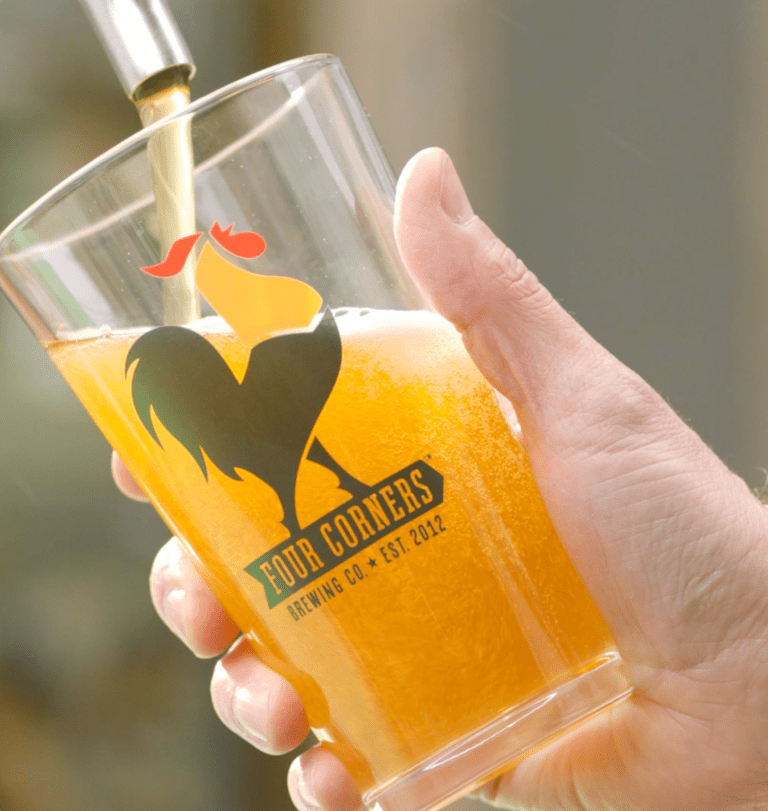
The name Four Corners was not the result of a branding workshop or a naming agency. It came from an actual intersection in their neighborhood. In their words: “The place simply had a unique cultural vibe. It was colorful, diverse, and inclusive.” The name was a map coordinate before it was a brand name. That matters — because every element of the brand that followed, from the Lotería-inspired packaging to the rooster weathervane logo (described as “a yard bird, but proud bird”), to the natural Spanglish voice of all their copy, came from the same place. These were not design choices. They were expressions of identity.
“The name of our brewery was inspired by an intersection in our neighborhood. The place simply had a unique cultural vibe. It was colorful, diverse, and inclusive.”
— Four Corners Brewing Co.
By 2016, something remarkable had happened: they outgrew their original home in just five years. For a startup brewery operating out of a converted mechanic shop in a Dallas neighborhood, that kind of growth is extraordinary. It also created a problem — no room to expand, no option to buy. So they searched for a new home. They found it in The Cedars, just south of downtown Dallas, in a building with its own history: a former horse stable to the Ambassador Hotel. They opened at their current location in 2017.
The move to The Cedars brought Four Corners into a neighborhood that was itself undergoing a renaissance — a culturally diverse, historically rich pocket of South Dallas with deep roots and a growing creative energy. It was, in many ways, the perfect address for a brewery whose whole identity was built on neighborhood belonging and cultural pride. The building that once housed the Ambassador Hotel’s horses now houses one of the most distinctive taprooms in Texas, and the “Vida Well Crafted” philosophy — dedicated to those who artfully craft their lives — moved with them into a space that would become a genuine community institution.
The founding story of Four Corners is not just inspiring because of the entrepreneurial grit it represents — though it is that. It’s inspiring because of what it proves: that authenticity is an ingredient. When the people who build something are genuinely the people that something is for, the result is different. You can taste it, literally and figuratively. And the beers that Four Corners built from that foundation are worth examining closely, because the cultural DNA runs all the way through them.
Culture in a Can: How Latino Identity Shows Up in Every Drop
There’s a version of cultural branding that lives only on the label. The font changes, the colors get warmer, maybe a Spanish word appears somewhere in the marketing copy, and that’s it. The liquid inside is unchanged. The people making decisions are unchanged. The story is performance, not identity.
That is emphatically not what Four Corners does. Their Latino identity isn’t a design element layered on top of the product. It runs through the product itself — through the names, the flavors, the ingredients, the attitude, and the voice. When you crack open an El Chingón IPA, you are not drinking a beer with a culturally adjacent label. You are drinking a beer that was conceived, named, and crafted by people for whom chingón is not a marketing word — it’s a lived value.
El Chingón IPA: The Flagship That Started a Conversation
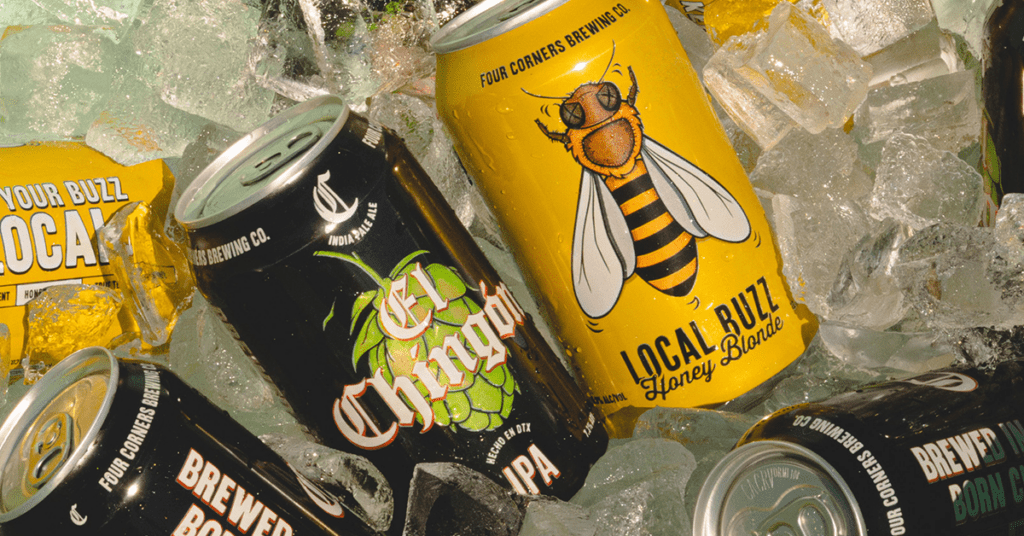
Let’s talk about the beer. El Chingón — 7.3% ABV, 72 IBU — is the flagship. The name carries serious cultural weight in Mexican and Chicano tradition. A chingón is not just someone who is badass. It’s someone who shows up fully. Someone who has earned their confidence. Someone who is the best at what they do not through arrogance but through preparation, dedication, and real excellence. To call your IPA El Chingón and then print “WE NAMED IT AFTER YOU” on the label is a statement of cultural respect. It’s the brewery saying to its community: this beer is worthy of you, and you are worthy of it.
The brewing itself backs up the name. El Chingón is built on a powerful blend of seven American C-hops — Cascade, Centennial, Chinook, Citra, Cluster, Columbus, and Crystal — delivered via the Falconer’s Flight 7C blend in a late-boil addition, with the boil itself amped up by Columbus, Cascade, and Centennial. A final whirlpool of Santiam bridges the robust malt bill to the hop character, and the whole thing is dry-hopped for what the brand brilliantly calls aromatic intensidad. The result is a full, pleasantly hoppy IPA with piney and floral notes, anchored by a Munich malt backbone that keeps it balanced and drinkable. This is not a beer that hides behind its name. It earns it.
“WE NAMED IT AFTER YOU.”
— Four Corners Brewing Co., on El Chingón IPA
Local Buzz Honey Blonde: The Neighborhood in a Glass
If El Chingón is the declaration, Local Buzz Honey Blonde is the welcome. At 5.0% ABV and 20 IBU, it is one of the very first beers Four Corners ever brewed, and the fact that it has remained in the year-round lineup ever since says everything you need to know about what it represents. This is not a legacy beer kept around out of sentiment. It is a foundational beer that has earned its permanent seat at the bar.
Local Buzz is brewed with Texas-sourced honey — a choice that is both a flavor decision and a statement of place. The honey brings a floral warmth and a delicate sweetness that never tips into cloying territory, balanced by a clean rye malt finish that gives the beer just enough edge to keep things interesting. The result is a golden ale that is crisp, approachable, and deeply refreshing — the kind of beer that works at 2pm on a hot Texas afternoon and still works at 9pm when the patio has come alive with conversation.
The name is not an accident. Local Buzz is the energy of a neighborhood — the hum of activity, the warmth of familiar faces, the particular electricity that a community generates when it is fully alive and fully itself. Four Corners named this beer after the feeling of The Cedars, of Oak Cliff, of the Dallas neighborhoods that shaped the founders and gave the brewery its reason for being. Every can is, in that sense, a love letter to the block.
For a newcomer to Four Corners, Local Buzz is the perfect introduction. It does not demand anything from you. It simply invites you in, pours itself out with quiet confidence, and lets you understand — in the most direct and delicious way possible — exactly what this brewery means when it says Vida, Well Crafted. Craft is not always loud. Sometimes it’s a golden beer on a sunny patio, and you realize you are exactly where you belong.
Pinchelada! Chelada: A Mexican Tradition, Elevated
Pinchelada! is the celebration. The chelada — beer meets fruit, citrus, salt, and spice — is a deeply rooted Mexican drinking tradition that long predates the craft beer movement’s interest in fruit-forward flavors. Four Corners didn’t borrow the concept from a trend report. They grew up with it. And they brought it into the craft category with the full respect and creativity it deserves.
The Pinchelada lineup (4.5% ABV, 13 IBU) includes Cantarito, Tropicante, Piña Picante, and Limón y Chile — each a fruit-flavored chelada brewed with natural fruit flavor and a hint of chile pepper. They are, in the brand’s words, “crisp, delicious, and refreshingly diferente.” That last word — diferente — isn’t just Spanglish copy. It’s an honest self-description. These beers occupy a category that the mainstream craft industry had largely overlooked, serving a flavor profile that millions of Latino beer drinkers already knew and loved but rarely found in craft packaging.
The Rest of the Year-Round Lineup
The year-round portfolio also includes Chingón Especial Lager (4.0% ABV, 6.6 IBU) — a direct nod to the Mexican lager tradition. It’s a deluxe, crisp, clean lager with light hop character, elevated to craft standards. The tagline says it perfectly: “Brewed in Texas. Born Chingón.”
What ties all of these beers together is not just a visual aesthetic or a brand voice. It’s a point of view. The Spanglish copy (¡Órale!, todo chingón, aromatic intensidad, un puro pari de cerveza, refreshingly diferente) is not a style guide affectation — it is the natural language of the people who built this brewery. The Lotería-inspired packaging and the rooster weathervane logo are not cultural references borrowed for appeal — they are expressions of a genuine cultural identity that predates any branding conversation. Four Corners was doing Latino craft beer before it was a trend, because they were never doing it as a trend. They were doing it as a life.
The beer tells the cultural story loudly and clearly — but the story of Four Corners also includes a chapter that tested the brand’s independence and ultimately proved what it was made of. That chapter begins in 2018.
Independence Is the Ingredient: Reclaiming the Brewery, Reclaiming the Story
In July 2018, Four Corners Brewing Co. was acquired by Constellation Brands — a Fortune 500 beverage alcohol company and one of the largest beer importers in the United States, with flagship brands including Corona, Modelo Especial, and Pacifico. On paper, the fit made a certain kind of sense. Constellation had deep ties to the Mexican beer market, and Four Corners brought a “bicultural (Hispanic and American)” identity, a distinctive brand voice, and a record of impressive growth — sales had grown five-fold since 2014, and production capacity had expanded from 8,000 barrels in 2016 to 25,000 barrels in 2017. The acquisition gave Four Corners access to distribution infrastructure and capital that independent craft breweries typically can only dream about.
Co-founder George Esquivel spoke enthusiastically about the partnership at the time: “We like to say that Four Corners Brewing is our collective beer journey, and partnering with Constellation continues that journey by opening amazing possibilities of where our brand and company can go.” And from a pure business mechanics standpoint, those possibilities were real. Greater shelf presence. Expanded markets. The kind of logistical muscle that moves product across state lines.
But there is something about a community-rooted brand that doesn’t translate cleanly into a corporate portfolio, no matter how well-intentioned the acquisition. The Spanglish voice, the Lotería packaging, the “WE NAMED IT AFTER YOU” ethos — these things did not come from a brand strategy document. They came from real people with real roots in a real neighborhood. When the people who created those things are still the ones making decisions, the brand breathes authentically. When they operate inside a corporate structure with different incentive systems and a different primary audience, something shifts. It’s subtle at first. But it’s real.
In 2023, the original founders reacquired Four Corners Brewing Co., returning it to independent, community-owned operation. The brewery came home.
Independence is not just a business status. For Four Corners, it is an essential ingredient.
What that reacquisition represents goes beyond a legal transaction. For a brewery built on neighborhood identity, cultural expression, and genuine community belonging, independence is not an abstract value — it is an operational one. Every decision that comes from inside the brand — what beers to brew, what stories to tell, who to partner with, which communities to show up for — is shaped by who is making it. When George Esquivel, Greg Leftwich, and Steve Porcari are in the room, those decisions carry the accumulated weight of everything that Four Corners was built to be. That is not replicable at scale inside a corporate structure. It’s site-specific. It’s neighborhood-specific. It’s people-specific.
The story of the Constellation acquisition and reacquisition is not a cautionary tale about selling out or a grievance about corporate beer. It is something more nuanced and, ultimately, more triumphant: it is the story of a brand that knew what it was, kept being what it was, and ultimately chose to come back to itself. In the broader context of Latino-owned businesses navigating an economy that has historically made ownership difficult — through access to capital, distribution challenges, and market access barriers — the act of reacquiring the brewery is a statement about who gets to own their story. Four Corners chose ownership. Chose the neighborhood. Chose the community. That choice is, in the brand’s own vocabulary, todo chingón.
With independence reclaimed and the brand more authentically itself than ever, the story expands outward — from the brewery to the community it has always been built for, and to the creative work that demonstrates, in vivid and award-winning form, exactly what it means to live a vida well crafted.
Más Que Cerveza: Community, Culture, and the Vida Well Crafted Film Series

Some breweries make great beer. A smaller number of breweries become genuine community institutions — places where the beer is almost secondary to what it facilitates: connection, belonging, story, and the particular kind of joy that comes from feeling like a place was made for you. Four Corners has always aimed to be the second kind. And nowhere is that ambition more vividly realized than in the Vida, Well Crafted short film series.
Vida, Well Crafted is not a marketing campaign. It is an episodic series of short films that profiles real people living distinctive, community-rooted, passionately crafted lives — lives that embody the brewery’s central philosophy without ever being about the brewery. Episodes have featured Spinster Records (a beloved Dallas independent record shop), Sandwich Hag (the celebrated Vietnamese-American restaurant in The Cedars), stories from the Rio Grande Valley, Germán Madrazo (an Olympic cross-country skier from Mexico who became the first Mexican to complete the Olympic biathlon), Kelly Harris “The Godfather,” Conquista (multidisciplinary artist and activist Uriel Landeros), and the Piñata Man. Each film is, at its core, a love letter to a person who has done something remarkable with their life in a way that is entirely their own.
The series was produced in collaboration with filmmaker Johnathan Brownlee and Torfoot Films, and the creative investment it represents — in time, vision, and genuine storytelling craft — paid off in a way that few could have predicted for a craft brewery’s content initiative. At the 2021 Dallas International Film Festival, the Vida, Well Crafted series won 14 Telly Awards. Fourteen. That is an extraordinary achievement by any content standard, and an almost unprecedented one for a brewery-produced series.
The Sandwich Hag episode alone earned eight awards, including Gold Tellys for Non-Broadcast Directing and Online Food and Beverage, Silver Tellys for Branded Content Documentary and Online Directing, and Bronze Tellys in multiple categories. The film captured restaurateur Reyna Duong’s story — her history, her passion for service, her love for her brother, and the food she makes — with a beauty and authenticity that transcended its branded content classification. It wasn’t a commercial. It was cinema.
“Our goal with these videos was to celebrate the different cultures and backgrounds that make up much of the Texas communities, and to celebrate our differences yet collective interests in living out our passions,” director Johnathan Brownlee said. “Each of these individuals lives a ‘Vida, Well Crafted’ life, and it was an honor to meet each one.”
“Every day, we strive to be more than a company that brews craft beer. We are passionate about promoting diversity, celebrating Hispanic cultures and serving our local communities.”
— George Esquivel, Co-Founder, Four Corners Brewing Co.
The film series is the brewery’s mission stated in its most expansive form. Four Corners has always described itself as “dedicated to individuals who artfully craft their life’s journey and uniquely express their joy to the world.” The Vida series is that mission in motion — proof that a craft brewery can be a cultural institution, a storytelling platform, and a community anchor all at once.
The taproom at 1311 S. Ervay St. is the physical embodiment of this mission. Housed in the historic carriage building that once served as the horse stables of the Ambassador Hotel, it is a space designed to be unpretentious, inclusive, and alive with the particular energy of a neighborhood that has always made room for everyone. The partnership with Pacheco Taco N Burger at the taproom is not accidental — it mirrors the philosophy of the beer lineup itself: two things that belong together, done well, celebrating the intersection of cultures that makes South Dallas what it is.
The awards that have recognized Four Corners over the years span both the brewing and the branding: D Magazine’s 2015 Editors’ Choice Award for Best Brewery, the Dallas Society of Visual Communications gold awards for packaging design and Judge’s Choice in 2015, and of course those 14 Tellys. The range of recognition — across product, design, and film — is itself a statement about what kind of company Four Corners aspires to be. Not just a great brewery. A great creative enterprise rooted in community.
The brewery has built something remarkable within Dallas’s cultural ecosystem — and that story, it turns out, has implications far beyond the Cedars neighborhood. It connects to a movement reshaping what Texas craft beer looks and feels like, and, critically, who it belongs to.
The Future Is Well Crafted: What Latino-Led Brewing Means for Texas Beer’s Next Chapter
Texas craft beer is navigating a complex moment. According to industry data, Texas produced approximately 1.369 million barrels of craft beer in 2024 — a significant market by any measure, but one that represented an 8.7% year-over-year decline. For the first time in two decades, more craft breweries closed in Texas than opened. The macro tailwinds that carried the craft industry’s explosive growth through the 2010s have calmed, and what remains is a more competitive, more selective landscape that demands more from breweries than a quality product alone.
In this environment, the breweries that are building lasting community equity — places where people feel they belong, not just that they are purchasing — are distinctly better positioned to weather the shift. And this is precisely where Latino-owned and Latino-identity-driven breweries like Four Corners carry a structural advantage that no amount of marketing budget can manufacture for a brand that wasn’t built from community roots.
Consider the specific resilience factors that Latino brewing culture brings to this moment:
Ingredients with cultural resonance: The flavors of Mexican and Mexican-American food culture — chiles, citrus, agave, corn, salt — map naturally onto beer in ways that speak to underserved palates and create genuine product differentiation. Four Corners understood this before it was a trend, building it into products like the Pinchelada! chelada lineup. Those products didn’t follow a flavor trend. They reflected a cultural reality.
Community infrastructure built on gathering:Latino social culture is, at its foundation, a culture of gathering — family, neighborhood, shared meals, fiestas, and the particular warmth of spaces that feel genuinely welcoming rather than aspirationally curated. A taproom built from that value set does not have to manufacture belonging. It radiates it.
A consumer base that is ready: In Texas, where nearly 40% of the population identifies as Hispanic or Latino, the idea that “mexican craft beer” is a niche category is a misreading of the market. It is the mainstream waiting to be served. Drinkers who want beers that speak their language — literally and culturally — represent not a sliver of the Texas market but a plurality of it. The demand has been there for years. What’s been lacking is the supply of brands that take that demand seriously.
The Brewers Association’s ongoing focus on diversity and inclusion is beginning to translate into resources, visibility, and industry support for BIPOC-owned breweries — a shift that, while overdue, creates meaningful new pathways for Latino entrepreneurs who want to enter and sustain themselves in the craft beer space. The Texas craft beer community’s collaborative spirit, even in a contracting market, continues to create opportunities for independent breweries that invest in relationships rather than just retail.
Four Corners is not merely a success story operating in this space. It is a proof of concept — a demonstration, over a 13-year arc, of what community-rooted, culturally authentic, independently owned brewing can actually build. From a 5-gallon kitchen experiment to a national IPA, from an old mechanic shop to a historic taproom in The Cedars, from a local homebrewing award to 14 Telly Awards at a film festival, from acquisition to reacquisition — the arc of Four Corners is the arc of a brand that refused to be anything other than exactly what it was built to be.
The broader movement of Latino entrepreneurs entering the Texas craft beer industry is not a moment. It’s a momentum. And the breweries at the forefront of it — places that brew from identity, from neighborhood, from genuine cultural fluency — are writing a new chapter for what Texas craft beer can mean. A chapter that is more colorful. More diverse. More inclusive. More chingón.
The Vida Well Crafted philosophy offers the industry a framework it needs right now: start from who you are, build for the community you belong to, craft with intention, and let that authenticity be the thing that lasts. In a contracting market, authenticity is not a brand value. It’s a survival strategy. And no one in Texas craft beer has been living it longer than Four Corners.
A Vida Worth Raising a Glass To
We started in The Cedars on a Thursday evening, with a cold can of El Chingón and the smell of Texas in the air. We end there too — because that is where this story has always lived. Not in acquisition headlines or production statistics, but in the taproom, in the neighborhood, in the can, and in the faces of the people who built this thing and then had the courage to take it back.
From a kitchen stove in 2004 to a nationally recognized IPA. From a bathroom-tub fermentation to 14 Telly Awards. From Salazar’s Garage to a historic carriage house in The Cedars. Four Corners Brewing Co. has crafted its vida with the same intention and the same authenticity it has always asked of its beer: no shortcuts, no pretense, and no apology for being exactly, completely, unapologetically what it is.
El Chingón IPA is more than a flagship beer. It is a declaration — that craft excellence and cultural pride are not competing values. They are, when done right, the same value. A beer named after you is a beer that sees you. And in an industry where Latino drinkers, Latino creators, and Latino stories have too often been invisible, being seen — fully, proudly, in Spanglish, with a rooster on the weathervane and a Lotería card on the can — is not a small thing. It is the whole thing.
Whether you have been drinking El Chingón since the Salazar’s Garage days, or you are picking up your first can at a Texas HEB this weekend, or you are someone who has never seen your culture reflected in a beer label before and you are reading this for the very first time — there is a place for you here. That is what Four Corners was built to say, from the very first batch. Esta cerveza es tuya. This beer is yours.
¡Salud!
Find Your Vida Well Crafted

The story doesn’t end here. It starts the next time you crack open a can, walk through a taproom door, or watch a short film about someone living their best, most crafted life. Here’s how to make that happen:
Find El Chingón near you — Use the Four Corners Brew Finder to locate El Chingón IPA and the full lineup at retailers and bars across Texas. Your nearest chingón is closer than you think.
Come through the taproom — The Four Corners Taproom is at 1311 S. Ervay St., Dallas, TX 75215, in The Cedars just south of downtown. Open Tuesday–Wednesday 3pm–10pm, Thursday–Saturday 11am–11pm, Sunday 11am–8pm. Come for the beer. Stay for the neighborhood.
Explore the full lineup — From El Chingón to the Pincheladas, browse all year-round brews and the latest special releases at fcbrewing.com. There’s always something new in the works.
Watch the Vida — The Vida, Well Crafted film series is waiting for you. Watch what a well-crafted life actually looks like. You might recognize someone. You might recognize yourself.
Stay in the loop — Sign up for the newsletter at fcbrewing.com — beer drops, taproom news, special events, y todo chingón.
Join the conversation — Tag @fcbrewing and use #FCBREWING on Instagram. Show us your Vida Well Crafted. The community wants to see it.
Esta cerveza es para ti. This beer is for you. Always has been.