

What Is a Mexican-Style Lager? The Cultural Story Behind the Craft Beer Trend
Close your eyes for a second. It’s July in Dallas. The kind of July where the heat sits on your shoulders like a wool blanket and the air shimmers above the pavement. Now imagine cracking open a cold, pale lager — ice-cold, condensation already pooling at your fingertips — and taking that first long, clean sip. Crisp. Bright. Refreshing in a way that makes you pause and actually think about what you’re drinking. Not just that it’s cold. But where it came from. Not geographically, though that’s part of it. Culturally. Historically. Who made this? Who made this style? And why does it feel like it was invented specifically for moments exactly like this one?
That’s the question we want to answer today: What actually is a mexican style lager?
It’s a question that sounds simple — and the beer style itself is deceptively simple — but the story behind it spans six thousand miles, two centuries, and at least three continents. It runs through the courts of Vienna, the battlefields of Puebla, the limestone springs of the Texas Hill Country, and lands right here in Oak Cliff, Dallas, at a Latino-owned brewery that was built — not incidentally, but intentionally — to carry this exact tradition forward.
That brewery is Four Corners Brewing Co. And this is their story as much as it is the story of the beer. Probably more.
What follows is a deep dive into the history, the brewing tradition, and the cultural significance of the mexican style lager — told by people who don’t just brew it, but live it. Pull up a stool. This one’s worth savoring.
Defining the Style: What Makes a Lager “Mexican-Style”?
Let’s start with the fundamentals — because if you’re going to fall in love with a beer style, you should know exactly what’s in your glass.
A lager is, at its most basic, a beer brewed with bottom-fermenting yeast at cold temperatures over an extended conditioning period — a process called lagering, from the German word lagern, meaning “to store.” This cold, slow fermentation is what gives lagers their defining character: clean, crisp, remarkably clear, and free of the fruit-forward or estery notes you often find in ales (which are brewed warm, with top-fermenting yeast). Where an ale can be like a conversation in a crowded room — complex, layered, occasionally chaotic — a lager is like that same conversation in a quiet space. Every note is deliberate. Every element precisely placed.
Now, what makes a lager specifically Mexican-style? The category sits within the broader family of pale lagers, but it has a distinct personality that separates it from a German Helles or a Czech Pilsner. A genuine mexican style lager is defined by:
- Light-to-medium body: Approachable and smooth, not thick or chewy.
- Low bitterness: Typically under 15 IBUs — International Bitterness Units — which is exceptionally low. You’re not looking for hop presence here. You’re looking for its absence.
- Corn adjuncts: One of the most misunderstood elements of the style. Flaked or processed corn is added during the brewing process, a practice that lightens the body, adds a subtle sweetness, and connects the style to Mexico’s deep fermentation heritage with corn — a relationship that predates European brewing by centuries.
- High carbonation: The bubbles are part of the experience. They carry the aroma, they cleanse the palate, they make the beer feel alive in the glass.
- Clean malt character: The malt is present but not dominant — a faint, grainy sweetness that supports the overall flavor profile without overwhelming it.
- Crisp, dry finish: The hallmark of a well-brewed mexican style lager. It ends clean, leaving you ready for the next sip.
The ABV typically sits between 4.0% and 5.5% — what beer people call “sessionable,” meaning you can enjoy more than one without losing track of your evening. This is by design. The style was built for warmth, for gatherings, for meals, for long afternoons on a porch. It was built for life.
“A Mexican-style lager isn’t just a category — it’s a philosophy of brewing. Clean. Crisp. Made for real life.”
It’s worth noting that the mexican style lager is a recognized craft beer category, distinct from simply “Mexican beer brands.” You’re not talking about a logo or a country of origin. You’re talking about a style — a methodology, a tradition, a set of decisions made in the brewhouse that result in a specific kind of experience in the glass. The Beer Judge Certification Program (BJCP), which serves as the authoritative body for craft beer style classification, recognizes related specifications under the “International Pale Lager” umbrella, lending the style legitimate craft credibility that goes far beyond the beach-chair branding it’s sometimes reduced to.
Today’s craft interpretation of the style honors that tradition while allowing brewers creative latitude. Water chemistry can be tuned to emphasize softness or mineral clarity. Adjunct choices — corn, rice, or even heritage grains — can nod to local terroir. A subtle dry-hop can add a whisper of aroma without compromising the fundamental drinkability that defines the genre. The canvas is limited. The skill required to paint something beautiful on it is considerable.
You can explore how the style fits into Four Corners’ full year-round lineup — alongside their IPA, honey blonde, and chelada — and start to understand how the lager anchors the range. It’s the bedrock. The center of gravity. The beer that everything else orbits.
As Wikipedia’s overview of beer in Mexico documents, the mexican style lager has deep roots that extend far beyond modern commercial production. But to understand how deep those roots really go, we have to travel — about 6,200 miles east, and about 160 years back in time.
From Vienna to Veracruz: The Unlikely Origin Story of the Mexican Lager
Here’s the thing nobody tells you about the mexican lager history: it doesn’t start in Mexico.
It starts in Vienna, Austria. With a style of beer called the Vienna Lager. And with a set of historical circumstances so unlikely, so strange, and so politically turbulent that if you wrote it as fiction, someone would tell you to dial it back.
The Pre-Colonial Foundation
Before any of that, though, let’s give credit where credit is absolutely due. Fermentation has never been foreign to Mexican culture. Long before European settlers arrived with their hops and their copper kettles, Indigenous communities across Mesoamerica — including the Maya, as early as 900 to 500 BC — were brewing fermented beverages from corn, cacao, and other native ingredients. The relationship between Mexican culture and fermentation is ancient. The European influence on the lager specifically was real and significant, but it did not arrive on a blank canvas. It arrived in a culture that already understood the alchemy of fermentation at a bone-deep level.
Spanish Colonial Era: A Brewing Industry in Chains
When Spanish colonists arrived and established New Spain, brewing was technically possible but practically hampered at nearly every turn. Hops were difficult to come by — they don’t grow naturally in Mexico’s climate. Imports of malted barley were inconsistent and expensive. The royal crown levied heavy taxes on brewing enterprises. And so brewers made do: substituting piloncillo (unrefined cane sugar) and corn as fermentable sugar sources, making the best of what was available. Beer existed in colonial Mexico. But it struggled.
Independence Opens the Door (1821)
When Mexico achieved its independence in 1821, everything changed. The country opened its borders to European immigration in ways that simply hadn’t been possible under colonial rule. Germans, Austrians, and other Central Europeans began arriving in significant numbers. And with them came their trades, their traditions, and their thirst for the beers of their homeland.
The Habsburg Chapter
By the 1860s, the Austrian connection to Mexico became dramatically more complex. European creditors — France chief among them — briefly installed an Austrian archduke, Maximilian, as Emperor of Mexico in a move that the Mexican people received with understandable fury. The French Intervention and the resistance it provoked culminated at the Battle of Puebla on May 5, 1862 — the event we celebrate today as Cinco de Mayo — and ultimately ended with Maximilian’s execution. The empire collapsed. But here’s what history doesn’t always record: many of the Austrian brewers, craftspeople, and tradespeople who had accompanied that imperial wave stayed behind. The empire fell. The brewing knowledge remained.
As Great Lakes Brewing Co.’s thorough historical account details, these Austrian transplants brought with them a deep love of Vienna Lager — bready, toasty, amber-hued, and produced by the same cold-conditioning techniques that defined the lager tradition back home. The only problem? Brewing a cold-fermented beer in Mexico’s climate, without refrigeration, was enormously difficult. The technology simply didn’t exist there yet.
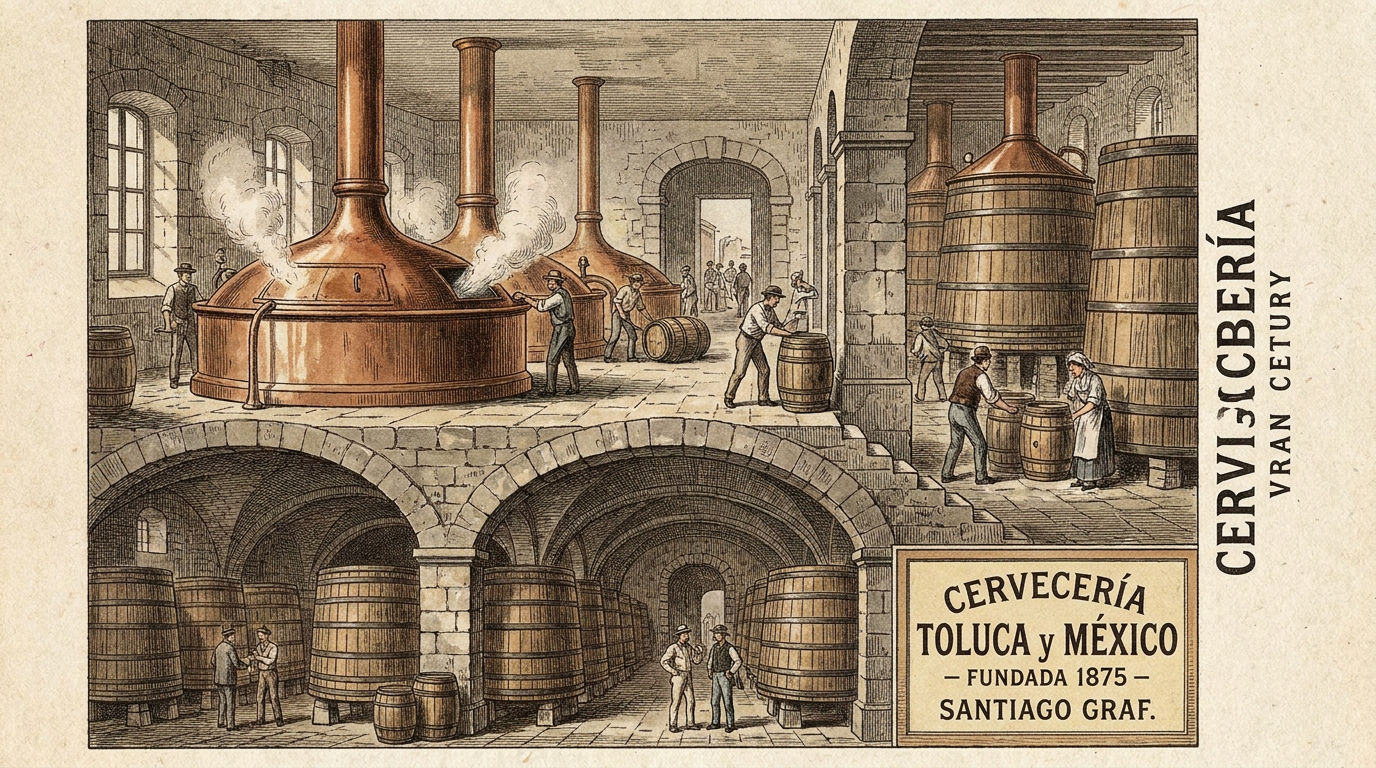
Santiago Graf and the First Mexican Lager
It wasn’t until the 1890s that a brewer named Santiago Graf changed everything. Graf operated a brewery in Toluca, in the Estado de México, and he was the first person to successfully lager beer in Mexico. His secret weapon? The railroad.
The expansion of Mexico’s rail infrastructure in the late 19th century allowed Graf to do something that had simply been impossible before: ship proper lagering equipment from the United States to his brewery. With cold storage finally available, Graf went to work. He imported his hops from Europe. He malted his own barley from U.S.-sourced grain. And he made a decision that proved to be a stroke of genius: he leveraged Mexico’s naturally alkaline water to soften the sharpness typically produced by his darker malts. The result was a lager that felt uniquely Mexican — deeper than an Austrian original, yet mellower. Toasty and rich, but smooth. It gained widespread popularity almost immediately. Some “Graf-style” Vienna Lagers are still brewed in Mexico today.
Santiago Graf didn’t just brew the first successful lager in Mexico — he built the blueprint for a style that would eventually circle the globe and land, 130 years later, in craft beer taprooms from Dallas to Denver.
The Evolution to Pale Lager
Graf’s Vienna Lager was transformative. But it wasn’t the end of the story — it was the middle. Even as his amber-colored creation was gaining traction in Mexico, Czech-style pilsner was conquering Europe. Clean, golden, brilliantly clear, and unmistakably refreshing, the pilsner was becoming the most popular beer style in the world. It was only a matter of time before that craze crossed the Atlantic.
Once Mexican brewers recognized that a pilsner-style lager could be brewed with the ingredients already available to them — including corn, which had been part of Mexican brewing culture for centuries — the evolution accelerated. The rich, toasty Vienna Lager gradually gave way to the lighter, crisper, more refreshing pale lager we recognize today. Corn, rather than being a compromise, became a feature. It lightened the body. It added a subtle, clean sweetness. It made the beer perfectly suited to Mexico’s warm climate, its vibrant cuisine, and its culture of communal gathering.
The University of Texas at Austin’s Life & Letters feature on lager and German-American immigration provides crucial academic context for this broader history of European lager-making spreading across the Americas — a story that was unfolding simultaneously on both sides of the Rio Grande.
That transatlantic transmission of brewing knowledge was remarkable in Mexico. But there was a parallel story happening just north of the border, on the other side of a river, in the limestone hills and cedar breaks of Texas. And it’s a story that Four Corners Brewing Co. knows personally.
When Germany Met Texas: The Tejano-German Brewing Heritage
If the history of the mexican style lager in Mexico is a story about Austrian innovation meeting Mexican ingenuity, then the Texas chapter is a story about something even more unexpected: the precise moment where German lager-making tradition met Mexican and Tejano culture, in the red clay hills and artesian springs of the Lone Star State.
It’s an underreported story. But it’s one of the most important stories in American brewing history. And it’s deeply, personally relevant to Four Corners Brewing Co. and every Latino-owned brewery in Texas.
German Settlers Arrive in Texas (1840s–1850s)
German immigration to Texas began in earnest in the 1840s and 1850s. Families and communities arrived by the thousands, drawn by land grants and the promise of fertile prairie. They settled primarily in a region roughly between Austin, Houston, and San Antonio — a swath of central Texas that, to their delight, bore a striking physical resemblance to the German countryside they’d left behind. The rolling hills. The clear-running rivers. And most importantly: the water.
The Texas Hill Country sits on top of the Edwards Aquifer, one of the most prolific artesian spring systems in North America. Its water percolates through layers of limestone before it reaches the surface — emerging slightly alkaline, mineral-soft, and eerily similar in chemistry to the water sources that German brewers had used for centuries in Bavaria and the Rhine Valley.
“The same limestone-tinged springs that German immigrants used to brew lager in the Texas Hill Country in the 1850s are still flowing today — and their legacy flows through every Texas craft brewery that followed.”
These immigrants didn’t just bring their culture with them. They brought their recipes. Their methods. Their commitment to quality that bordered on obsession. And they found, to their amazement, that Texas was practically engineered for the kind of lager brewing they’d perfected back home.
Kreische Brewery, La Grange (1855)
The most tangible monument to this heritage sits on a bluff overlooking the Colorado River, about 100 miles northeast of San Antonio, near the town of La Grange.
German stonemason and brewmaster Heinrich Kreische purchased 172 acres on that bluff in 1849. By 1855, he had constructed what would become one of Texas’ most significant early commercial breweries. The Texas Historical Commission documents the operation in detail: Kreische engineered a gravity-based water filtration system that drew from a natural spring source and moved downhill through a series of specially engineered stone-filtration systems before reaching the brewhouse. He brewed according to German purity laws — water, barley, and hops only. No shortcuts. No substitutions. The resulting beer, known as Kreische’s Bluff Beer, was brewed with extreme attention to detail.
When a new batch was ready, Kreische would raise a flag high above the bluff bearing the German phrase Frisch Auf! — “Freshen Up!” — to advertise availability to the surrounding community. It is one of history’s great marketing moments, and it predates the concept by about 150 years.
The Kreische Brewery ruins are today a Texas Historical Commission State Historic Site, and they are worth visiting. Standing among those stone walls above the Colorado River, you can feel the weight of what was built there — not just the physical brewery, but the brewing tradition it represents.
A Statewide Brewing Boom
Kreische was not alone. By 1876, Texas had 58 operating breweries — a remarkable number for a state still being shaped by Reconstruction. The UT Austin research on German-American brewing documents that by 1880, more than 80% of all breweries in the United States were operated by first- or second-generation German immigrants. The lager wasn’t an American invention. It was a German transplant that took root in American soil — and nowhere more naturally than in Texas.
San Antonio became the epicenter. By 1880, one-third of San Antonio’s entire population was of German descent. The Western Brewery opened on Alamo Square in 1855. The Pearl Brewing Company followed in 1883. The Lone Star Brewery opened in 1895 and became the state’s largest by 1900, earning San Antonio the enduring title of “the Milwaukee of Texas.”
Then there’s Shiner. Founded in 1909 by German and Czech settlers, the Spoetzl Brewery has been brewing from centuries-old family recipes ever since. The legendary Kosmos Spoetzl — a Bavarian native who took over the brewery in 1914 — is said to have kept his secret recipes tucked under his hat, which he always wore tilted to one side. Those recipes are still in use today.
The Cultural Convergence That Created Something New
Here is the part of the story that doesn’t get told enough. German lager-brewing tradition didn’t just arrive in Texas — it met Mexican and Tejano culture there. The German Biergarten tradition, built around the concept of Gemütlichkeit — a uniquely German word for warmth, conviviality, and communal belonging — merged naturally with the Mexican tradition of communal gathering, of the table as a gathering place, of celebration as a way of being.
The music blended, too. German polka rhythms, carried into Texas by immigrant communities, fused with the musical traditions of northern Mexico. The result was norteño — and eventually Tejano — accordion music. A cultural mashup that is now, unmistakably, quintessentially Texan.
This convergence — German craft, Mexican soul, Texas heat — is not just history. It’s the living DNA of every Latino-owned brewery in the state. Including Four Corners Brewing Co., a brewery that doesn’t just nod at this heritage but is built from it.
That heritage went dormant for decades, buried under Prohibition and the consolidation of the American beer industry. But in 2026, it’s louder than it’s ever been.
The 2026 Lager Renaissance: Why Everyone’s Ordering a Mexican-Style Lager Right Now
Let’s talk about what’s happening right now. Because the cultural history of the mexican style lager is fascinating on its own terms — but there’s a reason this blog is being published in July 2026, and it’s not just nostalgia.
The craft beer industry is in the middle of something significant. And if you’re a bar operator, a retailer, or a distributor anywhere in Texas, understanding what’s happening is not optional. It’s the difference between a tap handle that moves and one that doesn’t.
The Great Re-Balancing
For the better part of a decade, the craft beer industry was defined by extremes. Hazy Double IPAs. Milkshake IPAs. Pastry stouts loaded with lactose, vanilla, and cereal adjuncts. Kettle sours so tart they made your jaw ache. The philosophy was “more is more,” and for a while, it worked. Novelty drove engagement. Intensity drove conversation. The weirder, the better.
Then something shifted. Palates got tired. Wallets got tighter. And consumers began looking for something they hadn’t needed to look for in years: balance.
According to Backbar’s 2026 Beer Trends report, the dominant theme of 2026 is what they call “the Great Re-Balancing.” Consumers are no longer just chasing novelty. They’re seeking quality, drinkability, and — crucially — value. Not cheap. Worth it. The distinction matters enormously. And the lager, which spent a decade being dismissed by craft beer enthusiasts as boring or unsophisticated, has emerged as the undeniable beneficiary.
The Lager Renaissance Is Now Fully Mature
It would be incorrect to call craft lager an “emerging trend” in 2026. That ship has sailed. What’s happening now is something more significant: the maturation of a fully formed movement.
As Backbar’s industry data confirms, bar menus are no longer stocking a single “craft pilsner” as a token concession to the lager category. Successful beer programs are building curated lager selections — multiple styles, multiple origins, multiple price points — anchored, as their report explicitly notes, by “still-dominant Premium Mexican-style Lagers.” The category has legs. More than legs — it has momentum.
The Celligroup’s June 2026 beer trends analysis — published from the European hospitality industry perspective — confirms this picture globally: “2026 is shaping up to be the year of a return to classic beer styles.” Mexican Lager is specifically listed among the styles driving this renaissance, alongside Czech Pilsner, German Lager, Helles, and Kellerbier. The style isn’t just popular in Texas. It’s part of a global recalibration of what “good beer” means.
Drinkability Is the Feature
For a generation that entered craft beer through extreme IPAs, the discovery that a perfectly executed lager can be complex in its simplicity is genuinely revelatory. The restraint required to brew a great lager is, paradoxically, what makes it so impressive. There’s nowhere to hide. A flabby body, an off-fermentation character, a water chemistry mistake — all of it shows in a lager in ways that a heavily dry-hopped IPA would easily mask.
As Celligroup’s analysts note: “Unlike heavily hopped or highly flavoured beers, lager leaves nowhere to hide. Any issue related to temperature, carbonation or serving conditions becomes immediately noticeable.” When a lager is right — when it’s truly right — it is one of the most technically impressive things a brewer can make. The craft beer community is catching up to what Mexican and Tejano communities have known for generations.
The Value Equation in 2026
There’s an economic dimension to this story that B2B readers need to understand. Backbar’s data shows that consumers in 2026 are bifurcating into two distinct groups: those who want trusted premium macro brands (Modelo Especial, Mich Ultra, Coors Light) for consistent, reliable value, and those who want premium craft that they genuinely believe is worth the price. The Mexican-style lager sits at the perfect intersection of these two groups. It speaks the language of the macro premium consumer — familiar, approachable, crisp — while delivering the craft credentials that drive premium pricing.
For operators looking to capitalize on peak season beer sales, the mexican style lager is one of the cleanest tap handle decisions available right now. High drinkability means high velocity. High velocity means consistent revenue. And cultural authenticity — especially from a Latino-owned Texas craft brewery — resonates with the fastest-growing consumer demographic in the state.
It’s also worth noting the myths around light beer vs. craft beer that have long held back the lager category in craft circles. Those myths are dissolving in real time. Operators who stocked their tap lists based on old assumptions are finding that their lager handles are their best performers.
In Dallas, one brewery has been positioned at this intersection for over a decade — and they have a lager that puts the entire story in a can.
Chingón Especial: How Four Corners Brewing Co. Brews the Story, Not Just the Beer
Every section of this blog has been building toward this one.
The history of the mexican style lager — the Austrian immigrants, the Habsburg intrigue, Santiago Graf in Toluca, the German settlers in the Texas Hill Country, the limestone springs, the norteño accordion music, the slow cultural convergence of two great brewing traditions — all of it has been building toward a simple point: this beer has a story. And not every brewery that brews it has the standing to tell that story.
Four Corners Brewing Co. does.
The Origin Story
It started, as the best brewery stories often do, around a kitchen table with some bad beer and a big idea. The founders — craft beer fans who became home brewers — began with a 5-gallon extract experiment brewed over a kitchen stove and fermented in a bathroom tub circa 2004. Batches got bigger. Equipment got better. They took over the home garage and started winning awards. By 2012, they’d put pen to paper, built a plan, found the courage, and opened Four Corners Brewing Co.
The name came from their neighborhood. An intersection in Oak Cliff — Davis Street and Llewellyn Avenue — where the community felt unlike anywhere else in Dallas. Colorful. Diverse. Inclusive. A place where multiple cultures didn’t just coexist but actually converged, creating something new and distinctly their own. That’s the brewery’s origin story. That’s also the origin story of the mexican style lager.
They moved into their first home — an old mechanic shop called Salazar’s Garage — and built something real. From Salazar’s Garage to The Cedars is one of the great short brewery origin stories in Texas craft beer, and it’s worth reading in full. In 2017, they outgrew that space and moved to their current home at 1311 S. Ervay St., in The Cedars neighborhood just south of downtown Dallas — a taproom built inside the old horse stables of the Ambassador Hotel.
That’s the kind of history that can’t be manufactured.

Chingón Especial: Born Chingón
The lager that carries this entire heritage is Chingón Especial — 4.0% ABV, 6.6 IBU, and described by the brewery with characteristic directness: “a deluxe lager with a light hop character and a crisp, clean finish. Proudly brewed with the finest ingredients by even finer people. Brewed in Texas. Born Chingón.”
That last line is everything. Not “Born in Texas.” Born Chingón. It’s a declaration of identity, not just origin. It tells you who made this beer and why they made it — not as a business calculation, but as a cultural statement.
At 4.0% ABV and 6.6 IBU, Chingón Especial is a textbook mexican style lager in the best possible sense. The body is light and supremely drinkable. The hop character is whisper-quiet — present enough to provide structure, absent enough to let the clean malt character breathe. The finish is crisp and dry, the way a properly brewed lager should always finish. It is, in technical terms, an extremely well-made beer. In cultural terms, it’s something more.
The Cultural Authenticity Angle
Look at the packaging. Four Corners’ cans are inspired by lotería — the traditional Mexican card game that has been played around family tables across generations for over two centuries. The beer names — El Chingón, La Bajada, La Lechuza — aren’t drawn from a marketing brief. They’re drawn from real cultural touchstones, from the vocabulary of a community that the founders actually belong to.
This is the brewery that was always going to make this lager. Not because it was a market opportunity. Because it was the truth.
“Beer is beyond a product. It’s a thing that brings cultures together.” — George Esquivel, Co-Founder, Four Corners Brewing Co.
Four Corners is a Latino-owned brewery in a city where Latino culture is not peripheral — it’s foundational. Dallas has one of the largest and fastest-growing Latino populations in the American South. Oak Cliff, where the brewery was born, is a neighborhood that has been shaped by Latino culture for generations. Four Corners is of that community. Not marketing to it from the outside, not deploying cultural aesthetics as a brand strategy. Of it. Rooted in it. Accountable to it.
“We’re trying to give the industry an artful balance… by merging worlds together. Our real mission is to bridge cultures.” — George Esquivel
That mission is exactly what the mexican style lager has always done, across two centuries and three continents. Four Corners just happens to be the brewery doing it most honestly right now, in Dallas, in 2026.
That’s what Vida Well Crafted means. It’s not a tagline. It’s not marketing copy. It’s a description of a life — crafted with intention, with identity, with pride, with community at its center. Chingón Especial is the liquid expression of that vida. Cold, crisp, and completely, unapologetically itself.
For B2B readers — operators, retailers, distributors — the proposition is equally clear. A Latino-owned Texas craft lager, distributed across the state, with over a decade of community credibility and a product that’s built for velocity. Find it in your area using the Brew Finder. Because the story is the story, and the beer is excellent — but at the end of the day, it also has to move. And it does.
The story of the mexican style lager — from Vienna to Veracruz to the Texas Hill Country to Oak Cliff — isn’t just history. It’s a living tradition. And in 2026, it’s being poured fresh every day.
Why Mexican-Style Lagers Matter More Than Ever. For Your Bar, Your Community, and Your Culture
Here’s an uncomfortable truth: the mexican style lager is one of the most consumed beer styles in the United States. Has been for years. And yet, for most of its history in the American market, its origins have been invisible. The Habsburg connection. The Santiago Graf story. The German-Tejano brewing convergence. The Indigenous fermentation heritage. None of it gets told. The beer gets consumed, the can gets recycled, and the history stays buried.
That invisibility is not accidental. It’s a pattern — a habit of treating culturally rooted products as commodities without origins, without authors, without stories. And in 2026, as the lager renaissance reaches full maturity and Mexican-style lagers cement their position as a dominant craft category, there is a real opportunity to do something different: tell the story right.
Cultural Representation Matters
The craft beer world has spent decades celebrating heritage brews from Belgium, Germany, and the Czech Republic. Entire festivals are dedicated to the precision and tradition of German lager-making. Belgian witbier and saison are treated with the reverence of museum pieces. And rightly so — those are remarkable traditions with remarkable histories.
The Mexican-style lager has a history that is at least as remarkable. Austrian immigration. A brewing pioneer who changed an entire national palate. A cultural tradition that absorbed European technique and made it into something distinctly, defiantly its own. That story deserves the same reverence. Not as a novelty. Not as a summer seasonal. As a year-round, culture-carrying, table-anchoring style that has earned its place at the top of the craft category.
Brewing this beer with intention — and buying it from breweries who brew it with intention — is an act of cultural acknowledgment. Small but real.
The B2B Case Is Rock-Solid
For operators and retailers, the argument for Mexican-style lagers in 2026 is not primarily cultural — though the cultural argument is real and growing. The argument is fundamentally commercial, and it’s strong:
-
High drinkability = high velocity. A lager with a 4.0% ABV and a crisp, clean finish is a beer people finish. And then order again. Velocity drives revenue in ways that a barrel-aged stout that takes 45 minutes to nurse simply cannot.
-
Broad demographic appeal. The mexican style lager bridges craft and non-craft drinkers in a way that almost no other style does. It’s not intimidating. It’s not exclusive. It’s an invitation.
-
Food versatility. Tex-Mex, grilled meats, spicy food, light salads, tacos, barbecue — the mexican style lager pairs with all of it. A beer that works with your entire food program is a beer that earns its tap handle.
-
Cultural resonance with the fastest-growing consumer segment. Latino consumers represent one of the most significant and fastest-growing segments of the Texas beer market. Understanding your Texas craft beer distribution options and positioning your tap list to reflect the community you serve isn’t just good ethics — it’s good business. And it’s increasingly what consumers expect.
-
The ROI of local craft. Research on the ROI of putting local craft beer on your restaurant’s tap list consistently shows that local and community-connected brands outperform their distribution-tier equivalents in both customer loyalty and margin. A locally made Mexican-style lager from a Latino-owned brewery hits both marks simultaneously.
The 2026 Moment Is Now
The industry data from Backbar and Celligroup both point in the same direction: the lager renaissance is not peaking, and it is not slowing. It is maturing into a sustained structural shift in how Americans drink beer. The operators who commit to the category now — who build curated lager selections anchored by culturally authentic Mexican-style lagers — will be ahead of the curve. The ones who wait will be catching up to their competition.
Four Corners Brewing Co. is a Latino-owned, Dallas-based, Texas-distributed craft brewery with over a decade of community credibility. They’ve been at this intersection — craft quality, cultural authenticity, community rootedness — since before it was a trend. Stocking their lager isn’t just a tap handle decision. It’s a statement about whose story you’re choosing to amplify on your beer list.
The Story in a Can: A Conclusion Worth Raising a Glass To
Start in Vienna, Austria. Move through the battle-torn plains of Puebla. Wind through the artesian springs of the Texas Hill Country, past Kreische’s bluff and Shiner’s polka halls and the norteño accordion music drifting from Oak Cliff’s kitchen windows on a Saturday night. And then end up here — at 1311 S. Ervay St., in a taproom built inside the old horse stables of the Ambassador Hotel, where Four Corners Brewing Co. pours a cold Chingón Especial and the entire journey makes sense in a single sip.
The mexican style lager is not just a beer style. It is a story of cultural convergence — two centuries of migration, adaptation, ingenuity, and pride compressed into a pale gold pour with a white foam head and a finish so clean it leaves room for the next chapter. It is the story of Austrian brewers who came to Mexico and stayed. Of Santiago Graf and his railroad-shipped lagering equipment. Of Heinrich Kreische raising Frisch Auf! flags above the Colorado River. Of a culture that has been brewing — in one form or another — since long before any European set foot on its soil.
And it is the story of Four Corners Brewing Co. A brewery that didn’t stumble onto this heritage. A brewery that is this heritage, built by and for a community that has lived at the intersection of these cultures for generations.
Whether you’re a craft beer drinker who just ordered your first Chingón Especial, a bar operator deciding what goes on your summer tap list, or someone who grew up playing lotería at the kitchen table — this beer is part of your story, too. The best stories always are.
Vida Well Crafted. One cold lager at a time.
Ready to Put This Lager on Your List?
¿Listo to make it official?
Find Four Corners Brewing Co. beers at retail and on-premise locations across Texas — or talk to us about distribution in your market.
👉 Use the Brew Finder →
Come taste the story in person.
Four Corners Brewing Co. is open Tuesday through Sunday at 1311 S. Ervay St. in The Cedars, Dallas. Cold lager. Historic taproom. La buena onda.
👉 Plan Your Visit →
Want more from the brewery that lives this culture?
Explore the full Four Corners beer lineup — from El Chingón IPA to Chingón Especial and beyond — and see what Vida Well Crafted actually tastes like.
👉 Explore Our Brews →
Subscribe to our newsletter for beer drops, taproom news, special events y todo chingón.