
ABV vs. IBU: What These Numbers Actually Mean for the Beer in Your Hand
You’re holding a cold one. On the side of the can it says 7.3% ABV and 72 IBU. You know it’s beer. You know it’s going to be good. But what do those two little number combos actually mean for what’s about to hit your palate? Are you in for something dangerously strong? Aggressively bitter? Smooth and sessionable? The can isn’t exactly volunteering that information in plain English — or plain Spanish, for that matter.
Here’s the thing: if you’ve been drinking craft beer for any amount of time, you’ve seen ABV and IBU on labels, tap lists, and menus dozens of times. Most people glance at them, nod vaguely, and order based on vibes. And honestly? That’s a totally valid way to live. But if you’ve ever been curious about what those numbers are actually telling you — and how they affect the beer experience before the first sip even lands — you’re in the right place.
Think of this as beer education the way it was meant to be: casual, useful, and served cold. No jargon. No snobbery. Just a real breakdown of what ABV and IBU mean, how they work together, and how to use them to find your next favorite craft beer. We’ll use the Four Corners Brewing Co. year-round lineup as our real-world anchor — because nothing explains numbers better than actual beer in your hand.
Bienvenidos. Let’s get into it.
Let’s start with the one you’ve probably heard the most: ABV.
What Is ABV in Beer And Why Should You Care?
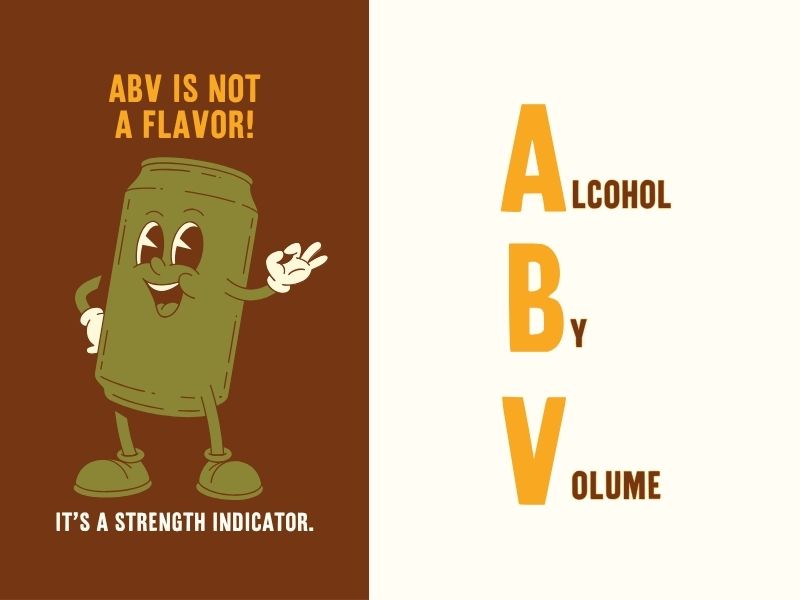
ABV stands for Alcohol By Volume — and it’s exactly what it sounds like. It’s the percentage of the liquid in your can or glass that is pure alcohol (ethanol). A beer labeled 5% ABV means that five out of every hundred milliliters is alcohol. Simple, right? But the implications of that number go a lot deeper than just “how drunk will I get.”
To understand why ABV varies so much from beer to beer, you have to understand a little bit about how beer is made. During fermentation, yeast consumes the fermentable sugars in the wort (that’s the sweet liquid extracted from malted grain) and converts them into two things: alcohol and carbon dioxide. Brewers measure the density of the liquid before fermentation — called the Original Gravity (OG) — and again after fermentation is complete — the Final Gravity (FG). The difference between those two numbers, run through a standard formula, gives you the ABV. More fermentable sugar in the recipe means more potential alcohol. Less sugar, lighter beer.
This is why big, malt-heavy styles like imperial stouts and barleywines can clock in at 10–13% ABV, while a crisp, light lager might sit at 3.5–4%. The brewer isn’t just picking a number — they’re engineering a specific experience from the grain bill up.
So what does ABV actually feel like in the glass? Higher ABV generally means:
- More body — the beer feels fuller and weightier on the palate
- A warming sensation — especially noticeable as you swallow
- Longer finish — the alcohol lingers and lets other flavors develop
- Greater complexity — higher-alcohol beers often carry more layered flavor compounds
But here’s the first myth to bust right now: ABV is not a flavor. It is a strength indicator. A 7% beer doesn’t automatically taste “boozy” or harsh. A 4% beer doesn’t automatically taste thin or watery. The ABV tells you how much alcohol is present — it says nothing about the craft, the balance, or the pleasure of drinking it. According to VinePair’s breakdown of how alcohol by volume shapes beer flavor perception, ABV interacts with everything from carbonation to hop character to malt sweetness to shape the final experience — it’s one input in a very complex equation.
Here’s a general mental map of where common beer styles fall on the ABV spectrum:
- Light lagers: 3–4.5% ABV
- Sessionable ales, blondes, wheats: 4–5.5% ABV
- IPAs and stronger ales: 6–8%+ ABV
- Imperials, barleywines, strong stouts: 9–13%+ ABV
At Four Corners, our range tells this story beautifully. The Chingón Especial Lager sits at a crisp, easy-drinking 4.0% ABV — light, refreshing, no rough edges, the kind of beer you can sip on a hot Dallas afternoon for hours without a second thought. On the other end, El Chingón IPA comes in at 7.3% ABV — fuller, warmer, more assertive. The difference between those two beers is absolutely felt before it’s even tasted. But “felt” doesn’t mean better or worse — it means different. And different is the whole point of having a lineup.
The key takeaway here: when you see ABV on a label, you’re looking at a map of the beer’s body and strength. Use it to calibrate your expectations — not to judge quality.
Now that ABV is in your toolkit, let’s talk about the number that confuses people even more: IBU.
What Is IBU in Beer? The Bitterness Breakdown
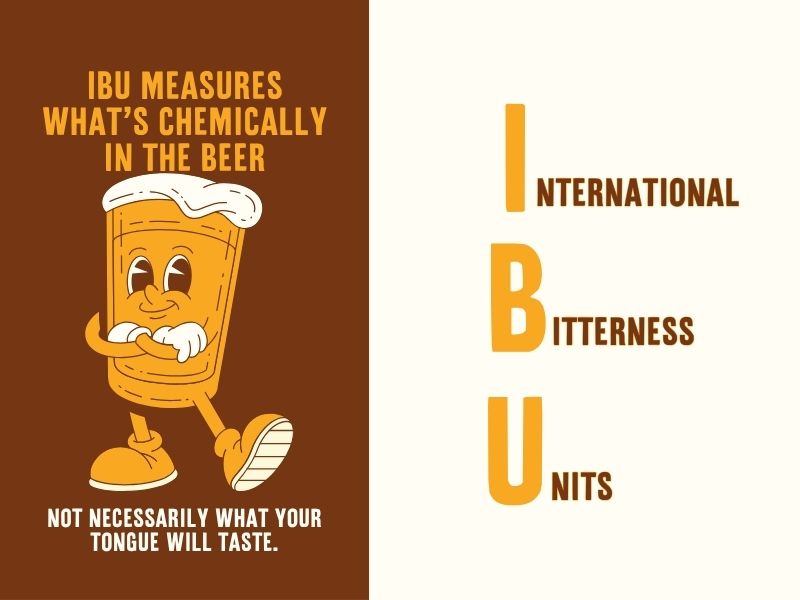
If ABV is the straightforward one, IBU is the number that makes people squint a little. IBU stands for International Bitterness Units — and it measures the concentration of bitter compounds in a finished beer. Specifically, it measures iso-alpha acids, which are the chemical compounds produced when the alpha acids in hops are isomerized (chemically transformed) during the brewing process.
One IBU equals one milligram of iso-alpha acids per liter of beer. The scale technically runs from 0 to 100+, though here’s an important nuance that most beer labels don’t bother to explain: most human palates can’t distinguish bitterness above roughly 80 IBU. Beyond that threshold, additional bitterness compounds are present in the liquid, but your taste buds have largely maxed out their ability to register the difference. So a beer at 100 IBU and a beer at 130 IBU will often taste about the same to the average drinker.
To understand where IBU comes from, you have to talk about hops. Hops are the flowering cones of the Humulus lupulus plant — and they’re one of the four essential ingredients in beer (alongside water, malt, and yeast). Alpha acids in hops don’t contribute bitterness on their own. It’s only when they’re exposed to heat during the boil that isomerization occurs, transforming them into the iso-alpha acids that IBU measures. The longer hops spend in the boil, the more bitterness gets extracted. This is why brewers who add hops late in the boil — or after it, in a process called dry-hopping — often get intense hop aroma without proportional bitterness.
According to MasterClass’s breakdown of how the IBU scale works, understanding IBU requires accepting one key truth: IBU measures what’s chemically in the beer — not necessarily what your tongue will taste. Perceived bitterness is shaped by malt sweetness, carbonation level, ABV, and even serving temperature. A high-IBU beer with a rich malt backbone can taste less bitter than a lower-IBU beer with almost no malt character to balance it.
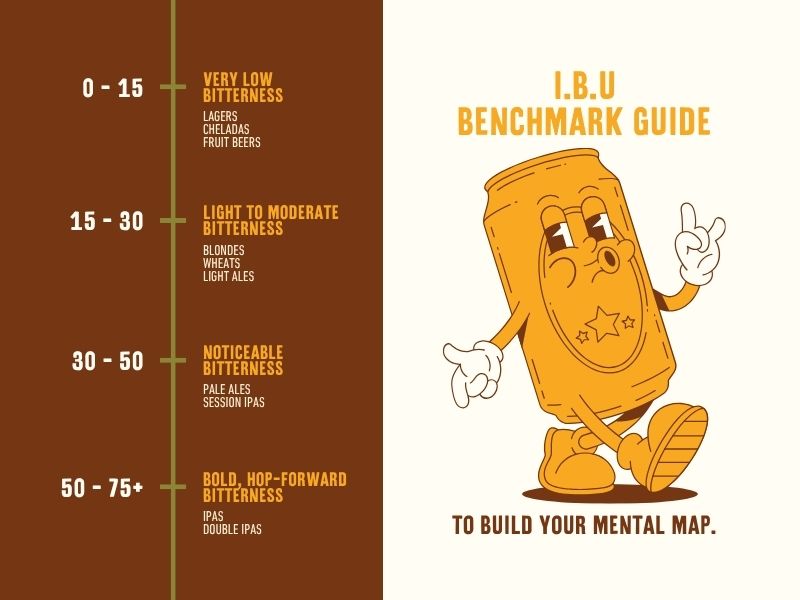
Here’s a general IBU benchmark guide to build your mental map:
- 0–15 IBU: Very low bitterness — easy-drinking lagers, cheladas, fruit beers. Bitterness is barely a whisper.
- 15–30 IBU: Light to moderate bitterness — blondes, wheats, light ales. Noticeable but soft.
- 30–50 IBU: Noticeable bitterness — pale ales, session IPAs. The hops are showing up to the party.
- 50–75+ IBU: Bold, hop-forward bitterness — IPAs, double IPAs. Hops are running the room.
The Four Corners lineup maps onto this spectrum almost perfectly. The Chingón Especial Lager sits at 6.6 IBU — bitterness so gentle it’s essentially a polite hello. The Pinchelada Chelada came at 13 IBU — still very mild, and that bitterness gets completely masked by the fruit and chile pepper character anyway. Local Buzz Honey Blonde sits right in the sweet spot at 20 IBU — enough bitterness to balance the honey sweetness without ever getting sharp. And El Chingón IPA stands tall at 72 IBU — assertive, hop-forward, and proud of it.
“Think of IBU like SPF — the number tells you something real, but it’s not the whole story. A higher number doesn’t always mean a more intense experience once everything is factored in.”
The craft beer education community at Craft Beer & Brewing reinforces this: IBU is a technical measurement of a specific class of compounds in the beer. It doesn’t account for dry-hop aroma additions, malt character, water chemistry, or any of the dozen other variables that shape how bitter a beer actually seems in your mouth.
IBU is a clue, not a verdict. And once you understand it in context — which is exactly where we’re headed next — it becomes a genuinely useful tool.
Here’s where it gets really interesting: ABV and IBU don’t live in separate worlds. They’re in constant conversation with each other — and understanding that relationship is the key to really reading a beer.
ABV vs. IBU: How These Two Numbers Talk to Each Other
Most beer drinkers treat ABV and IBU as two separate stats on a trading card — glance at them, compare them to other cards, move on. But the truth is, these two numbers are constantly interacting in the glass. Understanding their relationship is what separates someone who reads beer labels from someone who actually understands them.
Let’s break this down with the kind of clarity that belongs on a bar napkin, not in a brewing textbook.
Does higher ABV mean stronger taste?
Not exactly. Higher ABV adds body, a warming sensation on the finish, and can amplify certain flavor compounds — but it doesn’t mean the beer will taste harsh, boozy, or overpowering. A well-crafted high-ABV beer like El Chingón IPA at 7.3% can be smooth, complex, and deeply satisfying. Meanwhile, a 4.5% sour ale with aggressive lactobacillus character can be face-puckeringly intense in a way a 7% malt-forward amber never would be. ABV affects the weight and warmth of a beer — it doesn’t determine the power of the flavor.
What IBU is considered bitter?
For most palates, anything above 40 IBU will register as noticeably bitter. Cross 60 IBU and you’re firmly in hop-forward territory — this is the land of IPAs and double IPAs. But here’s the critical nuance: a stout at 60 IBU can taste less bitter than a lager at 35 IBU, because the stout’s deep, roasty malt character absorbs and softens the bitterness while the lager has almost nothing to offset it. Columbia Distributing’s primer on how IBU and ABV work together puts it well — bitterness is always relative to the beer’s full profile, never absolute.
The malt-hop balancing act
This is the heart of the ABV/IBU relationship. Malt sweetness — which comes from fermentable sugars — is also largely what drives ABV up during fermentation. So in many cases, a higher-ABV beer has more malt character to counterbalance a higher IBU. This is exactly what’s happening with El Chingón IPA: 7.3% ABV and 72 IBU sounds intense on paper, but the Munich malt backbone provides a rich, slightly toasty sweetness that tames the hop bitterness and creates a beer that’s assertive without being aggressive. The bitterness has somewhere to land.
Contrast that with a very low-ABV, higher-IBU session IPA. Strip away the malt body, and that bitterness suddenly has nothing to balance it — the beer can taste sharp and thin even at a lower IBU number. This is why you can’t look at IBU in isolation.
The four quadrants of ABV/IBU
Here’s a simple mental framework:
- Low ABV + Low IBU (like Chingón Especial Lager — 4.0% / 6.6 IBU): Light, crisp, refreshing. Easy-drinking. Great for long sessions. The priority is drinkability, not complexity.
- Low ABV + Higher IBU (think session IPAs around 4.5% / 40+ IBU): The hop character is upfront, but the body is light. Can feel sharp because there’s less malt to balance the bitterness.
- Mid ABV + Moderate IBU (like Local Buzz Honey Blonde — 5.0% / 20 IBU): Balanced and approachable. The sweet spot for a wide range of palates. Flavor complexity without intensity.
- High ABV + High IBU (like El Chingón IPA — 7.3% / 72 IBU): Bold, complex, rewarding. The alcohol and malt create the foundation for the hops to shine without overwhelming.
Great craft brewers use ABV and IBU as tools, not targets. They’re not trying to hit a number — they’re engineering a flavor experience, and these metrics are two of the instruments they use to get there. As we explored in our post on what makes a Helles lager distinct, the best beer styles are defined by their internal balance — not by any single measurement in isolation.
The real lesson? Stop reading ABV and IBU as independent data points. Start reading them as a conversation between strength and bitterness — and ask yourself: what’s the malt doing to mediate between them?
The best way to really get this? Stop reading and start tasting — or, if you’re reading from the couch, let’s at least walk through four real beers from our lineup and see exactly how ABV and IBU show up in your glass.
The Four Corners Lineup: Reading the Numbers in Real Life
All of that theory lands a lot better when you’ve got actual beer in front of you. So let’s do a guided tasting — four beers, four different ABV/IBU stories, each one telling you something different about how these numbers translate into a real drinking experience. This is the whole Four Corners spectrum, from the sessionable to the bold, spread out in front of you like a flight at the taproom.

Chingón Especial Lager | 4.0% ABV | 6.6 IBU
This is the one you reach for when the Texas heat is doing its thing and you just want something cold, crisp, and honest. At 4.0% ABV, the Chingón Especial is firmly in sessionable lager territory — light-bodied, easy-going, and designed for long afternoons. There’s no warming sensation, no weight on the palate, no finishing heat. It just drinks clean and disappears like it was never there, leaving you wanting another.
At 6.6 IBU, bitterness is barely a whisper. If you’ve ever thought beer bitterness wasn’t for you, this is your proof that it’s a spectrum, not a binary. Six-point-six IBU means the hops are present enough to contribute crispness and a clean finish — but they’re not showing off. Brewed in Texas. Born Chingón. This is the entry point of the lineup and one of the most underrated craft lagers in Dallas. Low numbers, high drinkability.
What to expect: Crisp. Clean. Refreshing. No rough edges, no complications. The beer equivalent of a perfectly timed high-five.
Pinchelada Chelada | 4.5% ABV | 13 IBU
The Pinchelada is a fascinating case study in why IBU alone tells you almost nothing. At 4.5% ABV, it’s still firmly sessionable — barely a step above the Especial. And at 13 IBU, there’s technically more bitterness than the lager. On paper. In the glass? You’d never know it.
That’s because the Pinchelada’s fruit character and hint of chile pepper completely redefine the flavor context. The IBU is real — the iso-alpha acids are in there, measured and accounted for — but they’re playing second fiddle to a whole concert of other flavors. Refreshingly diferente. This is the beer that proves the point about perceived versus measured bitterness better than any explanation could. IBU tells you what’s chemically in the beer. It doesn’t tell you what’s going to dominate your palate when fruit, spice, and effervescence are all in the mix.
What to expect: Fruity, bright, with a subtle kick of chile. Sessionable and surprising. The beer for people who think they don’t like beer.
Local Buzz Honey Blonde | 5.0% ABV | 20 IBU
Here’s where things start to feel a little more substantial — and a little more interesting. At 5.0% ABV, Local Buzz has noticeably more body than the lager or the chelada. There’s a gentle warmth on the finish, a little more weight to each sip. Nothing dramatic — but you feel it.
The 20 IBU is where this beer really earns its keep. That moderate bitterness does something elegant: it balances the natural sweetness from the Texas-sourced honey and provides a clean, zesty counterpoint to the rye malt finish. Without those 20 IBUs, the honey sweetness could easily tip into cloying territory. With them, the beer lands in a perfect equilibrium — sweet but not saccharine, bitter but never sharp. The floral aroma from the honey adds another dimension that has nothing to do with either ABV or IBU, which is a reminder that these two numbers are just two chapters of a much richer story.
Refreshing taste is what the buzz is all about. Local Buzz represents the sweet spot for a huge range of craft beer drinkers — complex enough to be interesting, approachable enough to win over almost anyone.
What to expect: Honey sweetness up front, clean bitterness in the middle, zesty rye finish. Floral, balanced, and crowd-pleasing. The beer that brings people into craft and keeps them there.
El Chingón IPA | 7.3% ABV | 72 IBU
And here’s the bold one. The flagship. The reason a lot of people walked into a Four Corners taproom for the first time. At 7.3% ABV, El Chingón is a full-bodied, warming, complex beer. You feel it settle. There’s a richness to the mouthfeel that the lower-ABV beers in the lineup simply don’t have — and that richness is doing critical work, because it’s what allows this beer’s 72 IBU to be assertive rather than aggressive.
Let’s talk about those hops, because they’re worth the detail. El Chingón is brewed with seven classic American “C” hops — Columbus, Cascade, Centennial, plus the Falconer’s Flight 7C blend (Cascade, Centennial, Chinook, Citra, Cluster, Columbus, and Crystal). A significant addition of Falconer’s Flight goes in toward the end of the boil, amplifying the complex hop profile without simply cranking up the bitterness. A whirlpool addition of Santiam hops adds a smooth, rounded finish. The Munich malt backbone provides the sturdy, slightly toasty sweetness that absorbs the 72 IBUs and transforms what could be a harsh bitterness into something piney, floral, and ultimately balanced.
Seventy-two IBU sounds like a lot. And on a malt-thin canvas, it would be. But on this canvas? It’s a painting.
Ready to crank up your chingón factor? ¡Órale, let’s go!
What to expect: Bold piney and floral hop aroma, rich malt backbone, warming finish. Complex, assertive, and endlessly rewarding. The beer for when you mean business.
Explore the full Four Corners year-round lineup and see the whole spectrum for yourself — because these four beers together tell a story no individual can or label can.
Now that you’ve got four real beers to anchor the concepts, let’s tackle the biggest myths people still believe about ABV and IBU — because there’s some serious misinformation floating around out there.
Common Beer Myths: Busted With Numbers to Back It Up
The craft beer world has a myth problem. Not because beer people are intentionally misleading anyone — but because ABV and IBU are easy to misread, and misread numbers have a way of calcifying into “common knowledge.” Let’s clear the record.
MYTH #1: “High IBU always means super bitter.”
REALITY: Perceived bitterness is not the same as measured bitterness. IBU tells you how many iso-alpha acids are dissolved in your beer — it does not tell you how bitter the beer will actually taste on your palate. A 72 IBU IPA with a strong Munich malt backbone (hi, El Chingón) can taste more balanced and approachable than a 35 IBU pale ale with almost no malt sweetness to offset it. Carbonation, serving temperature, and even the glassware you use can affect perceived bitterness. IBU is an ingredient in the recipe of flavor — not the final verdict.
MYTH #2: “Higher ABV means stronger-tasting beer.”
REALITY: ABV measures alcohol content. It does not measure flavor intensity, complexity, or “strength” in any qualitative sense. According to Beer100’s breakdown of what ABV actually means in practice, a 7% amber ale can be smooth, malty, and easy-drinking, while a 4.5% sour can be bracingly intense — tart, funky, and face-puckering in a way that has nothing to do with alcohol content. ABV affects body and warmth. Flavor power is a different variable entirely, shaped by the full grain bill, hop schedule, yeast character, and adjuncts. Don’t let the percentage fool you.
MYTH #3: “If the IBU is high, I won’t like it.”
REALITY: This one sends a lot of great beers to the bottom of the tap list unfairly. IBU is context-dependent. Many people who say they “don’t like bitter beers” are really saying they haven’t found a well-balanced IPA yet — one where the malt character is doing its job alongside the hops. El Chingón at 72 IBU surprises a lot of people who come in skeptical. The seven-hop blend and Munich malt create a beer where the bitterness has texture and depth, not just edge. Don’t let a number make your decisions before your palate does.
MYTH #4: “Low IBU means bland beer.”
REALITY: Ask anyone who’s ever cracked a Chingón Especial on a hot Friday afternoon if that beer was boring. Spoiler: they won’t say yes. At 6.6 IBU, it is not a bitter beer — but it is a crisp, clean, refreshing beer with real craft behind it. The Pinchelada at 13 IBU is complex, vibrant, and layered with fruit and spice character that has nothing to do with hop bitterness. Low IBU means low bitterness. It absolutely does not mean low quality, low craft, or low enjoyment. As we explored in our craft beer cooler guide, the low-IBU options in the lineup are just as intentionally crafted and just as delicious as the hop-forward ones.
MYTH #5: “I need to understand all of this to enjoy craft beer.”
REALITY: You really, truly don’t. These numbers are tools — not gatekeeping. They exist to help you make informed choices, not to create a knowledge barrier between you and a good time. The best way to find your personal ABV and IBU sweet spot isn’t to study a chart. It’s to taste a range of beers, pay attention to what you enjoy, and let your palate be your guide. Everything in this post is meant to make that process easier and more fun — not to add homework to your Friday night.
So now you know what these numbers actually mean — and what they don’t. Let’s put it all together into something you can actually use the next time you’re staring down a tap list or a beer fridge.
How to Use ABV and IBU to Find Your Next Favorite Beer
All right. You’ve got the theory. You’ve got the real-world examples. You’ve busted the myths. Now let’s make this genuinely useful — because the whole point of understanding ABV and IBU is being able to walk up to a tap list, scan the numbers, and have an actual sense of what you’re getting into before the pint lands in your hand.
Here’s a simple three-question framework to guide your next beer choice:
1. How long do I want to be drinking this?
If you’re settling in for a long afternoon — a cookout, a game, a lazy Sunday on the patio — you want something in the lower ABV range (3.5–5%). Lower alcohol means you can pace yourself comfortably without feeling it stack up. This is the session beer zone, and it’s a perfectly glorious place to be.
If you’re sitting down for one or two intentional beers — a dinner pairing, a craft beer flight, a post-work decompression — a higher ABV (6–8%) gives you more complexity and body to explore in a shorter window.
2. Do I prefer hoppy and bitter, or smooth and malty?
This is where IBU earns its keep as a decision-making tool. If bitter, hop-forward flavors make your eyes light up, you’re looking for 40+ IBU and probably higher. If you prefer smoother, softer, sweeter profiles, you want to stay under 25 IBU and pay attention to the malt character in the description.
If you’re somewhere in the middle — which is where most drinkers land — 20–40 IBU is a reliable zone. Enough bitterness to balance sweetness and add character, not enough to dominate the experience.
3. What’s the occasion?
Beer is always contextual. A cold, crisp lager hits differently after yard work than a complex IPA does at a craft beer bar, even if you’d enjoy both. Match the beer to the moment — and use ABV and IBU together to identify which beer fits which context.
The Four Corners Quick-Pick Guide:
- Want something easy, refreshing, and completely fuss-free? → Low ABV (4%), low IBU (under 10). Reach for the Chingón Especial Lager and don’t look back.
- Want something sessionable but with a little more personality? → Low ABV (4.5%), very low IBU (13), fruit-forward character. The Pinchelada Chelada is your move.
- Want balance — a little sweetness, a little bitterness, a lot of drinkability? → Mid ABV (5%), moderate IBU (20), floral and honeyed. Local Buzz Honey Blonde is the sweet spot of the lineup.
- Ready for the full craft beer experience — bold hops, real body, rewarding complexity? → Higher ABV (7.3%), high IBU (72), seven hops and a Munich malt backbone. El Chingón IPA doesn’t disappoint.
One important note: don’t use IBU alone to judge whether a beer will be “too bitter” for you. Always consider the ABV and malt profile alongside it. A number without context is just a number. Together, these measurements paint a picture.
The best way to learn your own ABV and IBU sweet spot isn’t to overthink it — it’s to experiment. Try the range. Pay attention to what you enjoy. Ask questions. Nobody worth knowing in the craft beer world will make you feel bad for not knowing something. That’s not what this is about.
At Four Corners, we’ve got the whole spectrum on tap at 1311 S. Ervay in Dallas. Come in, tell us what you usually like, and we’ll point you in the right direction. From 6.6 IBU to 72 IBU, from 4.0% to 7.3% ABV — the Four Corners lineup is a complete craft beer education in a single flight. And it’s a lot more fun than reading about it, we promise.
If you want to go even deeper into the culture and community behind the beers — the why behind every recipe, every label, every ingredient — check out our piece on how Latino culture is shaping the future of Texas craft beer. It’s the story behind the story.
You’re Now Officially Dangerous at the Beer Fridge
Here’s the real takeaway from everything we’ve covered: ABV tells you how strong the beer is. IBU tells you how much the hops are contributing to bitterness. And neither number, alone, tells the whole story.
The magic — the part that makes craft brewing an art and not just a chemistry experiment — is in how a skilled brewer balances both. It’s in how Munich malt at 7.3% ABV absorbs 72 IBUs and turns what could be an assault into an invitation. It’s in how 13 IBUs disappear entirely behind a wall of fruit and chile. It’s in how 20 IBUs and Texas honey find each other and create something genuinely beautiful.
At Four Corners, every beer in the year-round lineup — from the Chingón Especial Lager to El Chingón IPA — is a carefully crafted balance of these elements, designed for real people who want to enjoy great beer without needing a brewing degree to understand what they’re drinking. We believe beer education shouldn’t feel like school. It should feel like a conversation between friends over a cold one.
Beer should bring you joy, not anxiety. Now that you know what you’re looking at, we hope it brings a little more of both.
Salud. Vida Well Crafted.
Ready to taste the difference? Come find your ABV/IBU sweet spot at the Four Corners Brewing Co. taproom — 1311 S. Ervay St., Dallas, TX.
Tuesday–Wednesday 3–10pm | Thursday–Saturday 11am–11pm | Sunday 11am–8pm.
Can’t make it in? Find Four Corners brews near you.
Want to stay up on new releases, taproom events, y todo chingón? Join The Buzz.